
Microsoft Ads Policies, Approval & Disapproval 2026

2024 Microsoft Advertising enforcement scale
1 billion+
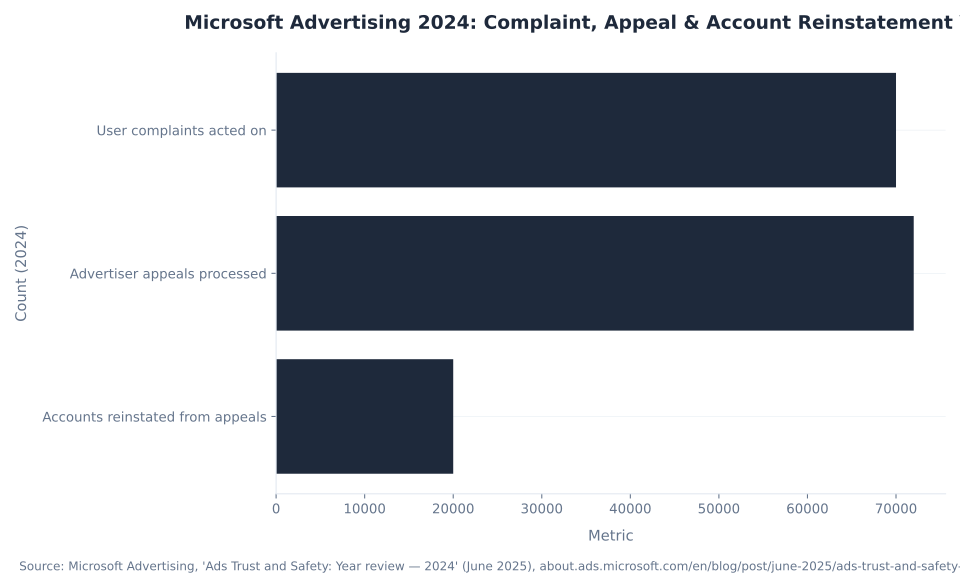
Ads removed or restricted for policy violations in 2024. In the same year, 72,000 advertiser appeals were processed and 20,000 accounts reinstated. Source: Microsoft Advertising, Ads Trust and Safety: Year Review 2024 (June 2025).
Microsoft Advertising Policies: Three Tiers, One Mental Model
Microsoft Advertising — formerly Bing Ads, rebranded in April 2019 — organizes its content rules into three tiers that work differently and require different responses from advertisers: prohibited (disallowed) content that is off-limits with no exception path, restricted content that is allowed only with conditions or certifications, and editorial guidelines that govern copy style, grammar, and landing-page quality for all ads. Understanding which tier a disapproval falls into determines the fix. The bing ads policies framework carried over from the pre-rebrand era intact — the tier structure, the reason codes, and the appeal path are the same system under a new name.
This page is written for the advertiser whose ad has just gone Disapproved, Approved Limited, or is sitting as Inactive under review — and who needs to know whether they did something wrong, how long the wait is, and how to get unstuck. It is also the reference page for policy-sensitive verticals — legal PPC, financial services PPC, insurance PPC, CBD & hemp PPC, and supplements & nutrition PPC — deciding before they spend whether Microsoft Advertising will accept their category and what certification or exception is required.
The search term "bing ads policies" still drives traffic to this topic years after the April 2019 rebrand. Whether you know the platform as Bing Ads or as Microsoft Advertising, the policy framework described here is the same. The rules apply on the Microsoft Search Network (Bing, Yahoo, AOL, DuckDuckGo, Ecosia, and their syndication partners) and the Microsoft Audience Network as distinct surfaces — a disapproval on Search does not automatically carry over to Audience placements. Ad statuses and account structure context are covered below.
Three misconceptions dominate this topic and each costs time or money: that "restricted" means banned (restricted means allowed with a condition); that a disapproval pauses the entire campaign (since November 2025, the November 2025 asset-level review means a disapproval typically pauses one asset while the rest of the ad keeps serving); and that "Approved Limited" signals low quality (it signals a location-eligibility gap, not a quality penalty). Each has a concrete, documented counter in Microsoft's own policy documentation — addressed in full below.
Key Takeaways
- Microsoft Advertising has three policy tiers: prohibited content (off-limits, no exception path), restricted content (allowed with conditions — certification or exception request), and editorial guidelines (style, grammar, and landing-page standards that generate the majority of disapprovals in practice).
- Most disapprovals are editorial hygiene — capitalization, punctuation, unsupported superlatives, vague CTAs, and landing-page gaps. All are fixable without involving Microsoft's compliance team: read the reason code, fix the specific asset or page, resubmit.
- Since November 2025, Microsoft reviews each ad asset independently. A disapproved headline pauses only that headline; the ad keeps serving on its remaining approved assets. The new statuses — "Some assets disapproved," "Most assets disapproved," "Essential assets disapproved" — describe how much of the ad is compromised, not a binary pass/fail.
- "Approved Limited" is a location signal, not a quality penalty. It means the ad serves where it passed review while still pending or held in at least one other targeted location. The fix is identifying which location is holding back approval, not rewriting the creative.
- The ad-level appeal system runs via
AppealEditorialRejectionswith a hard limit of 2,000 appeals per 24-hour rolling window and 10,000 maximum pending appeals per account at any time. - Account-level enforcement operates on a separate track from ad disapprovals. Egregious violations — malware, phishing, circumventing ad-system safeguards — trigger immediate permanent suspension. Policy compliance is account-protection, not just ad-approval mechanics.
Why “It Passed Google” Is Not a Pre-flight Check
Google Ads and Microsoft Advertising share a surface-level similarity — both review ads before serving them — but run with different editorial standards. An ad that has run cleanly on Google for months can fail Microsoft on copy style or landing-page hygiene alone. Treating a Google approval as a Microsoft pre-flight is the most common source of disapprovals on cross-platform launches.
The full reference is Microsoft Advertising's Editorial Reason Codes, but the practically important distinctions cluster in four areas:
- Capitalization and punctuation. Microsoft disallows excessive or random capitalization (reason codes 16, 45) and repeated punctuation or symbols such as "!!!" or "★" (code 19). Google rarely disapproves on these grounds.
- Superlatives and vague calls-to-action. "Best," "#1," and "guaranteed" trigger codes 92, 93, 362, and 363 unless the claim is substantiated on the landing page. "Click here" is a documented disapproval under code 53; Google treats it as a style preference, not a rejection trigger.
- Grammar, word count, and phone numbers. Spelling errors (codes 46, 54), fewer than three words (codes 31, 63), and phone numbers embedded in ad text (codes 7, 35, 52, 8155) each trigger a discrete disapproval. Phone numbers belong in call extensions, not ad copy.
- Landing-page quality. Microsoft requires the landing page to be reachable around the clock, relevant to the ad offer, carry a privacy policy if collecting personal data (codes 67, 119, 152–154), and serve without pop-ups on entry or exit (codes 56, 89, 117). A page Google accepted without issue fails Microsoft's landing-page review on any of these points.
MB Adv Agency treats a Google-to-Microsoft migration as requiring a genuine editorial pre-flight, not a copy-paste of approved Google creative. The pre-flight covers ad copy style, landing-page hygiene, and a review of the reason-code reference for any restricted categories in the account's verticals. Catching these differences before submission eliminates the review cycle for advertisers running Microsoft Ads keywords and ad copy.
The pre-flight list that matters most for SaaS & software PPC and financial services PPC migrating from Google: title case vs. ALL CAPS, no repeated punctuation, substantiated superlatives, specific CTAs, landing-page reachability, and a privacy policy if the page collects any personal data. These five checks cover the majority of editorial disapprovals on cross-platform launches.
Restricted and Prohibited Content Under Bing Ads / Microsoft Advertising Policies
Microsoft Advertising's content policies — the same framework known as Bing Ads policies before the April 2019 rebrand — divide into two distinct tiers that require different responses. Prohibited content is off-limits with no exception path. Restricted content is allowed with conditions: a market-specific certification, a formal exception request, or licensing compliance. Conflating the two is the most expensive misread a policy-sensitive advertiser can make.
| Category | Microsoft treatment | What it means for advertisers |
|---|---|---|
| Hate speech, counterfeit goods, malware, illegal drugs | Prohibited (disallowed) | Off-limits, no exception path. Egregious violations trigger immediate account suspension. |
| Tobacco & e-cigarettes; weapons (firearms, ammunition, gun parts) | Prohibited (disallowed) | Not advertisable on the network; includes vaping hardware and liquid nicotine. |
| Adult / sexually explicit content | Prohibited in general marketplace; restricted via Adult Marketplace Program | Disallowed by default; only enrolled Adult Marketplace advertisers run on an approved keyword list. |
| Political / election advertising | Disallowed / heavily restricted (verify by market) | Disallowed in many markets and for ads that exploit sensitive political issues. Confirm current scope before relying on this category. |
| Alcohol; gambling | Restricted (conditional) | Allowed only in specific markets with industry/regulatory compliance and age-related requirements. |
| Prescription drugs / pharmacy | Restricted (certification required) | Requires market-specific certification — US pharmacies need NABP/VIPPS accreditation (editorial reason codes 14, 40, 109, 149, 150, 366). |
| Financial products & services; healthcare; addiction recovery; supplements | Restricted (compliance / exception / certification) | Allowed with local-law compliance; financial and addiction-recovery categories often require a formal exception request before serving (codes 8186–8210, 8436). |
| Cosmetic surgery; sexual-health products; mature dating / movies / video games | Restricted (market / licensing limits) | Allowed in some markets with licensing or maturity-gating (codes 323, 5200–5204); restricted or disallowed in others. |
Sources: Microsoft Advertising — Disallowed content policies; Microsoft Advertising — Editorial Reason Codes. Category assignments vary by market and change over time; verify at publish.
The restricted tier has lead time built into it. For pharmacy advertising in the US, NABP/VIPPS accreditation is the gate. For financial products and services, local-law compliance is required and a formal exception request is often necessary before any ad serves. For drug and alcohol addiction recovery, certification is required under reason code 8436. These are not creative problems — they are credential and process problems. MB Adv Agency builds the certification and exception-request lead time into the campaign timeline so launch day is not the day the review process starts. For personal injury law PPC and dental PPC, the editorial tier is the primary gate — scrutiny on claims and disclaimers, not restricted-content certification. And for advertisers running regulated-vertical campaigns in markets like Missoula legal PPC, the state-level regulatory requirements stack on top of the federal restricted-category rules.
Sources: Microsoft Advertising — Disallowed content policies; Microsoft Advertising — Impact to your account (account-level enforcement and egregious policy risk). Re-confirm all borderline category assignments against the live Microsoft policy pages before launching any restricted-vertical campaign.
Microsoft Advertising 2024: Complaint, Appeal & Account Reinstatement Volume
Common Disapprovals on Microsoft Advertising — Cause and Fix
Most Microsoft Advertising disapprovals fall into two buckets: editorial style (ad copy formatting, grammar, word count, prohibited phrasing) and landing-page quality (site reachability, ad-to-page relevance, privacy policy, pop-ups). Neither bucket requires interacting with Microsoft's compliance team — the fix is in the reason code attached to the disapproved asset.
The reframe that matters: a disapproval is far more often a fixable quality signal than an accusation that the business is in a banned category. Read the reason code, apply the documented fix, resubmit the asset or appeal via the editorial review and appeals process. For Microsoft Advertising campaign types with multi-asset creative — Responsive Search Ads, Performance Max — the fix targets the specific flagged asset, not the whole ad. That is the practical benefit of the November 2025 asset-level review.
| Bucket | What triggers it | How to fix |
|---|---|---|
| Editorial style | Excessive/random capitalization; repeated punctuation or symbols (codes 16, 19, 45) | Use sentence/title case; remove "!!!", "★", and ALL-CAPS words; resubmit the asset. |
| Editorial style | Unsupported superlatives ("best," "#1," "guaranteed"); vague CTA ("click here") (codes 53, 92, 93, 362, 363) | Drop unprovable claims or substantiate them on the landing page; replace generic CTAs with specific ones ("Get a quote"). |
| Editorial style | Spelling/grammar errors; fewer than three words; phone number in ad text (codes 7, 31, 35, 46, 52, 54, 63, 8155) | Proofread; meet the three-word minimum; move the phone number to a call extension. |
| Landing-page quality | Site unreachable; landing page not relevant to ad/keyword; thin content (codes 4, 24, 51, 60, 85, 88, 349) | Ensure 24/7 availability; point the ad at a page that contains the offer; add substantive content. |
| Landing-page quality | No privacy policy while collecting personal data; pop-ups / pop-unders (codes 56, 67, 89, 117, 119, 152–154) | Add a prominent privacy-policy link; remove entry/exit pop-ups; resubmit. |
| Trademark / IP | Competitor trademark in copy or keyword; copyrighted image | Remove the mark, or file the appeal with proof of authorized, compatible, or informational use; swap to owned imagery. |
| Restricted vertical | Pharmacy, financial, healthcare, or addiction-recovery content flagged for certification/compliance | Do not just edit — complete the required certification (e.g. NABP/VIPPS for US pharmacy) or submit the exception request, then re-review. |
Sources: Microsoft Advertising — Editorial Reason Codes; Microsoft Advertising — Editorial Review and Appeals. The in-platform reason code on your specific disapproval is authoritative; these fixes are general guidance.
The trademark row is especially relevant for legal advertisers and insurance advertisers who reference competitor names in comparative ads. Microsoft distinguishes three legitimate use categories — authorized reseller/service provider, compatible use, and informational/editorial use — and the appeal requires documentation of the relationship. The restricted-vertical row is relevant for CBD & hemp advertisers: the fix is not a copy edit, it is completing the exception or certification path before expecting the ad to pass. For advertisers running accounts in specific markets — including campaigns managed through PPC management in Austin and PPC management in Chicago — state-level requirements layer on top of the federal policy framework.

Frequently Asked Questions
How long does Microsoft Advertising ad review take?
Microsoft Advertising states that ad review can take up to two days. In practice, automated checks clear most ads within a few hours, and human editorial review of flagged ads typically resolves within one to two business days (these intermediate timings are practitioner estimates, not a published Microsoft service level). Ads enter an Under Review state on submission and on every meaningful edit, so plan creative changes ahead of launch dates and avoid editing live ads immediately before a high-traffic period.
What does the “Approved Limited” status mean?
Approved Limited is a location-eligibility signal, not a quality penalty. It means the ad is approved to serve, but only in some of the locations you target, because the ad or landing page touches content that is restricted in certain markets. The fix is to confirm which markets are affected and either adjust the targeting or bring the creative and landing page into compliance for those regions. An Approved Limited ad still serves and spends in the locations where it is eligible.
Can I appeal a disapproved ad on Microsoft Advertising?
Yes. Microsoft Advertising provides an editorial appeal path for ads you believe were disapproved in error. Appeals are submitted from the disapproved item and are subject to volume limits (on the order of 2,000 appeals per account per 24 hours, with a cap on pending appeals). Before appealing, re-read the specific editorial reason code attached to the disapproval; many disapprovals are faster to fix directly (rewording a headline, fixing landing-page issues) than to appeal.
Why does an ad that passed Google get disapproved on Microsoft Advertising?
Because the two platforms run separate editorial systems with different rules, certifications, and review behavior. “It passed Google” is not a pre-flight check for Microsoft Advertising. Microsoft maintains its own prohibited and restricted content lists and its own certification requirements for regulated verticals, and it reviews assets independently. Treat each platform's policy center as the source of truth for that platform, and expect that some creative or claims approved on one will need adjustment on the other.
What changed with the November 2025 asset-level editorial review?
Microsoft Advertising moved to reviewing individual assets within an ad rather than approving or rejecting the ad as a single unit. An ad can now serve on its approved assets even when some are disapproved, surfaced through statuses such as Some, Most, or Essential assets disapproved. The practical effect is that a single bad headline or image no longer halts the whole ad, but you should still resolve disapproved assets, because losing essential assets reduces eligibility and delivery.
What content needs certification or special handling on Microsoft Advertising?
Restricted verticals are allowed only with conditions or certification. These include pharmacy and healthcare, financial services, and addiction-recovery services, among others, each with its own documentation or program requirements. Prohibited content (the top policy tier) is never allowed. Most day-to-day disapprovals, however, are editorial: capitalization and punctuation rules, unsupported or superlative claims, vague calls to action, and landing-page requirements such as a working privacy policy and functional, relevant pages.
Sources & references
- about.ads.microsoft.com/en-us/policies/home
- about.ads.microsoft.com/en-us/policies/disallowed-content
- about.ads.microsoft.com/en-us/policies/restricted-categ...
- learn.microsoft.com/en-us/advertising/guides/editorial-...
- learn.microsoft.com/en-us/advertising/guides/editorial-...
- almcorp.com/blog/microsoft-advertising-asset-level-edit...
- help.ads.microsoft.com/apex/index/3/en/52302
- searchengineland.com/microsoft-advertising-suspensions-...
- about.ads.microsoft.com/en/blog/post/november-2025/asse...
- stubgroup.com/blog/microsoft-advertising-circumventing-...
- about.ads.microsoft.com/en-us/policies/impact-to-your-m...
- about.ads.microsoft.com/en/blog/post/june-2025/ads-trus...
- searchengineland.com/microsoft-removes-billion-ads-2024...
- theedigital.com/blog/bing-ads-rebrands-to-microsoft-adv...
- help.ads.microsoft.com/apex/index/3/en/60210

As a Google Ads expert, I bring proven expertise in optimizing advertising campaigns to maximize ROI.
I specialize in sharing advanced strategies and targeted tips to refine Google Ads campaign management.
Committed to staying ahead of the latest trends and algorithms, I ensure that my clients receive cutting-edge solutions.
My passion for digital marketing and my ability to interpret data for strategic insights enable me to offer high-level consulting that aims to exceed expectations.
Google Partner Agency
We're a certified Google Partner Agency, which means we don’t guess — we optimize withGoogle’s full toolkit and insider support.
Your campaigns get pro-level execution, backed by real expertise (not theory).

4.9 out of 5 from 670+ reviews on Fiverr.
That’s not luck, that’s performance.
Highly recommend Matteo to set up your server side tracking. He has a deep understanding of e-commerce tracking and will go above and beyond to make sure everything is set up correctly and working 100%. If you are scaling your store this set up is non-negotiable in my opinion and there isn't many people who have this much knowledge or put the effort in to get it right. Thanks again!
avorodesign.com
I can only recommend Matteo! He was very patient, professional and very knowledgeable about GA4, Consent Mode v2, and GDPR compliance. Communication was clear, and the setup was done professionally and efficiently. Highly recommend him for anyone needing reliable tracking implementation.

www.natureiki.life
Matteo shines in the realm of online professionals. His work is not only deep in data but also complemented by his proactive communication and cooperation, setting a new standard for freelancers. If you want someone who truly exceeds expectations, look no further. Highly recommended!

www.omanbeverlysmyth.com
Exceptional Service Beyond Expectations - Outstanding Service Impeccable depth, flawless delivery, and exceptional language fluency—this service exceeded all expectations. Highly recommended. Matteo truly ROCKS!!!
ium-paris.com
Top-notch, always highly value working with Matteo. An absolute Google Ads Genius. This is approximately the 8th time I have hired him and he's helped us get 6-7 ROAS. We are excited in continuing to improve our lead flow. Hire this guy if you need Google Ads help. Thanks Matteo!

www.dleeventgroup.com
I finally found the guy who can setup server side tracking and all the ecosystem properly. I definitely recommend Matteo. He is very responsive, kind and wants to dig into things. He configured GA4, Meta, Google Ads, Outbrain and google consent v2 with Cookiebot. Thanks Matteo.

inomega.fr
MB Adv delivered exceptional work with outstanding professionalism and lots of patience, taking time to see effects of changes made and not just do the work and submit it. The proactive communication and video summaries of the work completed made working with Matteo a pleasure, as he consistently went above and beyond. Highly recommended for web analytics projects! We are already working on another project.

www.withnellsensors.co.uk
Working with Matteo on my Google Ads was a game-changer. He's not just a strategist, he's a true partner. He understood my goals and tailored a campaign that perfectly reached my target audience. I'm grateful for his expertise and dedication.

dccargo.com
Click-driven mind
with plastic-brick obsession.
We build Google Ads campaigns with the same mindset we use to build tiny brick worlds: strategy, patience, and zero tolerance for wasted pieces.
Data is our blueprint. Growth is the only acceptable outcome.