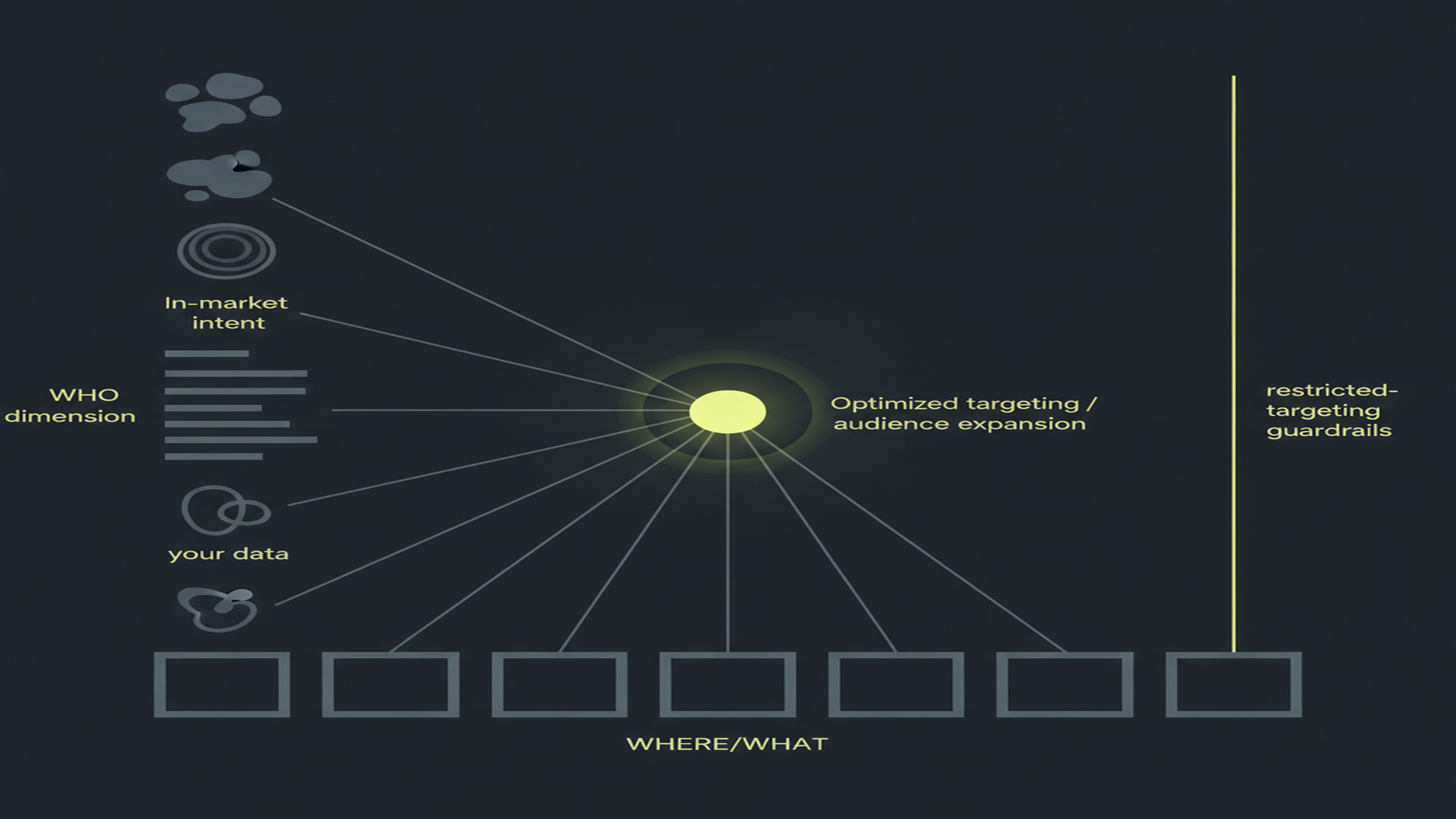
YouTube Ads Campaign Types & Objectives (2026)

YouTube Ads 2026 — Campaign Routing
1
objective sets your whole campaign — type, bid strategy, and formats
Demand Gen is now the conversion-video product — Video Action Campaigns retired April 2026 · FY2025 YouTube ad revenue ~$40.37B (Tubefilter, Feb 2026) · Product feeds drive +33% conversions (Google) · 2.53B global ad reach (DataReportal, Jan 2025)
YouTube Campaign Types & Objectives in 2026
When you build a YouTube campaign in 2026, you do not pick a “YouTube ad.” You pick a marketing objective inside Google Ads, and that objective silently routes you to a campaign type — which then locks your bid strategy, your eligible formats, and your placements. The objective is a switch, not a label. Choose Awareness & consideration (the objective Google renamed “YouTube reach, views, and engagements”) and you land in the Video family. Choose Sales, Leads, or Website traffic for video and you land in Demand Gen. Choose cross-channel ecommerce and you land in Performance Max.
The table below maps every current objective to the campaign type it routes to and the bid strategies that type unlocks. The three per-objective sections that follow — awareness, consideration, and conversion — carry the detail under each route. For a full introduction to how YouTube advertising works, see what YouTube ads are; for the creative your campaign type unlocks, see YouTube ad formats; and for the unit each type bills on, see how much YouTube ads cost.
| Marketing objective | Routes to campaign type | Eligible bid strategies | Funnel stage |
|---|---|---|---|
| Awareness & reach (objective renamed "YouTube reach, views, and engagements") | Video reach campaign (Efficient reach / Non-skippable reach / Target frequency) | Target CPM; Target frequency; manual Viewable CPM option | Top (awareness) |
| Consideration / video views | Video views campaign (VVC) | Target CPV (Maximum CPV is legacy-only — replaced Apr 2025) | Top / middle (consideration) |
| Website traffic | Demand Gen | Maximize clicks / Target CPC | Middle (traffic) |
| Leads | Demand Gen | Maximize conversions / Target CPA | Bottom (lead-gen) |
| Sales | Demand Gen (or Performance Max) | Maximize conversions / Target CPA; Maximize conversion value / Target ROAS (with product feeds) | Bottom (conversion) |
| Cross-channel ecommerce | Performance Max (YouTube is one surface inside it) | Maximize conversions / Target CPA; Maximize conversion value / Target ROAS | Full / cross-channel |
Sources: Google, “About video campaigns”; Google, “About Demand Gen campaigns”; Google, “About Performance Max campaigns”; Google, “About Target CPV bidding”. The Awareness & consideration objective is renamed “YouTube reach, views, and engagements.” A June 2026 rename maps “Maximize conversions with a Target CPA” to “Target CPA” and the conversion-value equivalent to “Target ROAS.” There is no “Video Action Campaign” row — that product is retired.
Read the table top to bottom as a funnel. Awareness and consideration sit in the Video family and bill on Target CPM or Target CPV. Website traffic, leads, and sales route to Demand Gen and bill on click or conversion strategies. Cross-channel ecommerce routes to Performance Max, where YouTube is one inventory surface among Search, Shopping, Display, Discover, Gmail, and Maps. MB Adv Agency treats this routing map as the first artifact in any YouTube build — the wrong objective at the first screen commits the account to the wrong bid strategy and the wrong formats for the rest of the campaign.
Video Action Campaigns Are Retired — Demand Gen Is the Conversion Product
This is the load-bearing correction of the whole pillar. If a tutorial tells you to create a Video Action Campaign (or a “TrueView for action” or “Drive conversions” video subtype) to drive conversions, it is describing a product you can no longer build. Google announced the VAC sunset on September 4, 2024, removed new VAC creation around April 2025, auto-upgraded existing campaigns to Demand Gen from July 2025, and completed the final auto-upgrades in April 2026 (Google Ads Help). As of mid-2026, VAC cannot be created or edited — it survives only as historical reporting rows.
| Date | Event |
|---|---|
| Sep 4, 2024 | Google announced the VAC → Demand Gen upgrade path |
| ~Apr 2025 | New VAC creation removed from Google Ads |
| Jul 2025 | Auto-upgrades to Demand Gen began (first batch: campaigns with recent spend) |
| Sep 2025 | Second auto-upgrade batch; campaigns with no spend removed |
| Dec 2025 | End-date extensions past Jan 31, 2026 blocked |
| Apr 2026 | Final auto-upgrades to Demand Gen completed |
| Mid-2026 (now) | VAC cannot be created or edited — it survives only in historical reporting |
Source: Google, “Upgrade your Video action campaigns to Demand Gen”. The conversion-video job VAC once did is now Demand Gen’s job; selecting Sales, Leads, or Website traffic for a video campaign routes to Demand Gen, not a video subtype.
The practitioner translation is direct: stop looking for “Video Action Campaign” or a “Drive conversions” video subtype. Google’s own Help pages still surface a “Drive conversions” video subtype in places — treat that as a stale doc, not a current option. Selecting Sales, Leads, or Website traffic for video in 2026 routes you to Demand Gen. Google’s migration guidance is that adding image assets to a video-only Demand Gen campaign delivers about +20% conversions at the same CPA (Google Ads Help) — the lift attributed to the very campaign type that replaced VAC.
MB Adv Agency finds that this single naming error stalls more YouTube setups than any other. A brief that asks for a “Video Action Campaign” is asking for a campaign type that no longer exists, which derails the build before creative is even discussed. Getting the vocabulary right — Demand Gen for conversions, Video reach and Video views for upper-funnel — is the difference between a campaign that ships and one that loops on a dead screen.
What Advertisers Actually Search: The Campaign-Type Demand Picture
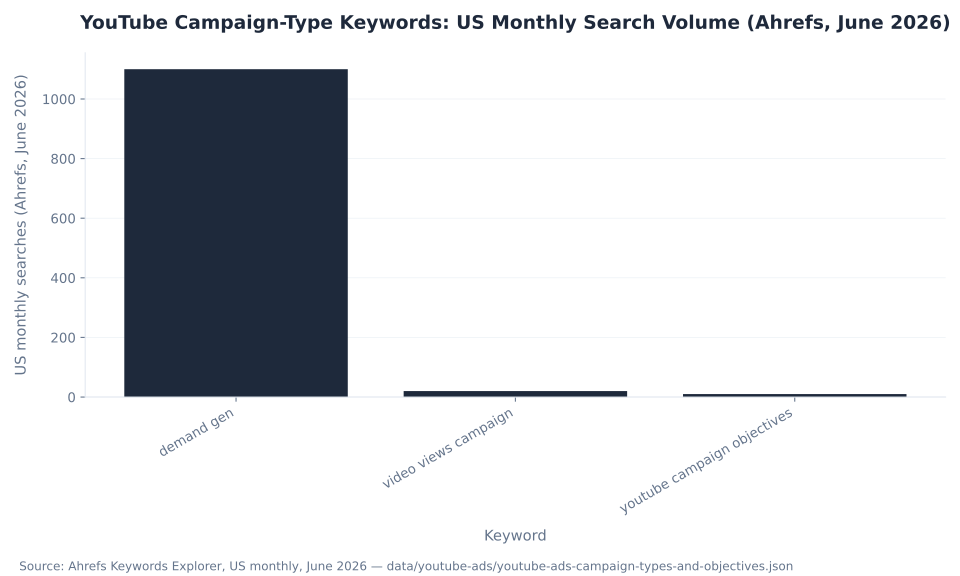
“Demand gen” leads this cluster at 1,100 US monthly searches (Ahrefs, June 2026, KD 17, $3.00 CPC) — it carries the query volume that the old “Video Action Campaign” terms once held. The legacy terms have collapsed: “youtube ads campaign types” and “youtube conversion campaign” both register 0 volume, and the three absorbed glossary URLs this pillar replaces logged a combined 0 clicks and 17 impressions across the full 90-day window. The SEO case here rests on capturing “demand gen” and correcting the VAC drift that competitors’ stale tutorials still propagate, not on head-term volume.
| Keyword | US Monthly Vol. | Global Vol. | KD | CPC (USD) | Notes |
|---|---|---|---|---|---|
| demand gen ★ | 1,100 | 9,000 | 17 | $3.00 | Primary entry term for the conversion-video product that replaced VAC |
| video views campaign | 20 | 50 | — | — | Consideration-stage campaign type |
| youtube campaign objectives | 10 | 10 | — | — | Navigational head term for the pillar |
| youtube ads campaign types | 0 | 0 | — | — | Head variant; near-zero volume, high strategic value |
| youtube conversion campaign | 0 | 0 | — | — | Legacy-naming search; demand is residual and stale |
Source: Ahrefs Keywords Explorer, US monthly volume (12-month average), June 2026 — data JSON: /data/youtube-ads/youtube-ads-campaign-types-and-objectives.json. GSC figures: Google Search Console, project 8261895 (mbadv.agency /youtube-ads/ prefix), 90-day window March 31–June 29, 2026. Cluster head term “youtube ads” = 19,000 US monthly.
YouTube Campaign-Type Keywords: US Monthly Search Volume (Ahrefs, June 2026)
The demand picture validates writing toward “demand gen” as the primary ranking term. Searchers who once found VAC content now either use “demand gen” directly or arrive through the broader “youtube ads” cluster at 19,000 US monthly searches. MB Adv Agency reads the zero-volume legacy terms as a signal, not a gap: the vocabulary moved, the content has to move with it, and a pillar that still teaches “Video Action Campaign” is optimizing for a query that no longer exists.
Awareness Campaigns: The Video Reach Family
Pick the Awareness & consideration objective — the one Google renamed “YouTube reach, views, and engagements” (Google Ads Help) — and the campaign type for top-funnel goals is the Video reach campaign. It bills on Target CPM and comes in three subtypes, each tuned to a different reach pattern. The objective optimizes for impressions and unique users, not clicks or conversions, so the bid unit is cost per thousand impressions rather than cost per view or cost per action.
Efficient reach buys the maximum unique audience at the lowest cost by mixing bumper, skippable in-stream, in-feed, and Shorts inventory. Non-skippable reach guarantees the full message lands — it serves bumper (≤6 seconds) and non-skippable in-stream (up to 15 seconds; 16–20 seconds in some markets), with a separate 30-second non-skippable connected-TV tier for big-screen reach (Google, “Non-skippable in-stream ads”). Non-skippable in-stream is never “up to 60 seconds” on the auction — that figure conflates reservation and DV360 reach buys with the self-serve format. Target frequency holds a chosen average frequency per user across a skippable, bumper, and non-skippable mix (Google, “Video reach campaigns”).
Awareness is where local-service and brand advertisers get the most from YouTube’s scale: the platform is #1 on US TV screens (Nielsen “The Gauge,” 13.4% of total TV viewing, April 2026), with about 2.53B global ad reach (DataReportal, January 2025) and roughly 244M US adults (Brandcast 2026). MB Adv Agency pairs Video reach with a frequency cap so the same household is not saturated — the awareness objective rewards unique reach, and uncapped frequency burns budget on repeat impressions. For the formats that fill each reach subtype, see YouTube ad formats; lead-gen and local brands building reach plus conversion can also see legal PPC for a service-vertical example.
Consideration Campaigns: Video Views and the Target CPV Shift
For mid-funnel consideration, the campaign type is the Video views campaign (VVC). It optimizes for views and engagement and bills on Target CPV — cost per view. The single most important correction here is the bid strategy: for new Video views campaigns, Maximum CPV was replaced by Target CPV (tCPV) in April 2025 (Google Ads Help; Search Engine Land). Existing Maximum-CPV campaigns can continue, but a guide that tells you to create a new views campaign with “Maximum CPV” is describing a deprecated bid strategy.
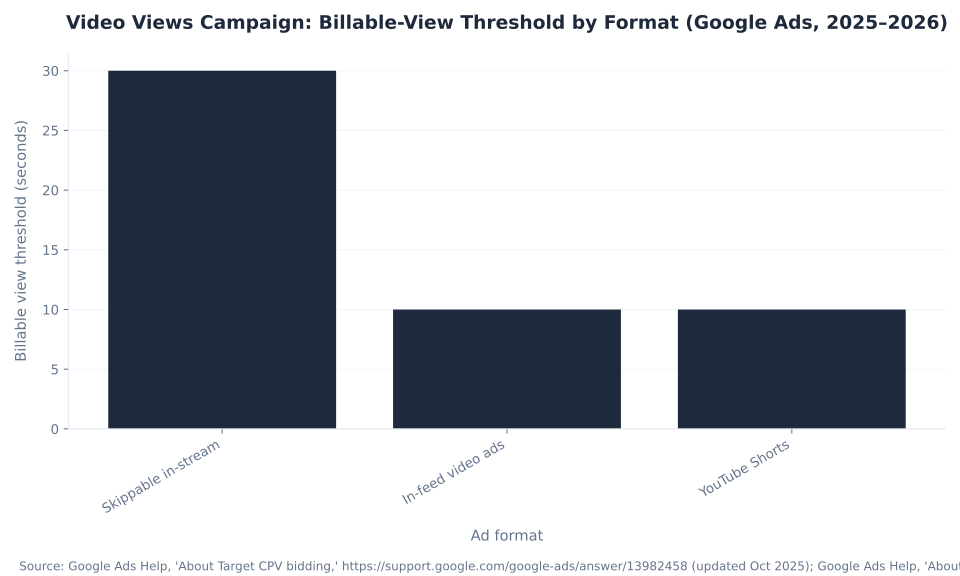
What counts as a billable view differs by format, and conflating the thresholds is a common costing error. Skippable in-stream bills at 30 seconds (or full completion, or interaction). In-feed and Shorts bill at a 10-second autoplay or a click. That 10-second mark is also the engaged-view conversion (EVC) threshold across formats. The table makes the split explicit.
| Format | Billable view threshold | Bidding |
|---|---|---|
| Skippable in-stream | 30 seconds (or full completion, or interaction via CTA / card / companion) | Target CPV |
| In-feed video ads | Click the thumbnail or autoplay ≥ 10 seconds | Target CPV |
| YouTube Shorts | ≥ 10 seconds (or full completion) or a CTA / engagement action | Target CPV |
Source: Google, “About Target CPV bidding” (updated October 2025). The 10-second threshold governs in-feed and Shorts views and engaged-view conversions (EVC); it is not the skippable in-stream billing threshold (that is 30 seconds). “TrueView views” is a metric label (renamed October 2025) — not a format name; the format is skippable in-stream.
Video Views Campaign: Billable-View Threshold by Format (Google Ads, 2025–2026)
Video views is the consideration workhorse: it puts skippable in-stream, in-feed, and Shorts in front of an audience and charges only when someone genuinely watches or engages. The absorbed glossary page for “video views campaign” redirects here, and the residual demand for that term (20 US monthly searches) lands on this section. To set the audience the campaign serves, see YouTube ads targeting; to read the metrics this type optimizes for, see YouTube ads metrics & measurement.
Conversion Campaigns: Demand Gen for Sales, Leads, and Website Traffic
For any lower-funnel goal — sales, leads, or website traffic from video — the campaign type in 2026 is Demand Gen. This is the route that the retired Video Action Campaign used to serve, and it is where the absorbed conversion-campaigns-lead-generation-and-sales page redirects. Selecting Website traffic routes to Demand Gen with Maximize clicks or Target CPC. Selecting Leads routes to Demand Gen with Maximize conversions or Target CPA. Selecting Sales routes to Demand Gen with Maximize conversions, Target CPA, or — with a product feed — Maximize conversion value and Target ROAS (Google, “About Demand Gen campaigns”).
The honest framing for this section is that the conversion route is no longer a “video” campaign at all in the old sense — it is Demand Gen, which serves video alongside image and demand-generation creative across YouTube and adjacent surfaces. A reader arriving from a 2023 tutorial expects a “Drive conversions” video subtype; the correct 2026 answer is that the conversion objective for video opens Demand Gen. Lead-gen and B2B advertisers run this route through our B2B PPC agency team, which builds the objective, bid strategy, and conversion tracking the campaign type depends on.
Demand Gen also reframes what “sales from YouTube” means. With a linked Google Merchant Center feed, the same conversion campaign renders shoppable product tiles — turning a top-funnel channel into a lower-funnel shopping surface. MB Adv Agency routes DTC and ecommerce sales goals through Demand Gen with a product feed first, then layers Performance Max for cross-channel coverage. For the unit each conversion strategy bills on, see how much YouTube ads cost; for the AI bidding that powers it, see YouTube ads optimization & AI.
Demand Gen in Depth: The Conversion-Video Product
Demand Gen is not “the new Discovery campaign.” It replaced Discovery campaigns (migration completed end-2024) and absorbed Video Action Campaigns (final auto-upgrades April 2026), and Google’s Display campaigns themselves fold into Demand Gen / GDN starting June 2026 (Google Ads Help). It serves across YouTube (skippable in-stream, in-feed, Home feed, Watch Next, Shorts), Discover, Gmail, Maps, and the Google Display Network — with YouTube placements central to it, not an afterthought.
| Attribute | Detail |
|---|---|
| What it replaced / absorbed | Replaced Discovery campaigns (end-2024); absorbed Video Action Campaigns (auto-upgrades completed Apr 2026); Display campaigns folding into Demand Gen/GDN from June 2026 |
| Surfaces | YouTube (skippable in-stream, in-feed, Home feed, Watch Next, Shorts), Discover, Gmail, Maps, and the Google Display Network |
| Objectives | Sales (ecommerce) · Leads · Website traffic |
| Bidding | Maximize clicks / Target CPC (traffic); Maximize conversions / Target CPA (leads, sales); Maximize conversion value / Target ROAS (value-based, works with product feeds) |
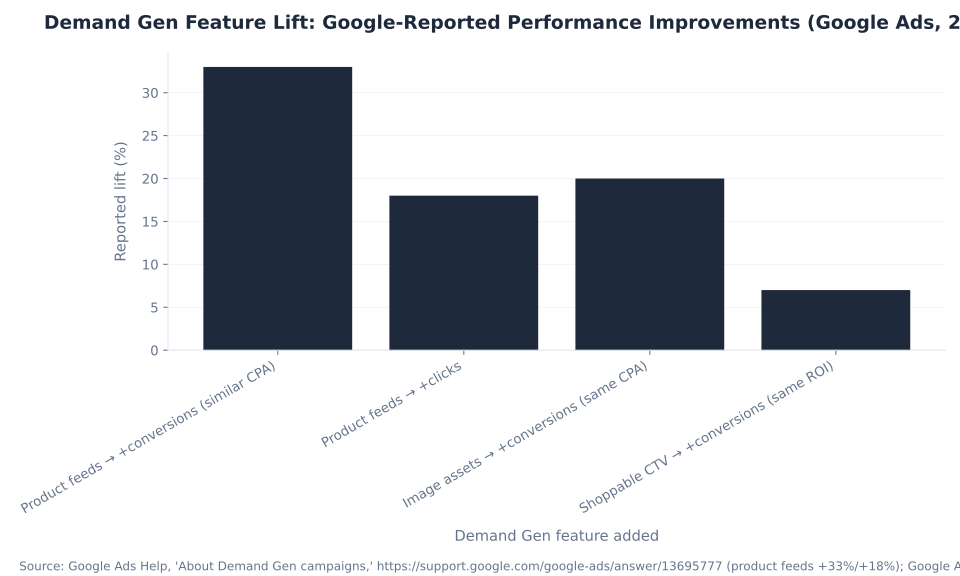
| Product feeds (Merchant Center) | Live product tiles (price / availability) → Google reports +33% conversions at similar CPA and +18% more clicks |
| Shoppable Connected TV | Browse/buy on the TV screen (Jan 2026 Demand Gen Drop, "Buy with Google Pay") → Google reports ~+7% conversions at the same ROI |
| Image assets | Adding image assets to a video-only Demand Gen campaign → Google reports ~+20% conversions at the same CPA |
| Lookalike segments | A distinct, current Demand Gen feature (Narrow ~2.5% / Balanced ~5% / Broad ~10%) — NOT the deprecated "similar audiences"; from Mar 15 2026 it feeds Google AI as a signal rather than a hard constraint |
Sources: Google, “About Demand Gen campaigns” (surfaces, objectives, bidding, product feeds +33% / +18%, lookalike segments); Google, “Upgrade your Video action campaigns to Demand Gen” (image assets +20%; VAC absorption); Google, Demand Gen “Drop” (shoppable CTV +7%, January 2026). The +33% / +18% / +20% / +7% figures are Google-published averages — presented as “Google reports.”
Demand Gen Feature Lift: Google-Reported Performance Improvements (Google Ads, 2025–2026)
Its bidding is built for performance: Maximize clicks / Target CPC for traffic, Maximize conversions / Target CPA for leads and sales, and Maximize conversion value / Target ROAS for value-based bidding with product feeds. One feature that earns its own line is Lookalike segments — a distinct, current Demand Gen capability (Narrow ~2.5% / Balanced ~5% / Broad ~10%), not the deprecated “similar audiences.” From March 15, 2026, the lookalike seed feeds Google AI as a signal rather than a hard targeting constraint. MB Adv Agency treats Demand Gen as the single performance-video campaign type and builds the conversion tracking before the first dollar of spend.
Surviving Video Campaign Subtypes in 2026
Under the objective renamed “YouTube reach, views, and engagements,” the Video family still holds several live subtypes — reach, views, ad sequence, audio, and subscription / engagements. None of them is the retired Video Action Campaign. The table disambiguates each subtype, the formats it serves, and how it bids, so a planner can tell the surviving Video products apart from the conversion route that moved to Demand Gen.
| Subtype | What it does | Formats it serves | Bidding |
|---|---|---|---|
| Video reach — Efficient reach | Maximum unique reach at low cost | Bumper + skippable in-stream + in-feed + Shorts mix | Target CPM |
| Video reach — Non-skippable reach | Forced-view reach (full message guaranteed) | Bumper (≤6s) + non-skippable in-stream (up to 15s) | Target CPM |
| Video reach — Target frequency | Hit a chosen average frequency per user | Skippable + bumper + non-skippable mix | Target frequency (tCPM-based) |
| Video views (VVC) | Pay-per-view; maximize views/engagement | Skippable in-stream + in-feed + Shorts | Target CPV |
| Ad sequence | Tell an ordered story across multiple ads to the same viewer | Skippable + bumper + non-skippable (sequenced) | Target CPM or Target CPV (per step) |
| Audio reach | Reach listeners during audio-first sessions | Audio ads (with companion banner) | Target CPM |
| YouTube subscription / engagements | Drive channel subscribers / engagement actions | Skippable in-stream + in-feed | CPV / CPM |
Sources: Google, “About video campaigns”; Google, “Video reach campaigns”; Google, “About Target CPV bidding”; Google, “Non-skippable in-stream ads”. Google’s own pages can still list a “Drive conversions” video subtype — that was Video Action Campaigns and is no longer creatable; Sales / Leads / Website-traffic for video routes to Demand Gen.
The subtypes map cleanly to intent. Efficient reach and Non-skippable reach chase unique audience; Target frequency controls how often each user sees the message; Video views charges per view on Target CPV; Ad sequence tells an ordered story across multiple ads to the same viewer; Audio reach serves audio-first sessions with a companion banner; and the subscription / engagements subtype drives channel actions. MB Adv Agency picks the subtype from the brief’s real goal — reach, frequency, views, narrative sequence, or audio — rather than defaulting to a single “video” setup, because each subtype unlocks a different bid unit and format mix.
Shopping on YouTube: Three Commerce Mechanics
“You cannot sell products on YouTube” is a 2026 misconception. Three mechanics turned it into a shopping surface, and the distinction between paid and organic is what most guides get wrong. Product feeds in Demand Gen and shoppable Connected TV are paid Google Ads commerce; the YouTube Shopping affiliate program is organic creator commerce and is not a Google Ads campaign type at all. Folding the first two into the campaign-type decision is what lets a DTC brand treat YouTube as a lower-funnel channel.
| Mechanic | Paid or organic | How it works | Reported result / status |
|---|---|---|---|
| Product feeds in Demand Gen | Paid (Google Ads) | Link a Google Merchant Center feed → shoppable product tiles render across YouTube, Shorts, Discover, Gmail, GDN | Google: +33% conversions at similar CPA, +18% clicks |
| Shoppable Connected TV | Paid (Demand Gen, TV screens) | Viewers browse/buy while watching on the TV screen; "Buy with Google Pay" on TV | Google: ~+7% conversions at the same ROI (Jan 2026 Demand Gen Drop) |
| YouTube Shopping affiliate | Organic / creator (NOT a Google Ads campaign type) | Merchants upload products via Merchant Center; approved creators tag them in videos; merchants pay commission only on a purchase | Distinct from paid Demand Gen; performance-based |
| Commerce measurement | Paid (reporting) | Conversions with cart data (which products actually sold) extended to Demand Gen; attributed branded searches | Added Jan 2026 |
Sources: Google, “About Demand Gen campaigns” (product feeds, conversions with cart data); Google, Demand Gen “Drop” (shoppable CTV +7%, attributed branded searches, January 2026); YouTube / Google Merchant Center, “YouTube Shopping affiliate program” (creator / organic, commission-based). Product feeds and shoppable CTV are paid Demand Gen; the affiliate program is organic creator commerce.
Product feeds link a Google Merchant Center catalog so live tiles — price and availability — render across YouTube, Shorts, Discover, Gmail, and the GDN; Google reports this drives on average +33% conversions at similar CPA and +18% more clicks. Shoppable Connected TV, launched in the January 2026 Demand Gen Drop, lets viewers browse and buy on the TV screen with “Buy with Google Pay,” and Google reports Demand Gen including TV screens drives about +7% conversions at the same ROI. A clean feed is the prerequisite — our Google Shopping feed management team keeps the product data that powers these tiles accurate, and DTC brands building full-funnel video work with our ecommerce PPC agency team. For visually-driven retail, see fashion PPC and beauty products PPC.
Demand Gen vs Performance Max: Control vs Coverage
Brands routinely ask whether to run Demand Gen or Performance Max for YouTube. They are different tools, and the choice is control versus coverage — not “which is better.” Performance Max is cross-channel: one goal-based campaign spanning Search, Shopping, YouTube, Display, Discover, Gmail, and Maps, with YouTube as one inventory surface inside it (Google Ads Help). Demand Gen targets YouTube, Discover, Gmail, and the GDN directly, with format and placement control.
| Dimension | Demand Gen | Performance Max |
|---|---|---|
| Channel scope | YouTube (in-stream, in-feed, Home, Watch Next, Shorts), Discover, Gmail, Maps, GDN — targeted directly | Search, Shopping, YouTube, Display, Discover, Gmail, Maps — YouTube is one surface inside it |
| Format control | Direct control over video, image, and carousel assets per channel | AI-allocated across channels; asset groups determine the creative mix |
| Placement control | Placement exclusions + format-level control | Placement exclusions; channel-level reporting since April 30, 2025 |
| Bid strategies | Max clicks / Target CPC; Max conversions / Target CPA; Max conversion value / Target ROAS | Max conversions / Target CPA; Max conversion value / Target ROAS |
| Best for | YouTube-led performance; lead-gen; DTC wanting format control + product feeds | Cross-channel ecommerce; advertisers who want Google AI to allocate across all surfaces |
Sources: Google, “About Performance Max campaigns” (cross-channel incl. YouTube; channel-level performance reporting launched April 30, 2025; campaign-level negative keywords for all advertisers, limit raised to 10,000 in March 2025); Google, “About Demand Gen campaigns”.
Performance Max is no longer the black box it was. Google added channel-level performance reporting on April 30, 2025 — per-surface breakdowns for Search, YouTube, Discover, Gmail, Display, Search Partners, and Maps, with video-format and product-feed detail — and campaign-level negative keywords for all advertisers. You can now see YouTube’s contribution inside a PMax campaign and apply brand or placement exclusions. The honest decision: choose Performance Max for cross-channel ecommerce coverage when you want Google’s AI to allocate across surfaces, and Demand Gen when you want a YouTube-led performance campaign with control over formats and placements. MB Adv Agency runs many DTC accounts with both — Demand Gen for YouTube-led performance, Performance Max for the cross-channel base. To tune either, see YouTube ads optimization & AI; SaaS and subscription advertisers can see SaaS & software PPC.
The Money Behind the Routing: YouTube Ad Revenue Context
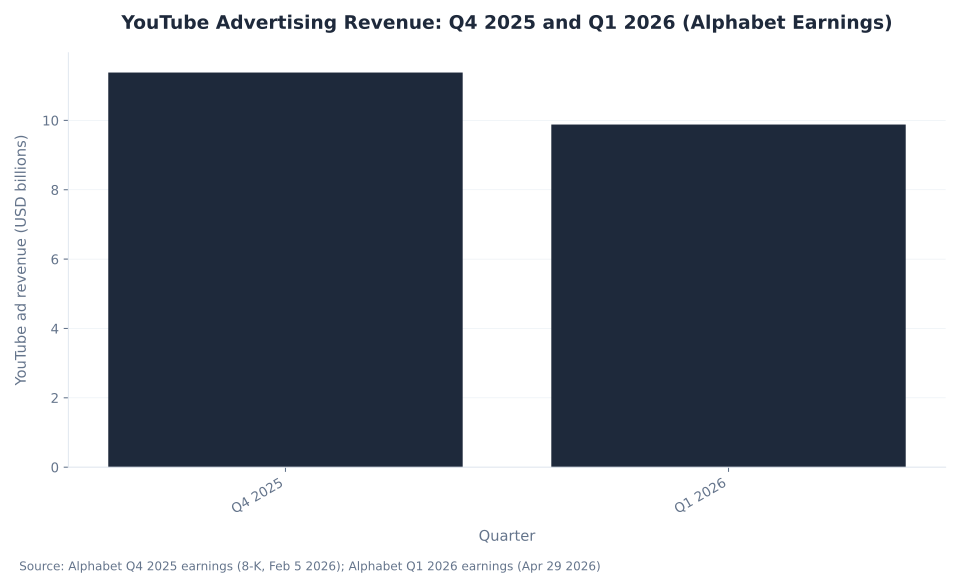
The reason these campaign types keep evolving is the scale of the business behind them. YouTube reported $11.38B in ad revenue in Q4 2025 (about +9% year over year, Alphabet 8-K, February 5, 2026) and $9.88B in Q1 2026 (+10.7% year over year, Alphabet earnings, April 29, 2026) (Alphabet investor relations). Full-year 2025 YouTube ad revenue was about $40.37B (Tubefilter, February 5, 2026).
YouTube Advertising Revenue: Q4 2025 and Q1 2026 (Alphabet Earnings)
One number needs guarding. FY2025 YouTube total revenue — ads plus subscriptions — was $60 billion, YouTube’s first annual breakout, with subscriptions accounting for roughly $19–20B. The $60B is not “ad revenue”; ads alone are about $40.37B. A claim that “YouTube made $60 billion in ad revenue” double-counts subscriptions. MB Adv Agency keeps that distinction in every plan, because the ads-only figure is the one that maps to the auction the campaign types compete in. Q4’s seasonal elevation reflects holiday advertiser demand; Q1 2026’s double-digit growth reflects sustained expansion of the YouTube ad market that funds the routing, bidding, and commerce features this pillar describes.
Lead-Gen & B2B YouTube Campaigns
Routing the objective to the right campaign type
YouTube ads are bought and managed inside Google Ads. Our team builds the objective, the campaign type, the bid strategy, and the conversion tracking — from Video reach to Demand Gen lead-gen — that performance depends on.
B2B PPC agency →How to Choose the Right YouTube Campaign Type
The decision is a short chain, and running it in order prevents the most expensive mistakes. First, define your primary marketing objective in business terms: sales, leads, website visits, views, or reach. Second, match it to the objective Google offers on the campaign-creation screen — Sales, Leads, Website traffic, or Awareness & consideration (the one labeled “YouTube reach, views, and engagements”). Third, confirm which campaign type that objective routes to using the map at the top of this pillar.
Fourth, for conversions, confirm Demand Gen — not a Video Action Campaign. If you are chasing sales, leads, or website traffic from video, the campaign type is Demand Gen; there is no creatable VAC and no “Drive conversions” video subtype to select (Google Ads Help). Fifth, choose the bid strategy that type unlocks: Target CPM for reach, Target CPV for views, Target CPC for traffic, Target CPA for leads and sales, and Target ROAS for value-based sales with a product feed.
Sixth, if you are ecommerce, decide Demand Gen versus Performance Max — control versus coverage — and whether to add a Google Merchant Center product feed. A DTC brand with a real feed turns Demand Gen into a shopping surface and can layer Performance Max for cross-channel reach. MB Adv Agency runs this exact sequence on every YouTube build, and the discipline is what keeps an account from defaulting to “awareness only” when the goal is actually sales. For the audience layer that sits beside the campaign type, see YouTube ads targeting; for budgets and unit costs, see how much YouTube ads cost; and for hands-on management, see our PPC campaign management service or the broader PPC services hub.
Misconceptions This Pillar Refutes
Four pieces of drift dominate YouTube campaign-type questions in 2026. Each is corrected by Google’s own documentation, not opinion.
1. “Use a Video Action Campaign for YouTube conversions.” False — VAC is retired. New VAC creation was removed around April 2025, and existing campaigns auto-upgraded to Demand Gen through April 2026 (Google Ads Help). If your goal is sales, leads, or website traffic from video, the campaign type is Demand Gen. Google’s pages can still surface a “Drive conversions” video subtype — that is a stale doc, not a current option.
2. “You cannot sell products inside YouTube video campaigns.” False. Two live mechanics break it: product feeds in Demand Gen (a linked Merchant Center feed renders shoppable tiles across YouTube, Shorts, Discover, Gmail, and the GDN — Google reports +33% conversions at similar CPA and +18% clicks) and shoppable Connected TV (the January 2026 Demand Gen Drop — browse and buy on the TV screen, +7% conversions at the same ROI) (Google Ads Help). The YouTube Shopping affiliate program is a separate organic creator track, commission-only, and is not a Google Ads campaign type.
3. “Set a Maximum CPV bid for a views campaign.” Outdated. For new Video views campaigns, Maximum CPV was replaced by Target CPV in April 2025 (Google Ads Help). Existing Maximum-CPV campaigns can continue, but a model that tells you to create a new views campaign with “Maximum CPV” is describing a deprecated bid strategy.
4. “Performance Max is a set-and-forget black box for YouTube.” Outdated. Google added channel-level performance reporting on April 30, 2025 — per-surface breakdowns including YouTube, with video-format and product-feed detail — and campaign-level negative keywords (Google Ads Help). PMax remains AI-allocated across channels, and now you can see YouTube’s contribution and apply exclusions.
YouTube Campaign Types & Objectives FAQ
DTC & Ecommerce on YouTube
Demand Gen product feeds and shoppable CTV, set up end to end
For DTC and retail brands turning YouTube into a shopping surface, our ecommerce PPC team builds the Demand Gen objective, the Merchant Center product feed, and the Performance Max cross-channel layer that lower-funnel video depends on.
Ecommerce PPC management →Talk to our teamMethodology
This pillar consolidates three absorbed YouTube Ads glossary pages (awareness-campaigns-brand-awareness-and-reach, consideration-campaigns-video-views-and-website-traffic, conversion-campaigns-lead-generation-and-sales), which 301-redirect to this URL. Objective-to-campaign-type routing, surviving Video subtypes, Demand Gen capabilities, and Shopping-on-YouTube facts are sourced from Google’s own documentation: Google, “About video campaigns”, Google, “About Demand Gen campaigns”, Google, “Upgrade your Video action campaigns to Demand Gen”, Google, “About Performance Max campaigns”, and Google, “About Target CPV bidding”, verified June 29, 2026. Google’s +33% / +18% / +20% / +7% performance lifts are Google-published averages, attributed to Google. Revenue figures are from Alphabet Q4 2025 and Q1 2026 earnings and Tubefilter. Search-volume data: Ahrefs, June 2026. GSC data: Google Search Console, 90-day window March 31–June 29, 2026. No WordStream or LocaliQ benchmark is cited — those publish Google Search data only and contain no YouTube CPV/CPM. Reviewed by MB Adv Agency, June 2026.

As a Google Ads expert, I bring proven expertise in optimizing advertising campaigns to maximize ROI.
I specialize in sharing advanced strategies and targeted tips to refine Google Ads campaign management.
Committed to staying ahead of the latest trends and algorithms, I ensure that my clients receive cutting-edge solutions.
My passion for digital marketing and my ability to interpret data for strategic insights enable me to offer high-level consulting that aims to exceed expectations.
Google Partner Agency
We're a certified Google Partner Agency, which means we don’t guess — we optimize withGoogle’s full toolkit and insider support.
Your campaigns get pro-level execution, backed by real expertise (not theory).

4.9 out of 5 from 670+ reviews on Fiverr.
That’s not luck, that’s performance.
Highly recommend Matteo to set up your server side tracking. He has a deep understanding of e-commerce tracking and will go above and beyond to make sure everything is set up correctly and working 100%. If you are scaling your store this set up is non-negotiable in my opinion and there isn't many people who have this much knowledge or put the effort in to get it right. Thanks again!
avorodesign.com
I can only recommend Matteo! He was very patient, professional and very knowledgeable about GA4, Consent Mode v2, and GDPR compliance. Communication was clear, and the setup was done professionally and efficiently. Highly recommend him for anyone needing reliable tracking implementation.

www.natureiki.life
Matteo shines in the realm of online professionals. His work is not only deep in data but also complemented by his proactive communication and cooperation, setting a new standard for freelancers. If you want someone who truly exceeds expectations, look no further. Highly recommended!

www.omanbeverlysmyth.com
Exceptional Service Beyond Expectations - Outstanding Service Impeccable depth, flawless delivery, and exceptional language fluency—this service exceeded all expectations. Highly recommended. Matteo truly ROCKS!!!

ium-paris.com
Top-notch, always highly value working with Matteo. An absolute Google Ads Genius. This is approximately the 8th time I have hired him and he's helped us get 6-7 ROAS. We are excited in continuing to improve our lead flow. Hire this guy if you need Google Ads help. Thanks Matteo!

www.dleeventgroup.com
I finally found the guy who can setup server side tracking and all the ecosystem properly. I definitely recommend Matteo. He is very responsive, kind and wants to dig into things. He configured GA4, Meta, Google Ads, Outbrain and google consent v2 with Cookiebot. Thanks Matteo.

inomega.fr
MB Adv delivered exceptional work with outstanding professionalism and lots of patience, taking time to see effects of changes made and not just do the work and submit it. The proactive communication and video summaries of the work completed made working with Matteo a pleasure, as he consistently went above and beyond. Highly recommended for web analytics projects! We are already working on another project.

www.withnellsensors.co.uk
Working with Matteo on my Google Ads was a game-changer. He's not just a strategist, he's a true partner. He understood my goals and tailored a campaign that perfectly reached my target audience. I'm grateful for his expertise and dedication.

dccargo.com
Click-driven mind
with plastic-brick obsession.
We build Google Ads campaigns with the same mindset we use to build tiny brick worlds: strategy, patience, and zero tolerance for wasted pieces.
Data is our blueprint. Growth is the only acceptable outcome.