What Are YouTube Ads? Platform Guide (2026)

YouTube Advertising Revenue — FY2025
$40.37B
YouTube ads-only revenue for FY2025 — the world’s largest video ad platform, reaching ~2.53 billion globally (DataReportal, Jan 2025) and 244M+ US adults across devices (Brandcast 2026). Note: YouTube total revenue (ads + subscriptions) ≈ $60B — the $40.37B is advertising revenue only.
Source: Alphabet FY2025 earnings via Tubefilter, February 5 2026 (Alphabet Q4 2025 / FY2025 earnings relay)
What Are YouTube Ads?
YouTube ads are paid video and Connected-TV placements bought and managed inside Google Ads — not a separate “YouTube Ads Manager” product. You create a campaign in Google Ads, choose a campaign type and objective, select a format, define a target audience or placement, and set a bid and daily budget. YouTube then serves your creative against that targeting and bills you per view, per thousand impressions, or per click depending on the format and objective.
The platform spans five self-serve surfaces: skippable in-stream ads (pre-roll that viewers can skip after five seconds), non-skippable in-stream (up to 15 seconds standard, plus a separate 30-second CTV tier for TV-screen placements), bumper ads (six seconds, non-skippable), in-feed video ads (a thumbnail in YouTube search results and the home feed), and Shorts ads (vertical 9:16 in the Shorts feed). Reserved buys — the Masthead homepage takeover and YouTube Select curated lineups — go through a Google sales rep and are not available in the standard self-serve auction. The complete format breakdown, billing rules, and creative length requirements live in YouTube ad formats.
Inside Google Ads, YouTube campaigns fall into two main families. Video campaigns (reach and views subtypes) handle awareness and consideration: efficient reach mixes bumpers and skippable ads to hit broad reach targets; video views campaigns optimize for views at a Target CPV; target frequency campaigns build share-of-mind at a set impression cadence. Demand Gen is the conversion and performance product — it replaced Video Action Campaigns, which Google retired through April 2026, and it bids toward sales, leads, and website traffic using Target CPA or Target ROAS. It serves across YouTube in-stream, in-feed, Shorts, Home, and Watch Next, plus Discover and Gmail. A third option, Performance Max, is a cross-channel campaign where YouTube is one inventory surface alongside Search, Shopping, Display, and Discover — useful when the goal spans channels rather than targeting YouTube specifically. Objective-to-campaign routing is mapped in full in YouTube ads campaign types and objectives.
Organic YouTube Video vs. YouTube Ad: The Key Difference
An organic YouTube video is content uploaded to your channel. Its reach is earned — through your subscriber base, YouTube’s recommendation algorithm, and YouTube search. You don’t pay for views, and you don’t control who sees it. A YouTube ad is a paid placement built in Google Ads: you define a target audience or placement, select a format and bid, set a daily budget, and YouTube serves your creative to those specific viewers on a timeline you control.
One detail that consistently confuses new advertisers: the same uploaded video can serve both purposes simultaneously. You upload a product video to your YouTube channel as organic content, then use that video’s YouTube URL as the creative asset inside a skippable in-stream campaign. The organic upload earns recommendations independently; the paid promotion runs against your targeting and budget at the same time. The two tracks share the creative asset but operate on entirely different distribution mechanisms — audience selection, cost, and reporting are separate.
There is no standalone “YouTube Ads Manager” product. YouTube Studio (studio.youtube.com) handles organic channel management: uploading videos, reviewing organic analytics, managing comments, and configuring creator monetization. Paid ad campaigns are built and managed in Google Ads (ads.google.com). If you open YouTube Studio looking for ad campaign settings, bidding controls, or audience targeting, you are in the wrong tool. MB Adv Agency finds this interface confusion costs new YouTube advertisers their first week on the platform — clarifying it upfront is the first step in any channel onboarding.
Paid YouTube = targeted, measurable, on-demand reach. Organic YouTube = free but unpredictable reach. Both tracks are worth building; they are different disciplines with separate management interfaces, and this guide covers the paid side.
For an advertiser with a time-sensitive goal — a product launch, a promotional window, or a local service that needs reach in a specific geography this week — paid is the only lever with a defined start time. Organic is the long-game compound investment. Understanding the distinction grounds every decision that follows: campaign type, format, targeting, and budget. Our PPC campaign management overview covers how to structure both tracks together.
Key Takeaways
- YouTube ads are managed in Google Ads — not a separate “YouTube Ads Manager.” YouTube Studio is for organic channel management only. Paid campaigns, billing, targeting, and reporting all live in Google Ads.
- YouTube’s potential ad reach is ~2.53 billion (DataReportal, Jan 2025 — advertising reach, not a logged-in user count) and it reaches 244M+ US adults (~91%) across devices (Brandcast 2026).
- Demand Gen is the 2026 conversion and performance product. Video Action Campaigns are retired — no new creation since about April 2025; all existing campaigns auto-upgraded to Demand Gen through April 2026.
- Skippable in-stream ads bill per view at 30 seconds. You don’t pay when a viewer skips before the 30-second mark, which structures wasted spend out of the format for small budgets.
- TV is now the primary YouTube viewing device in the US: 13.4% of total US TV viewing by minutes (Nielsen “The Gauge,” April 2026), #1 streaming platform for nearly three consecutive years, with over 1 billion hours watched on TV screens daily (Neal Mohan, Feb 2025).
The YouTube Ad Ecosystem: Formats, Campaign Types, and Targeting
YouTube advertising is not a single ad type — it is a platform with distinct formats, campaign types, and targeting layers that combine differently depending on the objective. This section names each layer and flags the key precision points; the sibling pillars carry the depth.
| Format | Skip? | Length / key rule | Billing |
|---|---|---|---|
| Skippable in-stream | After 5s | No hard max (rec <3 min); billable view at 30s, full, or interaction | Target CPV or Target CPM |
| Non-skippable in-stream | No | Up to 15s standard (16–20s some markets); separate 30s CTV tier for TV screens | Target CPM |
| Bumper ads | No | ≤6 seconds, non-skippable | Target CPM |
| In-feed video ads | N/A (click to watch) | Thumbnail in search results, home feed, watch-next | Per click or 10s autoplay view |
| Shorts ads | Swipe to skip | Vertical 9:16; served in Shorts feed | Target CPV or Target CPM |
| Masthead | N/A | Homepage takeover; reserved buy via Google rep | CPM / CPH (reserved) |
Sources: Google Ads Help, About video ad formats; About non-skippable in-stream ads. Overlay ads and Sponsored cards are discontinued (overlays April 6 2023). Non-skippable standard length is up to 15s — never “up to 60 seconds.” The 30s CTV tier is a separate product for TV-screen placements only.
Three naming traps to clear up at this orientation level. First, the skippable format is “skippable in-stream,” not “TrueView in-stream” — that name was retired; the only surviving “TrueView” term is the “TrueView views” metric (renamed October 2025, counting rules unchanged). Second, “in-feed video ads” is the current name for what was previously called “TrueView Discovery” (renamed November 2021). Third, the conversion/performance product is Demand Gen — not “Video Action Campaign” (retired) and not “Performance Max” (a distinct cross-channel product with different mechanics and reporting).
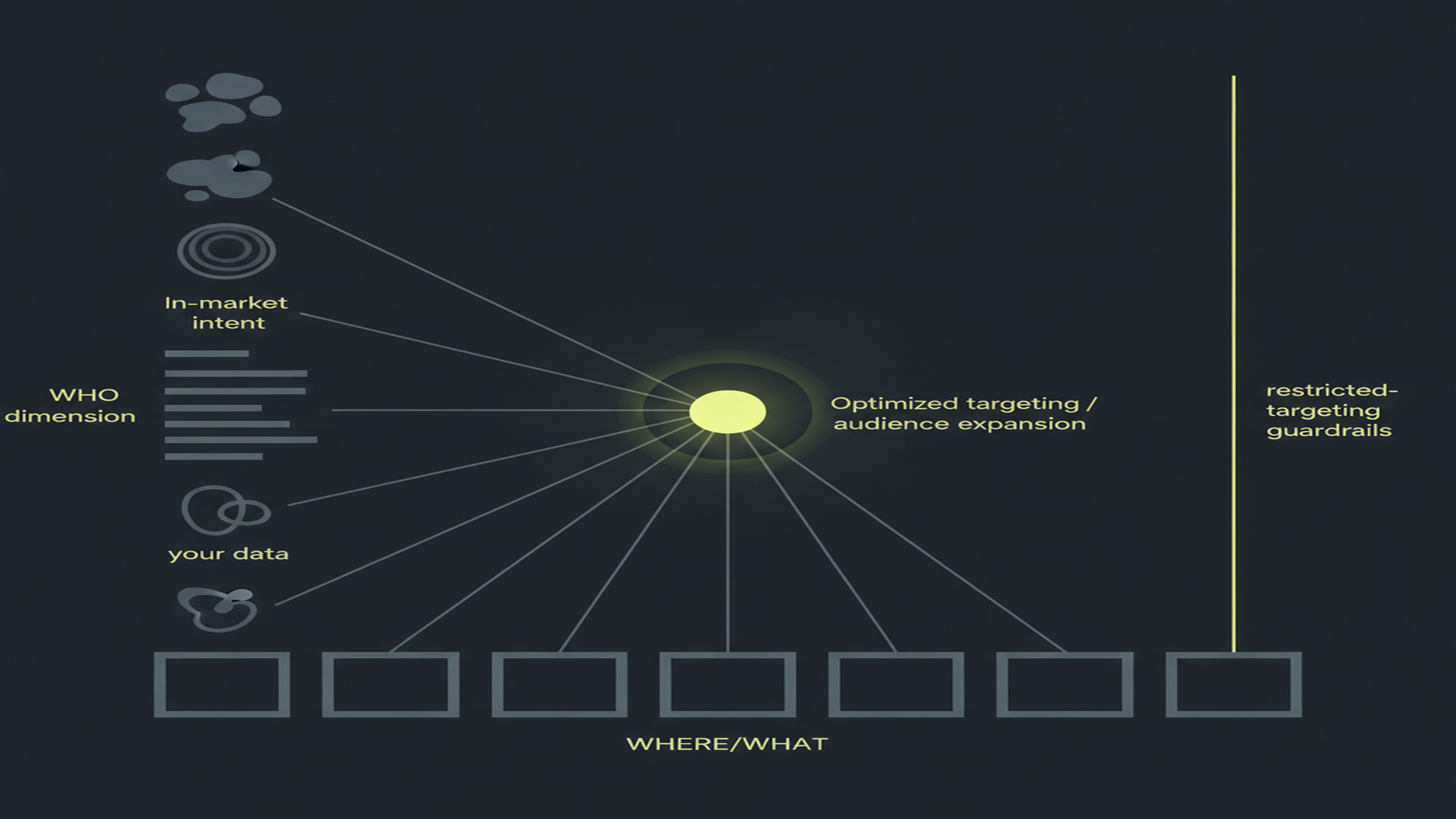
Targeting on YouTube works in three layers: audience segments (affinity for broad interest groups; in-market for active purchase intent; custom segments built from keywords, URLs, and apps; your-data segments from first-party lists and channel interactions; detailed demographics), contextual targeting (specific channels or videos as placements, topics, and content keywords), and geographic and device controls. One type no longer exists: “similar audiences” were removed from all campaigns in August 2023. The 2026 replacements are optimized targeting (on by default for Demand Gen and action campaigns — looks beyond your seed audience for likely converters) and audience expansion (for Video reach and views campaigns). The full taxonomy, layering logic, and what each type can target is in YouTube ads targeting.
For fashion advertisers, the combination of Shorts ads and in-feed video ads at the consideration stage reaches viewers in active discovery mode with visually-led creative. For SaaS and software brands, in-market and custom-segment targeting on Demand Gen reaches buyers researching solutions — not just browsing content passively. The format and campaign-type choice follows the objective, which is why the campaign decision always comes first.
YouTube’s Reach, Scale, and Commercial Intent
The case for YouTube advertising rests on two structural facts: its reach is platform-class, and its commercial intent signals are stronger than any other streaming service. The table below is the reference set — every figure is attributed to a named external source, not an aggregator estimate.
| Signal | Figure | Source |
|---|---|---|
| Global potential ad reach | ~2.53 billion (advertising/potential reach — not a logged-in user or MAU count) | DataReportal, Jan 2025 |
| US adults 18+ reached across devices | 244M+ (~91% of US adults) | YouTube Brandcast 2026, May 2026 |
| Share of total US TV viewing (April 2026) | 13.4% — #1 streaming platform, nearly 3 consecutive years | Nielsen “The Gauge” via TheWrap, May 2026 |
| Hours watched on TV screens daily | 1 billion+ (TV screens specifically; TV is now the primary YouTube viewing device in the US) | Neal Mohan, YouTube CEO, annual letter, Feb 2025 |
| #1 US podcast platform (weekly listeners 13+) | 31% use YouTube most — ahead of Spotify (27%) and Apple Podcasts (15%) | Edison Research Podcast Metrics, Oct 2024 |
| US viewers: creator content aids product research | 81% say creator content helps research/discover products when shopping | YouTube Brandcast 2025 (Google self-reported) |
| ROAS vs other streaming TV (Google MMM data) | 4.5× higher ROAS than other streaming TV | YouTube Brandcast 2025 (Google self-reported) |
All figures are from named external sources, not mbadv client data. The ~2.53B figure is DataReportal’s “advertising/potential reach” — explicitly not a logged-in user or MAU count; DataReportal itself warns that ad reach is not a user-base proxy. The 81% and 4.5× ROAS figures are Google/YouTube self-reported from Brandcast presentations — use attributive framing (“Google reports”, “per Brandcast 2025”), not as independently audited benchmarks.
One figure in the table requires a precise attribution note: the ~2.53 billion reach figure is DataReportal’s advertising/potential reach measurement — not a count of logged-in monthly users. DataReportal explicitly warns that advertising reach is not a user-base proxy. The figure that has propagated across blog posts as “YouTube has 2.7 billion monthly logged-in users” is not a current YouTube or Alphabet statistic. The last official YouTube phrasing was “2 billion+ logged-in monthly users,” circa 2019–2021. The correct attributable 2026 figures are: ~2.53B ad reach (DataReportal, Jan 2025) and 244M+ US adults (~91%, Brandcast 2026).
The reach figures put YouTube in the same bracket as broadcast television — but the 4.5× ROAS advantage over other streaming TV (Google MMM data, Brandcast 2025) is what the comparison to broadcast TV misses. YouTube is not reach-only; it is intent-adjacent. Google reports that 81% of US viewers say creator content helps them research and discover products when shopping (Brandcast 2025), and viewers are 13× more likely to search a brand and 5× more likely to buy when creators discuss products (Google internal study, n=60, Feb 2026 — platform-self-reported). For legal advertisers running awareness-to-consultation funnels, or for any brand where consideration takes multiple touchpoints, that intent layer is the core of the YouTube value proposition.
YouTube's US Advertising Reach: Key Signals (2026)
YouTube Is Not Just for Branding: The Full-Funnel Case
“YouTube ads are only for awareness and branding — if you want sales or leads, use Search or Shopping.” That framing describes YouTube circa the TrueView era, not 2026. The conversion and performance product today is Demand Gen, built from the ground up for sales, leads, and website traffic, with performance bidding and conversion-optimized serving across YouTube and Google’s full intent network.
Demand Gen replaced Video Action Campaigns — Google officially retired new VAC creation around April 2025 and auto-upgraded all existing campaigns to Demand Gen through April 2026. As of mid-2026, VAC cannot be created or edited; it exists only as historical reporting rows. Demand Gen bids toward conversions and conversion value (Target CPA, Target ROAS), supports engaged-view conversions (for viewers who watch 10 or more seconds of a skippable in-stream ad without clicking), and integrates with Google Merchant Center product feeds. Google reports that adding a product feed to a Demand Gen campaign drives on average +33% conversions at similar CPA and +18% clicks compared to the same campaigns without a feed (Google product feed performance data). These are Google’s own self-reported figures — frame them as platform claims, not independently benchmarked results.
The most significant 2026 development in the performance case is shoppable Connected TV. The January 2026 “Demand Gen Drop” introduced the ability for viewers to browse and buy while watching YouTube on the TV screen, with “Buy with Google Pay” available on TV-screen placements. Google reports that Demand Gen campaigns including TV screen inventory drive ~+7% conversions at the same ROI compared to campaigns without TV screens. That figure converts what was historically a pure-awareness surface — the living-room TV — into a conversion channel. For an ecommerce advertiser, the implication is direct: a shopper watching YouTube on their television sees a product in a Demand Gen ad, interacts with the remote, and completes a purchase without switching devices.
The strategic model that emerges: YouTube is full-funnel by product design. Video reach campaigns handle broad awareness and frequency-building at the top. Demand Gen handles consideration and conversion at the middle and bottom. Performance Max spans the entire stack as a cross-channel goal-based product where YouTube is one surface. The “branding only” framing collapses entirely when you account for the Demand Gen product, shoppable CTV, and the fact that the previous conversion-video product (VAC / TrueView for action) existed for years because performance buyers were already running YouTube for direct response. The performance use case is not new; Demand Gen is the upgraded, extended form of it. See YouTube ads campaign types and objectives for the full product routing by funnel stage and objective.


YouTube & Video Advertising
Ready to Run YouTube Ads?
MB Adv Agency helps businesses build full-funnel YouTube campaigns — from skippable in-stream awareness to Demand Gen conversion campaigns and shoppable CTV. Talk to us about your objective, budget, and creative situation before you spend your first dollar.
Get YouTube Ads advice →CTV, Shorts, and Podcasts: Why YouTube Matters More in 2026
Three structural shifts have expanded YouTube’s advertiser value in the past two years, each one opening a distinct inventory surface and behavior an ad can reach. An advertiser treating YouTube as it was in 2022 — mobile-dominant, pre-roll focused, awareness-only — buys the smallest version of the platform available.
The living room became the primary screen. TV is now the primary device for YouTube viewing in the US. Over 1 billion hours of YouTube are watched on TV screens every day, per YouTube CEO Neal Mohan’s February 2025 annual letter. YouTube holds 13.4% of total US TV viewing by minutes (Nielsen “The Gauge,” April 2026, via TheWrap) — the most-watched streaming platform on US TV screens for nearly three consecutive years, per Mohan’s January 21 2026 letter. CTV ad conversions on YouTube grew 200%+ year-over-year (Q1 2025 to Q1 2026, Brandcast 2026), and 150M+ Americans watch YouTube on CTV monthly (Google, 2025). The TV surface is not a niche segment; it is the default large-screen entertainment experience for a substantial share of US adults, with a shoppable conversion layer added in January 2026.
Short-form reached a scale that demands its own format decision. YouTube Shorts delivers 200 billion daily views (Neal Mohan, Cannes Lions June 2025, reconfirmed in his January 21 2026 letter). One methodological note: YouTube changed Shorts view-counting on March 31 2025 — a view now counts on start or replay, with no minimum watch time required. The 70 billion daily views (March 2024) to 200 billion jump is partly definitional, not a purely organic 3× increase. The scale is real; the growth rate against a pre-change baseline is not a clean comparison. For advertisers, the practical implication is straightforward: Shorts ads are a distinct surface requiring vertical 9:16 creative, with their own CPM and CPV dynamics. A YouTube strategy that excludes Shorts leaves the platform’s highest-volume daily surface unbought.
YouTube is now the #1 podcast platform in the US — by listener share. According to Edison Research Podcast Metrics (October 2024), 31% of weekly US podcast listeners aged 13 and older use YouTube as their primary podcast service — ahead of Spotify (27%) and Apple Podcasts (15%). Video podcasts are a distinct ad context: lean-in, episodic, high-intent audiences in a mid-to-long viewing session. For SaaS advertisers and professional services brands building consideration with a decision-maker audience, podcast pre-roll on YouTube reaches that segment in a context that broadcast radio or traditional podcast audio sponsorships cannot replicate on a self-serve basis — and with the video-first creative format that YouTube’s algorithm rewards. The cross-platform cost and reach comparison lives in YouTube ads vs other video advertising platforms.
Are YouTube Ads Worth It for Small Businesses?
The assumption that YouTube advertising requires a broadcast TV budget is wrong. YouTube ads are self-serve inside Google Ads, with no fixed dollar minimum for video campaigns and a daily budget the advertiser sets. A local service business runs a skippable in-stream campaign targeting a specific city at $20/day. A DTC brand tests a Demand Gen campaign at $500/month. The floor is the creative, not the budget.
The cost structure of skippable in-stream ads works in favor of small budgets. A view counts at 30 seconds (or a full-ad completion if shorter, or an engagement/interaction) — you don’t pay when a viewer skips before the 30-second mark. Third-party benchmarks place average in-stream CPV around $0.05: AdConversion’s analysis of a real ~$1.04M YouTube spend dataset (B2B SaaS-skewed, 2023–24) arrives at $0.05 average CPV (range $0.01–$0.19), and Store Growers’ 2026 benchmarks corroborate the same figure for in-stream. At $0.05 CPV, a $300/month budget delivers roughly 6,000 genuine engaged views from targeted viewers. Full cost breakdowns by format, objective, vertical, and device live in how much do YouTube ads cost.
The real barrier for a small business running YouTube ads is not the media budget — it is the creative. YouTube’s algorithm rewards genuine creative quality over production polish. Google’s ABCD framework (Attention, Branding, Connection, Direction — built on analysis of 17,000+ campaigns with Ipsos, Nielsen, and Kantar) identifies the opening five seconds as the determinant of whether a viewer continues watching or skips. A well-framed smartphone video with a clear hook in the first three seconds outperforms polished creative that buries the value proposition after a fifteen-second brand build. MB Adv Agency’s recommendation to first-time YouTube advertisers: allocate at least as much planning time to the opening hook as to the bid strategy. The hook determines whether the CPV buys genuine engagement or wasted credit on a viewer who skipped.
For verticals where YouTube’s targeting and audience behaviors align naturally, small and mid-size businesses see high return per dollar spent. Fashion brands with strong product video run skippable in-stream and Shorts ads against in-market and custom-segment audiences. Local law firms — see legal PPC — run 15-second non-skippable ads with metro-level geographic targeting for name recognition in a defined market. The PPC services overview at MB Adv covers how YouTube fits into a full-funnel paid media plan across business sizes and budgets.
Frequently Asked Questions: What Are YouTube Ads?
Next in the YouTube Ads series
YouTube Ad Formats — In Depth
Skippable in-stream, non-skippable, bumper, in-feed, Shorts, and the reserved Masthead: each format has different billing, creative length requirements, and placement contexts. The YouTube ad formats guide maps every current format with mechanics, use cases, and what to send to creative.
Read the YouTube ad formats guide →Methodology & Sources
This pillar consolidates six absorbed URLs from the mbadv.agency YouTube Ads cluster. Reach figures (~2.53B ad reach, 244M US adults) are from DataReportal (Jan 2025) and YouTube Brandcast 2026 (May 2026). CTV viewing share (13.4%) is from Nielsen “The Gauge,” April 2026, via TheWrap. YouTube ad revenue ($40.37B FY2025, ads-only) is from Alphabet earnings via Tubefilter, February 2026. Shorts daily views (200B) are from Neal Mohan’s January 21 2026 annual letter; the March 31 2025 view-counting methodology change is noted. Podcast rank (31% weekly US listeners 13+) is from Edison Research Podcast Metrics, October 2024. CPV benchmarks (~$0.05 in-stream) are from AdConversion (2023–24, ~$1.04M dataset, B2B SaaS-skewed) and Store Growers (2026). VAC retirement timeline and Demand Gen mechanics are from Google Ads Help documentation. No mbadv client metrics appear in this article. Last updated: June 2026. Reviewed by MB Adv Agency, June 2026.

As a Google Ads expert, I bring proven expertise in optimizing advertising campaigns to maximize ROI.
I specialize in sharing advanced strategies and targeted tips to refine Google Ads campaign management.
Committed to staying ahead of the latest trends and algorithms, I ensure that my clients receive cutting-edge solutions.
My passion for digital marketing and my ability to interpret data for strategic insights enable me to offer high-level consulting that aims to exceed expectations.
Google Partner Agency
We're a certified Google Partner Agency, which means we don’t guess — we optimize withGoogle’s full toolkit and insider support.
Your campaigns get pro-level execution, backed by real expertise (not theory).

4.9 out of 5 from 670+ reviews on Fiverr.
That’s not luck, that’s performance.
Highly recommend Matteo to set up your server side tracking. He has a deep understanding of e-commerce tracking and will go above and beyond to make sure everything is set up correctly and working 100%. If you are scaling your store this set up is non-negotiable in my opinion and there isn't many people who have this much knowledge or put the effort in to get it right. Thanks again!
avorodesign.com
I can only recommend Matteo! He was very patient, professional and very knowledgeable about GA4, Consent Mode v2, and GDPR compliance. Communication was clear, and the setup was done professionally and efficiently. Highly recommend him for anyone needing reliable tracking implementation.

www.natureiki.life
Matteo shines in the realm of online professionals. His work is not only deep in data but also complemented by his proactive communication and cooperation, setting a new standard for freelancers. If you want someone who truly exceeds expectations, look no further. Highly recommended!

www.omanbeverlysmyth.com
Exceptional Service Beyond Expectations - Outstanding Service Impeccable depth, flawless delivery, and exceptional language fluency—this service exceeded all expectations. Highly recommended. Matteo truly ROCKS!!!

ium-paris.com
Top-notch, always highly value working with Matteo. An absolute Google Ads Genius. This is approximately the 8th time I have hired him and he's helped us get 6-7 ROAS. We are excited in continuing to improve our lead flow. Hire this guy if you need Google Ads help. Thanks Matteo!

www.dleeventgroup.com
I finally found the guy who can setup server side tracking and all the ecosystem properly. I definitely recommend Matteo. He is very responsive, kind and wants to dig into things. He configured GA4, Meta, Google Ads, Outbrain and google consent v2 with Cookiebot. Thanks Matteo.

inomega.fr
MB Adv delivered exceptional work with outstanding professionalism and lots of patience, taking time to see effects of changes made and not just do the work and submit it. The proactive communication and video summaries of the work completed made working with Matteo a pleasure, as he consistently went above and beyond. Highly recommended for web analytics projects! We are already working on another project.

www.withnellsensors.co.uk
Working with Matteo on my Google Ads was a game-changer. He's not just a strategist, he's a true partner. He understood my goals and tailored a campaign that perfectly reached my target audience. I'm grateful for his expertise and dedication.

dccargo.com
Click-driven mind
with plastic-brick obsession.
We build Google Ads campaigns with the same mindset we use to build tiny brick worlds: strategy, patience, and zero tolerance for wasted pieces.
Data is our blueprint. Growth is the only acceptable outcome.