How Google’s EU user Consent policy audits can quietly destroy your Google Ads performance in Europe
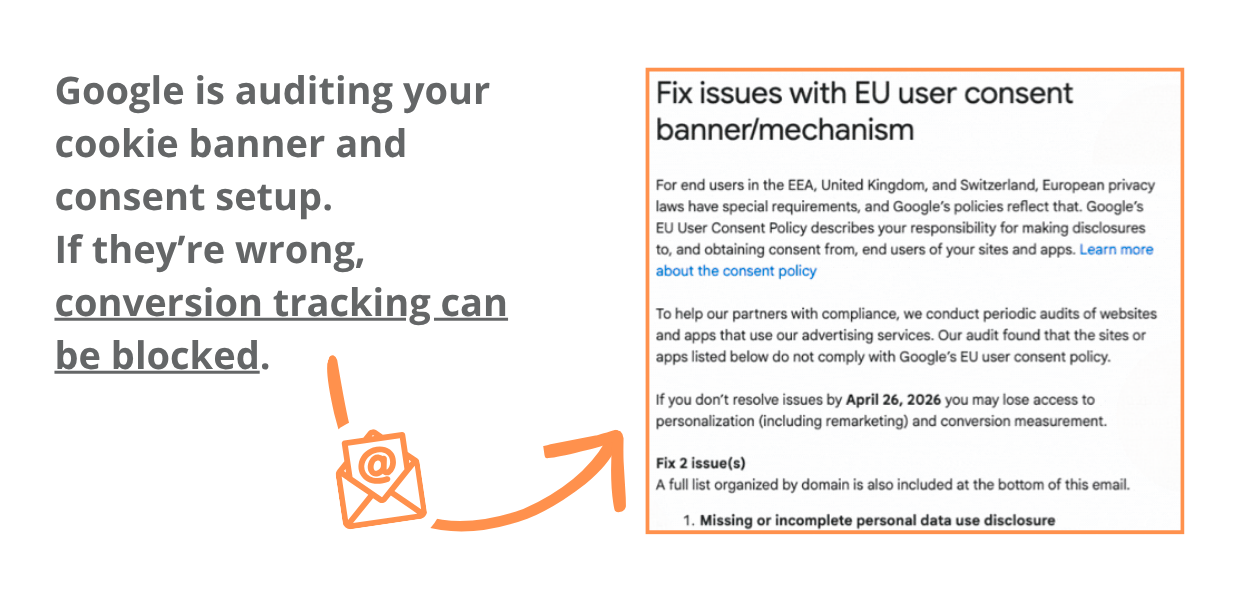
Google is actively auditing cookie consent, and it’s no longer a theoretical risk. If your consent setup doesn’t meet Google’s EU User Consent Policy, you can lose both ad personalization and conversion tracking in the EEA, UK, and Switzerland. For anyone running serious Google Ads programs in Europe, this is now a core part of account risk management, not a legal side-note.
This isn’t just about “being compliant.” It’s about whether your bidding models, remarketing strategies, and measurement frameworks will continue to function as designed.
What Google is actually enforcing
The enforcement mechanism is quite simple conceptually, and that’s what makes it dangerous: it’s automated and scalable.
Google is effectively checking three things on your site:
First, whether you have a valid consent mechanism in place. That can be a cookie banner or a Consent Management Platform (CMP), but it must be clearly visible, not half-hidden, and must actually gate tracking. If Google cannot detect a meaningful consent experience, you are already in a risky position.
Second, whether cookies and tags fire before consent is given. This is where most advertisers fail in practice. A lot of implementations still allow Google tags (via hard-coded scripts or GTM) to run on page load, then try to “retrofit” consent with configuration changes. From Google’s perspective, that’s the wrong way around: consent must be the precondition for firing non-essential tags, not an afterthought.
Third, whether the banner and associated documentation are transparent enough. Google is looking for explicit disclosure of ads personalization and the use of cookies or mobile identifiers for advertising purposes, not just vague references to “analytics and improvements.” It also expects a clear link to Google’s Business Data Responsibility documentation, either in the banner itself or, more realistically, in a well-structured privacy policy.
If any of these elements are missing or misconfigured, you can receive a compliance notice with a fixed deadline—typically around two months. Miss that deadline, and Google can restrict ad personalization and conversion tracking for your account in the affected regions.
Why this hits Google Ads performance so hard
From a pure campaign logic standpoint, there are three main impact areas: attribution, optimization, and audiences.
Attribution is the most obvious. When conversion tracking is disabled or heavily restricted, your data in Google Ads and GA4 starts to fragment. Bid strategies switch from optimizing on robust, first-party conversion signals to working with partial or modeled data. That transition may be survivable in low-volume accounts, but for performance-driven setups with many campaigns and complex structures, you lose the fine-grained feedback loops that make automated bidding effective.
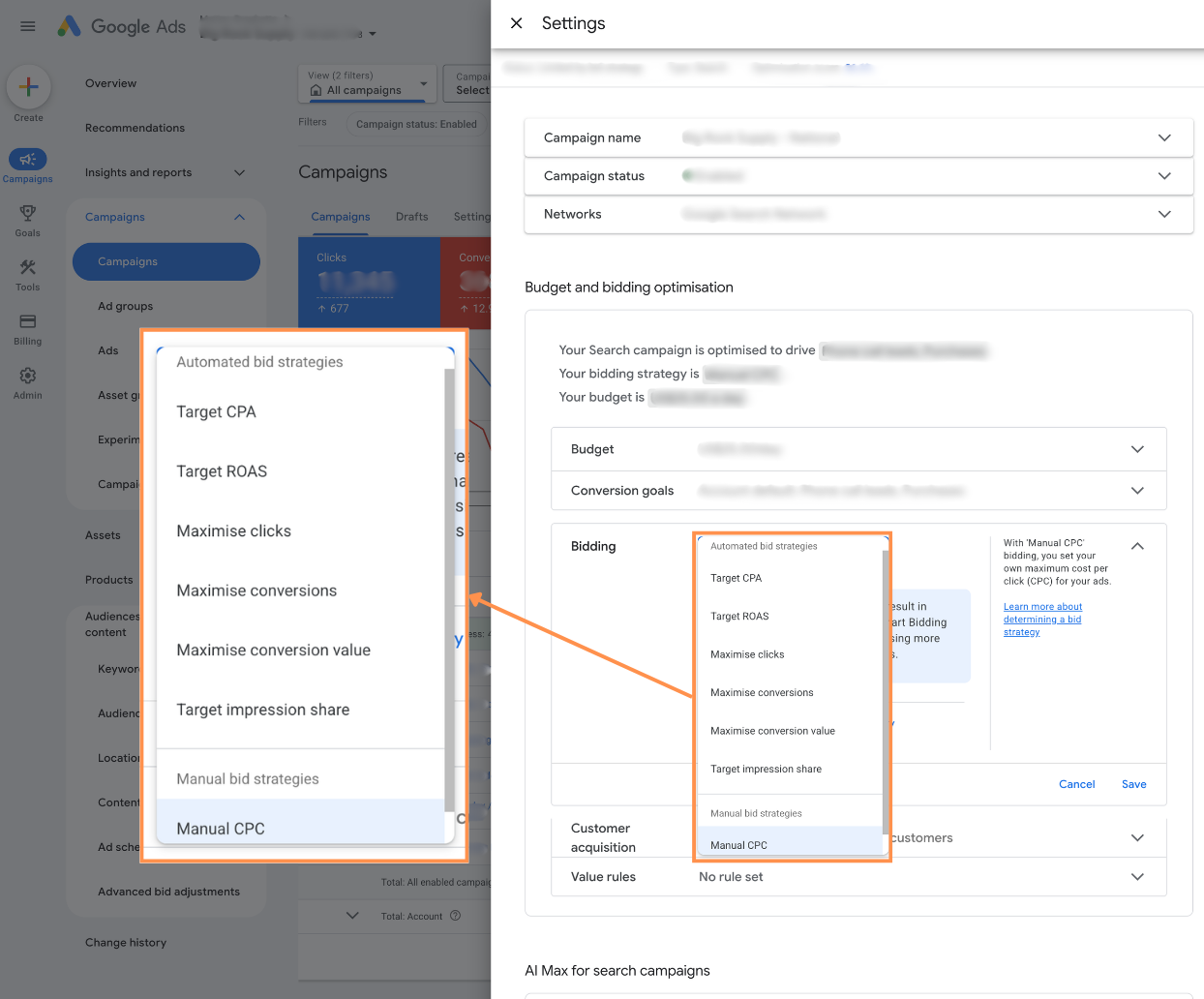
Optimization then degrades over time. Smart Bidding strategies like Target ROAS or Target CPA are only as good as the signals you feed them. If Google disables or limits conversion tracking in the EEA, your bidding models effectively become blind in those markets. You’ll see more volatility, slower learning, and a higher dependence on proxy metrics like clicks or sessions, which are much weaker indicators of business value.
Audience strategies are the third casualty. Restrictions on ad personalization hit remarketing lists, customer match audiences, and similar audiences (where still applicable or in legacy setups). That means fewer users in your high-intent segments, weaker frequency control, and more generic delivery. For accounts that rely heavily on RLSA, cart abandoner lists, or lifecycle-based segments, this is not a minor inconvenience; it fundamentally changes how you can structure and scale campaigns in Europe.
In short, non-compliance can quietly dismantle the core levers that advanced Google Ads programs rely on, even if your budgets and creatives stay exactly the same.
Where consent implementations usually break
In practice, the technical failures are often mundane, but their consequences are strategic.
The first recurring issue is cookies firing on page load. This is particularly common with Google Tag Manager. A “page view – all pages” trigger attached to your Google Ads or GA4 tags, without proper consent conditions, will fire regardless of user choice. Even if your banner appears instantly, the tags may already have set cookies or sent hits. From a compliance standpoint, the damage is done before the user has any meaningful ability to consent.
The second failure point is language that is too narrow or incomplete. Many banners still talk about “analytics cookies” and “improving our website experience” but never explicitly mention advertising, profiling, or ads personalization. Under Google’s policy, the user must be clearly informed that their data may be used to personalize ads and build or use advertising audiences. If that’s not stated clearly, the consent you collect is not considered valid for ad personalization.
The third is documentation that’s technically present but practically invisible. You might have a privacy policy that includes a link to Google’s Business Data Responsibility page, but if it’s buried under several layers of navigation or written in a way that doesn’t clearly map to your cookie banner, you’re in a grey zone. Google is looking for a coherent, discoverable explanation of how its services use data on your site, not just a token link added to tick a box.
Even when a CMP is in place, these gaps are common. Many organizations assume that buying a “GDPR-compliant” tool solves the problem. In reality, the risk often lies in how that tool is configured, how it integrates with GTM, and whether the actual wording and logic align with Google’s specific policy expectations.
Strategic implications for PPC teams
For performance marketers, this isn’t just a legal or technical issue to delegate. It changes how you think about risk in your measurement stack.
First, it raises the importance of resilient conversion frameworks. If your entire bidding strategy depends on a single, fragile implementation of browser-based conversion tracking, you are exposed. Server-side tagging, enhanced conversions, and consent-aware tracking setups are no longer “nice to have experiments”; they are part of business continuity planning for your data.
Second, it forces closer collaboration between PPC, analytics, and legal/compliance teams. The days when the media team could operate independently of privacy considerations are over in Europe. You need shared ownership of the consent experience, the wording, and the technical triggers that control tags.
Third, it changes how you interpret performance trends. If conversion volume drops in the EEA while impressions and clicks remain stable, you now have to consider consent enforcement as a potential cause, alongside market conditions or creative fatigue. A sudden loss of remarketing volume or audience size should also trigger a consent and policy review, not just a bid or budget adjustment.
Finally, it nudges advertisers toward more privacy-aligned strategies. That includes a greater reliance on first-party data collected transparently, clearer value exchanges with users, and a measurement strategy that accepts some level of aggregation and modeling as a structural reality, not a temporary inconvenience.
Looking ahead
Google’s enforcement of its EU User Consent Policy is a signal of where the broader ecosystem is heading: fewer shortcuts, more scrutiny, and a tighter coupling between privacy compliance and advertising performance.
For practitioners, the question is no longer whether to adapt, but how deliberately and how early. Those who treat consent as a strategic component of their Google Ads infrastructure—rather than a compliance checkbox—will be in a much stronger position as the next wave of privacy and platform changes arrives.

As a Google Ads expert, I bring proven expertise in optimizing advertising campaigns to maximize ROI.
I specialize in sharing advanced strategies and targeted tips to refine Google Ads campaign management.
Committed to staying ahead of the latest trends and algorithms, I ensure that my clients receive cutting-edge solutions.
My passion for digital marketing and my ability to interpret data for strategic insights enable me to offer high-level consulting that aims to exceed expectations.
Google Partner Agency
We're a certified Google Partner Agency, which means we don’t guess — we optimize withGoogle’s full toolkit and insider support.
Your campaigns get pro-level execution, backed by real expertise (not theory).
4.9 out of 5 from 670+ reviews on Fiverr.
That’s not luck, that’s performance.
Highly recommend Matteo to set up your server side tracking. He has a deep understanding of e-commerce tracking and will go above and beyond to make sure everything is set up correctly and working 100%. If you are scaling your store this set up is non-negotiable in my opinion and there isn't many people who have this much knowledge or put the effort in to get it right. Thanks again!

avorodesign.com
I can only recommend Matteo! He was very patient, professional and very knowledgeable about GA4, Consent Mode v2, and GDPR compliance. Communication was clear, and the setup was done professionally and efficiently. Highly recommend him for anyone needing reliable tracking implementation.

www.natureiki.life
Matteo shines in the realm of online professionals. His work is not only deep in data but also complemented by his proactive communication and cooperation, setting a new standard for freelancers. If you want someone who truly exceeds expectations, look no further. Highly recommended!

www.omanbeverlysmyth.com
Exceptional Service Beyond Expectations - Outstanding Service Impeccable depth, flawless delivery, and exceptional language fluency—this service exceeded all expectations. Highly recommended. Matteo truly ROCKS!!!

ium-paris.com
Top-notch, always highly value working with Matteo. An absolute Google Ads Genius. This is approximately the 8th time I have hired him and he's helped us get 6-7 ROAS. We are excited in continuing to improve our lead flow. Hire this guy if you need Google Ads help. Thanks Matteo!

www.dleeventgroup.com
I finally found the guy who can setup server side tracking and all the ecosystem properly. I definitely recommend Matteo. He is very responsive, kind and wants to dig into things. He configured GA4, Meta, Google Ads, Outbrain and google consent v2 with Cookiebot. Thanks Matteo.

inomega.fr
MB Adv delivered exceptional work with outstanding professionalism and lots of patience, taking time to see effects of changes made and not just do the work and submit it. The proactive communication and video summaries of the work completed made working with Matteo a pleasure, as he consistently went above and beyond. Highly recommended for web analytics projects! We are already working on another project.

www.withnellsensors.co.uk
Working with Matteo on my Google Ads was a game-changer. He's not just a strategist, he's a true partner. He understood my goals and tailored a campaign that perfectly reached my target audience. I'm grateful for his expertise and dedication.

dccargo.com
Click-driven mind
with plastic-brick obsession.
We build Google Ads campaigns with the same mindset we use to build tiny brick worlds: strategy, patience, and zero tolerance for wasted pieces.
Data is our blueprint. Growth is the only acceptable outcome.