How to use the new Google ads performance max “your data exclusions” setting to separate acquisition from retention and improve incrementality
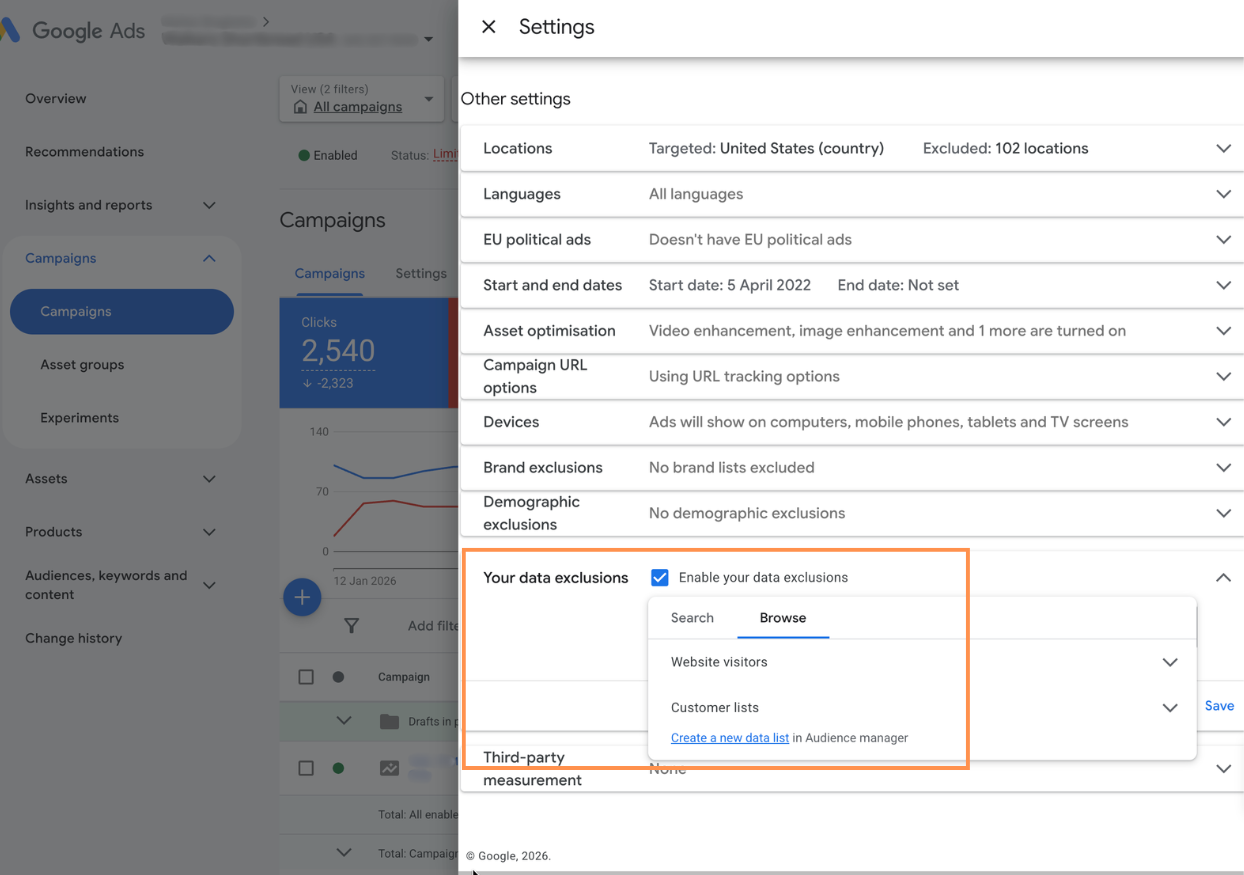
Google Ads quietly shipped a small but important change to Performance Max: a new “Your data exclusions” setting at the campaign level. It looks minor in the UI, but it has real implications for how you structure acquisition vs. retention, how you think about incrementality, and how you diagnose what PMax is actually doing.
This is not the old “Data exclusions” feature for conversion outages. It’s a separate control that lets you exclude your own first‑party audiences from a Performance Max campaign: remarketing lists and Customer Match lists.
For anyone who has been fighting PMax’s tendency to chase the easiest conversion, this is a welcome lever.
What “Your data exclusions” changes in practice
Until now, the default behavior of Performance Max has been to happily lean on your first‑party signals whenever they’re available. Feed it a bunch of high‑intent audiences, and it will do what machine learning does best: exploit them.
That’s useful when you’re trying to maximize total conversions at a blended CPA or ROAS. But it’s unhelpful when your strategic goal is incremental, net‑new customer acquisition.
The new “Your data exclusions” setting introduces a structural distinction:
- You can still upload and use first‑party data across the account.
- You can now tell a specific PMax campaign to ignore some or all of those lists when deciding who to show ads to.
In other words, you’re no longer forced to choose between “PMax with all first‑party data baked in” and “PMax with no meaningful audience signals.” You can keep your overall account strategy intact while ring‑fencing certain campaigns to stay away from known users.
From a campaign‑design perspective, this finally supports a cleaner separation between:
- Prospecting‑focused Performance Max (explicitly excluding existing customers or warm leads), and
- Retention or cross‑sell/upsell activity (which can still happily lean on those lists).
Where to find it and what you can actually exclude
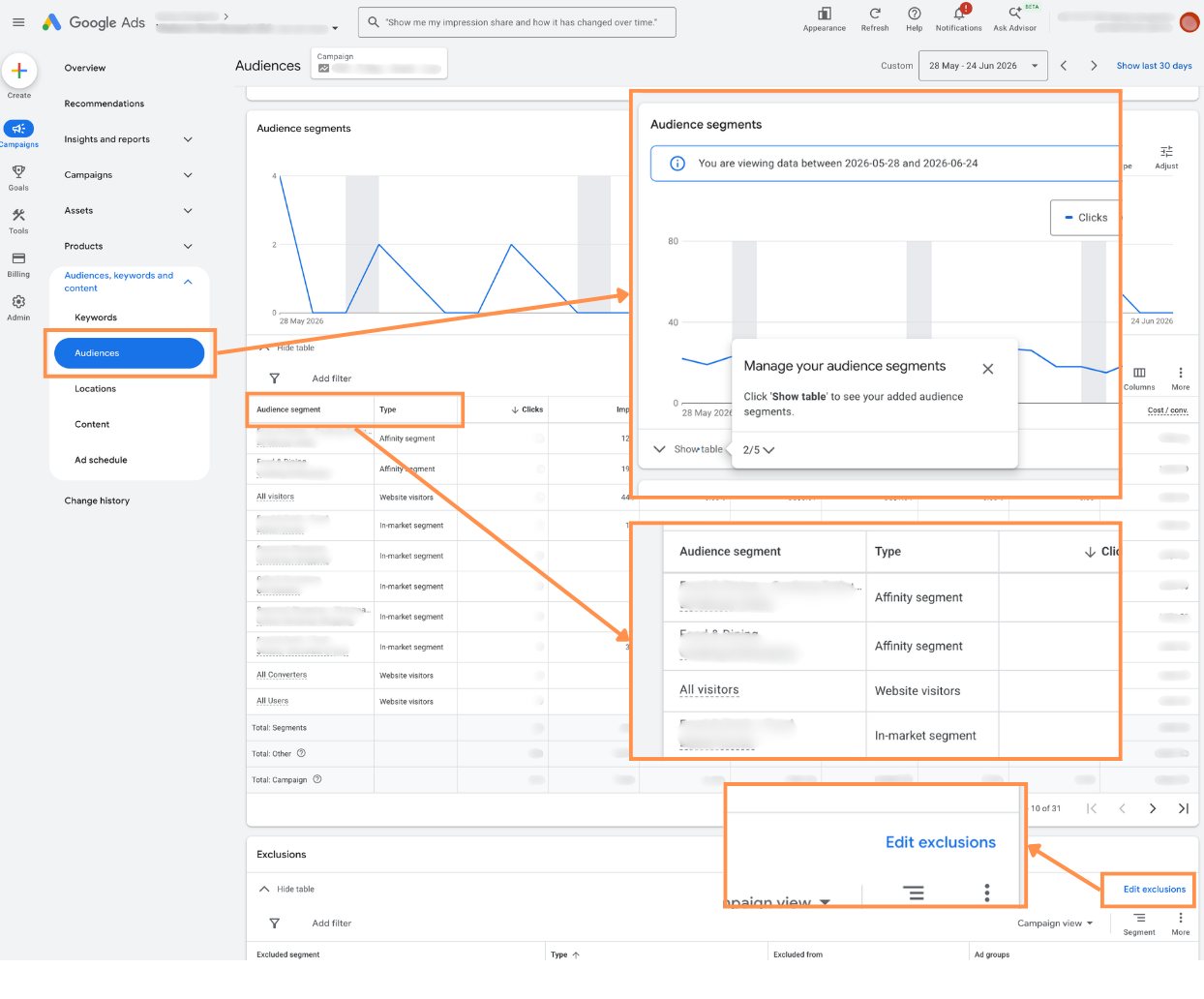
In the Performance Max campaign settings, under the audiences area, you’ll now see a “Your data exclusions” section. The options are straightforward: you can exclude your own first‑party audiences at the campaign level, specifically remarketing lists and Customer Match lists.
In practical terms, that means you can keep the following out of a given PMax campaign:
- Site visitors and app users (remarketing lists built from tags or app events)
- Past purchasers or high‑value customers (Customer Match lists from CRM or offline data)
- Lead lists (uploaded email lists of MQLs, SQLs, or closed‑won customers)
The exclusions work at the campaign level, not the asset group level. That’s an important nuance: you’re making a strategic decision about the role of the entire PMax campaign in your funnel, not micro‑tweaking segments inside it.
If you want some asset groups to prospect and others to retarget, you still need separate campaigns. “Your data exclusions” is designed to support that separation, not replace it.
Why this matters for incrementality
The main value here is not “more control” in the abstract. It’s about incrementality: understanding what conversions PMax is truly adding versus what it is simply capturing from people who would have converted anyway.
Performance Max is extremely good at finding users who are already close to the bottom of the funnel. If you feed it a rich Customer Match file of recent purchasers, or a remarketing list of cart abandoners, it will eagerly spend there because those users are cheap to convert. That’s optimal for the algorithm’s objective, but not necessarily for your business objective.
By excluding first‑party audiences from a prospecting‑oriented PMax campaign, you’re forcing the system to work harder:
- It cannot lean on your highest‑intent lists.
- It must find new people who look like the right fit but are not already in your database or recent site activity.
- The resulting conversions are more likely to be incremental, new‑to‑file customers.
The trade‑off is obvious: CPAs will usually look worse when you remove the “easy wins” from your denominator. But the quality of those conversions, in terms of net‑new revenue and long‑term growth, is often higher. Having a native way to implement this trade‑off, rather than relying on workarounds, is a step forward.
Budget efficiency and the “cheap conversion” trap
One of the more subtle problems with Performance Max is that it can distort your budget allocation by over‑optimizing for cheap, high‑intent conversions that sit very close to your first‑party data.
In blended reporting, that looks fantastic: CPAs drop, ROAS spikes, and dashboards are green. But under the surface, you might be:
- Paying to re‑acquire customers who would have come back via organic, direct, or email.
- Starving genuine prospecting efforts because they can’t compete with the short‑term efficiency of retargeting.
- Over‑crediting PMax for revenue that is primarily driven by brand equity or lifecycle marketing.
“Your data exclusions” gives you a way to protect a portion of your budget from this dynamic. You can run a Performance Max campaign that is deliberately less “efficient” in the short term, because it’s not allowed to chase the cheapest conversions from your own lists.
This is especially relevant for brands with strong repeat behavior. If your existing customers are heavy repeat purchasers, PMax will naturally gravitate toward them. Excluding those audiences in an acquisition‑focused campaign helps ensure your paid search and paid shopping budgets are not just recycling the same users.
Cleaner testing and diagnostics
From a measurement standpoint, the new setting is also useful for structuring cleaner tests.
Previously, if you wanted to compare “PMax with first‑party audiences” vs. “PMax without,” you had to play games with audience signals, separate accounts, or aggressive negative audiences elsewhere. None of that produced a clean read, because PMax would still find ways to overlap with your warm users through other signals.
Now you can design a more controlled setup:
- Campaign A: Performance Max with no first‑party audience exclusions (full‑funnel behavior, likely to include a lot of warm users).
- Campaign B: Performance Max with key first‑party lists excluded (primarily prospecting, limited re‑engagement).
You can then compare:
- Differences in CPA/ROAS.
- New‑to‑file customer rate (if you can match back to CRM).
- Overlap in paths to conversion when you look at attribution or conversion path reports.
No, this still doesn’t turn PMax into a transparent, line‑item channel you can fully dissect. But it does give you a more interpretable experiment: you’re explicitly instructing the system to avoid specific audiences, which makes performance differences easier to attribute to audience composition rather than random model behavior.
Parallel acquisition and retention strategies
The most compelling use case is when you’re running parallel acquisition and retention strategies inside Google Ads.
A common pattern looks like this:
- A Performance Max campaign focused on prospecting, with “Your data exclusions” applied to all existing‑customer and high‑intent remarketing lists.
- Separate campaigns (PMax, Search, Display, or YouTube) that intentionally target existing customers and high‑value segments using Customer Match and remarketing lists.
The benefits of this structure are straightforward:
- You reduce cannibalization: the acquisition campaign is not free‑riding on your existing customer base.
- You can budget by objective: set distinct targets and budgets for new customer acquisition vs. customer marketing.
- You get clearer reporting: it becomes easier to reason about what share of your spend is going to net‑new growth versus lifecycle monetization.
There will still be gray areas. Users can appear on multiple lists, and Google’s understanding of identity is probabilistic. But the strategic intent is clearer, and that alone makes performance analysis more meaningful.
Limitations and trade‑offs to keep in mind
This is not a magic switch that turns Performance Max into a pure prospecting engine.
A few practical limits are worth acknowledging:
- Excluding first‑party lists doesn’t prevent Google from using similar audiences, lookalike behaviors, or other signals that correlate with your existing users. It only blocks direct targeting of the users on those lists.
- If your first‑party data coverage is thin, the impact of exclusions will be modest. PMax may already be doing a lot of broad prospecting out of necessity.
- You’re likely to see higher CPAs and more volatile performance in campaigns that exclude high‑intent lists. That’s not a bug; it’s the cost of chasing harder‑to‑win users.
The key is to align expectations internally. If stakeholders are accustomed to judging channels solely on blended CPA or ROAS, acquisition‑focused PMax with data exclusions will look “worse” on the surface. The conversation has to shift from “cheapest conversion” to “most incremental revenue.”
A small setting with strategic implications
“Your data exclusions” is a small UI tweak that nudges Performance Max a bit closer to how practitioners actually structure growth: with distinct acquisition and retention motions, different budgets, and different performance expectations.
It doesn’t solve every transparency issue, and it doesn’t eliminate the need for careful measurement and CRM‑level analysis. But it does give you a native, campaign‑level way to tell PMax: “This campaign’s job is to find new people, not just harvest the ones we already know.”
Used thoughtfully, that’s a meaningful step toward making Performance Max not just efficient, but strategically aligned with how businesses actually grow.

As a Google Ads expert, I bring proven expertise in optimizing advertising campaigns to maximize ROI.
I specialize in sharing advanced strategies and targeted tips to refine Google Ads campaign management.
Committed to staying ahead of the latest trends and algorithms, I ensure that my clients receive cutting-edge solutions.
My passion for digital marketing and my ability to interpret data for strategic insights enable me to offer high-level consulting that aims to exceed expectations.
Google Partner Agency
We're a certified Google Partner Agency, which means we don’t guess — we optimize withGoogle’s full toolkit and insider support.
Your campaigns get pro-level execution, backed by real expertise (not theory).

4.9 out of 5 from 670+ reviews on Fiverr.
That’s not luck, that’s performance.
Highly recommend Matteo to set up your server side tracking. He has a deep understanding of e-commerce tracking and will go above and beyond to make sure everything is set up correctly and working 100%. If you are scaling your store this set up is non-negotiable in my opinion and there isn't many people who have this much knowledge or put the effort in to get it right. Thanks again!

avorodesign.com
I can only recommend Matteo! He was very patient, professional and very knowledgeable about GA4, Consent Mode v2, and GDPR compliance. Communication was clear, and the setup was done professionally and efficiently. Highly recommend him for anyone needing reliable tracking implementation.

www.natureiki.life
Matteo shines in the realm of online professionals. His work is not only deep in data but also complemented by his proactive communication and cooperation, setting a new standard for freelancers. If you want someone who truly exceeds expectations, look no further. Highly recommended!

www.omanbeverlysmyth.com
Exceptional Service Beyond Expectations - Outstanding Service Impeccable depth, flawless delivery, and exceptional language fluency—this service exceeded all expectations. Highly recommended. Matteo truly ROCKS!!!

ium-paris.com
Top-notch, always highly value working with Matteo. An absolute Google Ads Genius. This is approximately the 8th time I have hired him and he's helped us get 6-7 ROAS. We are excited in continuing to improve our lead flow. Hire this guy if you need Google Ads help. Thanks Matteo!

www.dleeventgroup.com
I finally found the guy who can setup server side tracking and all the ecosystem properly. I definitely recommend Matteo. He is very responsive, kind and wants to dig into things. He configured GA4, Meta, Google Ads, Outbrain and google consent v2 with Cookiebot. Thanks Matteo.

inomega.fr
MB Adv delivered exceptional work with outstanding professionalism and lots of patience, taking time to see effects of changes made and not just do the work and submit it. The proactive communication and video summaries of the work completed made working with Matteo a pleasure, as he consistently went above and beyond. Highly recommended for web analytics projects! We are already working on another project.

www.withnellsensors.co.uk
Working with Matteo on my Google Ads was a game-changer. He's not just a strategist, he's a true partner. He understood my goals and tailored a campaign that perfectly reached my target audience. I'm grateful for his expertise and dedication.

dccargo.com
Click-driven mind
with plastic-brick obsession.
We build Google Ads campaigns with the same mindset we use to build tiny brick worlds: strategy, patience, and zero tolerance for wasted pieces.
Data is our blueprint. Growth is the only acceptable outcome.