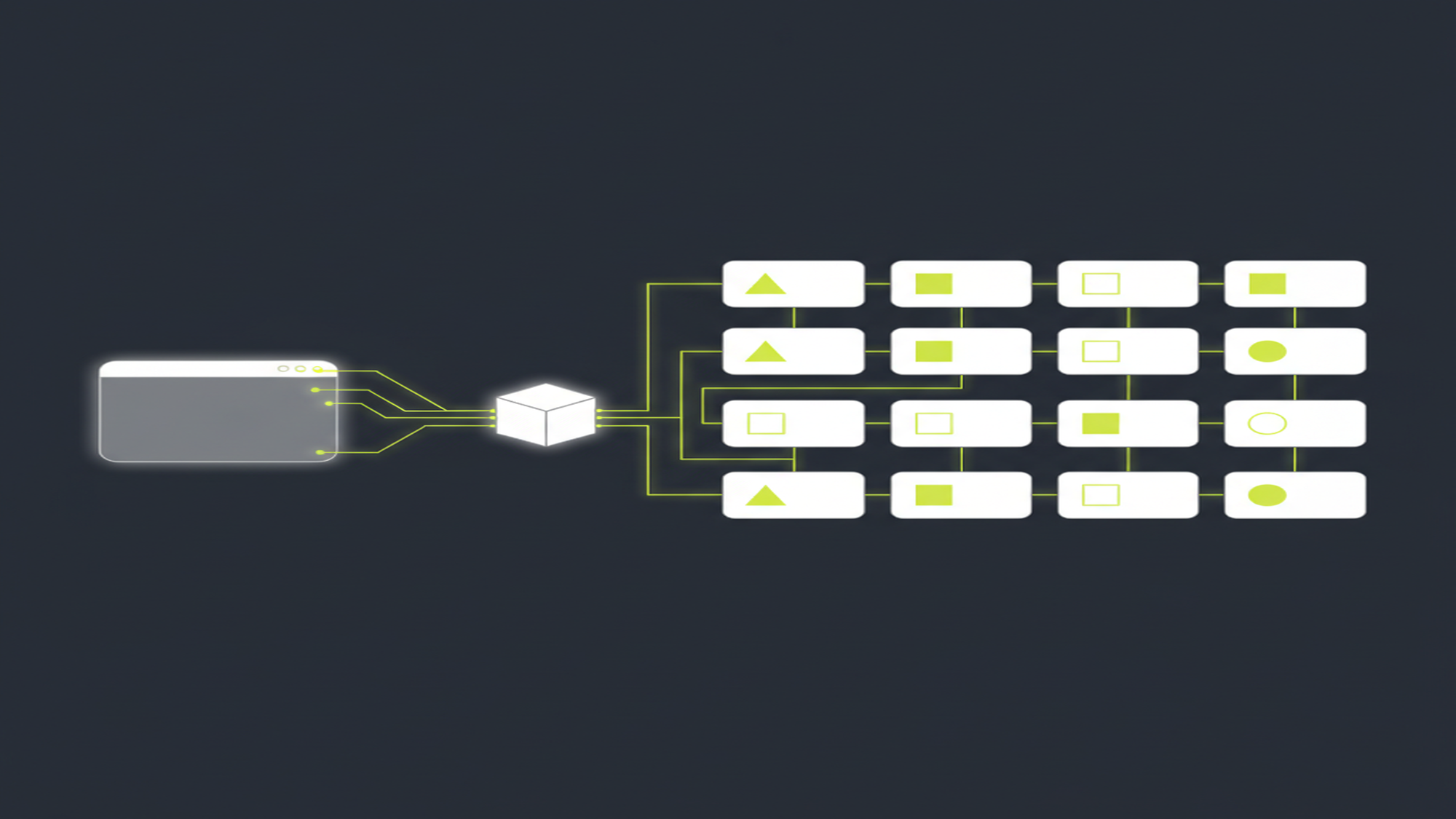
Google Ads Account Structure & Tools Guide

2×
Google can spend up to twice your average daily budget on a single high-traffic day. The monthly ceiling is 30.4× that daily figure — the number that actually bounds your bill.
Source: Google Ads Help — overdelivery and average daily budget, 2026
What Is Google Ads?
Google Ads is Google's paid advertising platform. Advertisers bid in real-time auctions triggered by user searches and pay per click (PPC) when someone clicks their ad. The account is built as a four-level hierarchy — Account, Campaign, Ad Group, Ads/Keywords — and each level controls a distinct set of decisions.
For a first-time advertiser, the platform reduces to three moving parts: a structure that tells Google what to optimize toward, a budget that sets the ceiling, and the ad-and-keyword layer that decides who sees what. Master those three and the rest is configuration. The structure is the strategy — not the keywords, not the bids. Account structure is no longer just an organizational preference. With Smart Bidding and AI Max handling in-campaign optimization, the hierarchy is a signal layer that Google's AI reads to decide which auctions to enter and how hard to bid.
This guide answers the four questions a beginner asks before spending a dollar: what Google Ads is, what PPC means, how an account is structured, and how budgets actually behave. It then covers the two tools — Google Ads Editor and Scripts — that separate agency operators from DIY advertisers. By the end, the decision of whether to run an account in-house or hire someone is grounded in mechanics, not guesswork.
From here, the rest of the cluster goes deeper. Once the account is structured, campaign type determines where ads appear and how Google optimizes delivery. Budget sets the ceiling; bidding strategy determines how that budget is deployed across auctions. This pillar is the orientation layer — the foundational vocabulary every other pillar builds on.
Key Takeaways
- The account hierarchy has four levels. Account holds billing and conversion tracking; Campaign holds budget and objective; Ad Group holds keyword themes; Ads/Keywords holds the message. Each level controls different settings.
- The daily budget is an average, not a hard cap. Google spends up to 2× the daily figure on peak days and underspends on slow ones. The real ceiling is 30.4× the daily budget per month.
- A March 2026 pacing change reshaped Ad Scheduling math. Restricted-schedule campaigns now pace toward the full 30.4× monthly cap, concentrating spend into active days. Set daily budget to target monthly ÷ 30.4.
- Google Ads Editor compresses hours into minutes. The free desktop app bulk-edits campaigns offline. Version 2.12 added brand-safety text guidelines, total-campaign-budget editing, and bulk URL replacement.
- Scripts automate the work nobody wants to do by hand. JavaScript programs run inside an account on a schedule. In 2026, AI coding assistants removed the JavaScript-fluency barrier to building them.
- There is no minimum budget. An account starts at any daily figure the advertiser sets. The barrier to small-business Google Ads is management time, not cost.
Google Ads Account Structure
A Google Ads account is a four-level hierarchy: Account → Campaign → Ad Group → Ads/Keywords. Each level owns a distinct job. Confusion between levels — setting a budget where a keyword belongs, or an audience where a campaign objective belongs — is the most common structural mistake new advertisers make.
The account level holds billing information, conversion actions, the GA4 link, shared audience segments, and brand-safety settings. It does not hold budgets. Wiring conversion tracking correctly here before launching any campaign is non-negotiable: Smart Bidding and AI Max both optimize toward the conversion objective defined at this level. An account with broken tracking trains Google's AI on the wrong signal, and no amount of campaign tuning recovers from that.
The campaign level holds the budget, the campaign type, the bidding strategy, geographic and language targeting, and ad scheduling. The technical limit is 10,000 campaigns per account. In 2026, with Smart Bidding handling in-campaign optimization, the campaign level is where budget allocation and conversion-objective choices carry the most strategic weight. The rule of thumb: one objective per campaign, and separate campaigns for fundamentally different budgets or geographies.
Getting structure right is not about tidiness. It is about giving the machine the correct objective and clean signal boundaries — the campaign level decides what Google optimizes toward, and that decision compounds across every auction.
The ad group level holds keywords for Search, audiences for Display and Demand Gen, ad variants, and individual bids where manual bidding is used. The technical limit is 20,000 ad groups per campaign. Tightly themed groups — 5 to 20 closely related keywords each — inform Quality Score and keep Google's AI working with coherent thematic signals instead of a mixed bag of intent. Ad group structure directly affects Quality Score and Ad Rank, Google's formula for how frequently and where ads show.
The ads and keywords level holds Responsive Search Ads, asset groups for Performance Max, keyword match types, and negative keywords. An RSA accepts up to 15 headlines and 4 descriptions. The discipline here: at least three RSA variants per ad group, and let Smart Bidding test combinations rather than over-pinning. Keyword choices and match types feed the auction directly — the keywords and match types pillar covers that layer in depth. MB Adv Agency has found that the single most reliable predictor of a healthy account is not bid strategy or creative volume — it is whether the ad group themes are tight enough that a stranger reading the ad copy can name the keyword set.
| Level | What lives here | What to configure here | Technical limits |
|---|---|---|---|
| Account | Billing, conversion actions, GA4 link, shared audiences, brand-safety settings | Conversion tracking setup; link GA4 before launching any campaign | 1 account per login (or many via MCC) |
| Campaign | Campaign type, budget, bidding strategy, targeting (geo, language, schedule), ad rotation | One objective per campaign; separate campaigns for different budgets or geos | Up to 10,000 campaigns/account |
| Ad Group | Keywords (Search), audiences (Display/Demand Gen), bids (where manual), ad variants | Tightly themed groups; 5–20 closely related keywords per group | Up to 20,000 ad groups/campaign |
| Ads / Keywords | Responsive Search Ads, asset groups (PMax), keyword match types, negative keywords | ≥3 RSA variants per ad group; let Smart Bidding test combinations | 15 headlines / 4 descriptions per RSA |
Sources: Google Ads Help — account organization; Google Ads Help — account limits.
Google Ads Account & Tools: US Search Volume vs. Keyword Difficulty (May 2026)
| Rule | How it works | $100/day example |
|---|---|---|
| Daily overdelivery cap | Google spends up to 2× your average daily budget on any single high-traffic day | Up to $200 on a peak day |
| Monthly spending cap | Total monthly spend never exceeds daily budget × 30.4 (average days per month: 365 ÷ 12) | Max monthly bill: $3,040 |
| Shared budgets | One budget pool distributed across campaigns; Google shifts spend toward better-performing campaigns | $300/day shared across 3 campaigns redistributes dynamically |
| Ad Scheduling pacing (March 2026) | Google now paces toward the full 30.4× monthly cap even for restricted-schedule campaigns; budget compresses into active days, hitting the 2× daily ceiling each day | Weekday-only: up to $200/day across active days on a $100/day setting. Correct formula: target monthly ÷ 30.4 = daily budget to set. |
Sources: Google Ads Help — overdelivery and average daily budget; Search Engine Land — budget pacing change.

The structure decides the outcome. So does who builds it.
MB Adv Agency builds and manages Google Ads accounts for high-intent lead-gen verticals — correct hierarchy, disciplined budgets, and the Editor and Scripts leverage DIY advertisers skip.
See Legal PPC services →What Is PPC and How Do Budgets Work?
PPC — pay-per-click — is the pricing model behind Google Ads Search: you pay only when a user clicks your ad, not when it is shown. The CPC you pay is set by an auction weighing your bid, your Quality Score, and the estimated impact of ad extensions against every other advertiser competing on that query.
PPC's defining property is not the “pay per click” mechanic — it is measurability at the individual interaction level. Every click generates a traceable event chain: keyword → ad → landing page → conversion (or not). No broadcast channel replicates that. This interaction-level accountability is why Google Ads PPC remains the default starting point for performance budgets. Cost-per-acquisition is calculable before scaling, bids adjust against real conversion data, and spend pauses in hours rather than weeks. A worked example: an ad group running a $4.00 CPC at a 6% conversion rate produces a $66.67 cost-per-conversion ($4.00 ÷ 0.06). Halve the CPC through better Quality Score and the cost-per-conversion drops to $33.33 at the same conversion rate — the math is fully visible before a budget scales.
Now the budget. The daily figure an advertiser sets is an average target, not a hard ceiling. Google spends up to twice the average daily budget on a single high-traffic day to capture demand, and compensates by underspending on slower days. The monthly financial ceiling is 30.4× the daily budget — derived from 365 days ÷ 12 months. Google's own documentation confirms a billing period is never charged more than 30.4 multiplied by the average daily budget.
A $50/day budget does not mean “$50 today.” It means up to $100 on a busy day, less on a quiet one, and a hard ceiling of $1,520 for the month ($50 × 30.4).
These rules governed Google Ads spending for years. What changed in March 2026 is how pacing interacts with Ad Scheduling — campaigns set to run only on certain days or hours. Before the change, a weekday-only campaign at $100/day spent roughly against the number of scheduled days. After it, Google's pacing engine targets the full 30.4× monthly cap regardless of restricted scheduling, concentrating budget into active days and hitting the 2× daily ceiling on each one. The correct formula for any scheduled campaign: target monthly spend ÷ 30.4 = daily budget to set. Dividing by the number of scheduled days systematically over-budgets. MB Adv Agency advises every client running Ad Scheduling to recompute their daily figure against this formula — the pacing change rewrote the arithmetic, and accounts set the old way overspend without breaking a single rule. The reporting that catches this lives in the metrics and KPIs a disciplined account watches weekly.
Manager Accounts: How Agencies Scale
A Manager Account — historically called MCC (My Client Center) — is a single Google Ads login that connects to and manages multiple client accounts. Agencies, multi-location brands, and holding-company teams run it as their operational hub: one place for cross-account reporting, shared negative keyword lists, and monthly invoicing.
The abbreviation MCC remains common practitioner shorthand even though Google's official UI now labels it “Manager Account.” An agency links client accounts under one MCC and nests MCCs inside each other for complex holding structures — a parent manager for the agency, child managers per client portfolio. This is the structural difference between managing one account and managing fifty: the MCC turns a directory of logins into a single command surface. MB Adv Agency runs every client engagement through a Manager Account from day one, because the alternative — juggling separate logins per client — is the operational tax that quietly caps how many accounts a team handles well.
For an in-house marketer managing a single brand, the MCC is optional. For anyone managing a roster — whether an agency serving dental PPC and HVAC PPC clients, or a franchise group running real estate PPC across regions — it is the foundation. Scripts run at the MCC level reach every linked account at once, which is where the tool leverage in the next section compounds. For local market work, PPC management in Austin runs through the same Manager Account structure.
Google Ads Editor and Scripts: Agency Leverage
Google Ads Editor is a free desktop application for bulk-editing campaigns offline. Scripts are JavaScript programs that run inside an account on a schedule. Together they are the leverage tools that separate agency operators from DIY advertisers — not because they do anything the UI cannot, but because they compress hours of work into minutes.
Editor lets an operator restructure hundreds of ad groups, swap headlines across campaigns, run find-and-replace on destination URLs, and upload every change at once when ready. No agency managing more than three accounts runs bulk operations through the web UI. Version 2.12 shipped in March 2026 with text guidelines for brand safety (up to 25 term exclusions plus 40 messaging restrictions per campaign, applied to AI-generated assets), total-campaign-budget editing, bulk URL replacement for broken destinations, 15 videos per Performance Max asset group, 9:16 portrait images for YouTube Shorts placements, and account-level default tracking templates. These are not cosmetic additions — brand-safety guidelines keep AI creative legally compliant at scale, and bulk URL replacement turns a site migration from a week of manual edits into an afternoon.
Scripts automate the work nobody wants to do by hand: budget pacing alerts, N-gram analysis for negative keyword discovery, Quality Score tracking to Google Sheets, and bid adjustments driven by external data like weather APIs or inventory feeds. Standard single-account scripts time out at 30 minutes; Manager Account scripts default to 30 minutes and extend to 60 when using the executeInParallel() method with a callback, which processes accounts in parallel rather than serially. The 2026 shift is decisive: AI coding assistants removed the JavaScript-fluency barrier. A practitioner who describes the automation in plain language — flag any campaign that has spent more than 80% of its monthly budget before the 20th — receives working script code without writing JavaScript from scratch. Scripts-based automation, once the province of technical specialists, is now open to any operator willing to invest an hour or two. For a plumbing PPC or roofing PPC account where demand spikes with weather, a weather-triggered bid script is the difference between catching a storm's lead surge and missing it.
Two Misconceptions That Cost Beginners Money
Two beliefs stop small businesses from running Google Ads well: that the platform is too expensive and complex for them, and that the daily budget is a hard cap. Both are false, and both are grounded in misreadings of how the system works.
“Google Ads is too expensive or too complicated for a small business.” The cost objection confuses average CPCs with minimum entry cost. There is no minimum budget — an account starts at any daily figure the advertiser sets. The complexity objection is real but bounded: the hierarchy has four layers, and a single-product business needs only two of them, Campaign for budget and objective, Ad Group for keyword theme. The harder question is not whether a small business can afford to run Google Ads — it is whether it can afford the time to manage it competently. An account left unoptimized for 90 days wastes budget as reliably as a bad structure does. The case for hiring an agency is opportunity cost, not complexity. That trade-off is sharpest in high-value verticals like financial services PPC and fashion PPC, where a wasted month is expensive.
“My daily budget is a hard cap — if I set $50/day, I spend exactly $50.” The daily budget is an average target. On high-traffic days Google spends up to 2× it ($100 on a $50/day setting); on slow days it underspends to compensate. The monthly cap of 30.4× the daily budget is the actual financial ceiling. After the March 2026 pacing change, a scheduled campaign hits the 2× ceiling on every active day — a $50/day weekday-only campaign spends $100/day across its scheduled days and delivers a monthly bill the advertiser did not anticipate. Set daily budgets against the monthly target, not against a per-day intuition. For market-specific setups, see Flagstaff HVAC PPC, Missoula legal PPC, and Missoula plumbing PPC.
Frequently Asked Questions
What is Google Ads?
Google Ads is Google's paid advertising platform. Advertisers bid in real-time auctions triggered by user searches and pay per click (PPC) when a user clicks their ad. The account hierarchy runs four levels deep — Account, Campaign, Ad Group, and Ads/Keywords — with each level controlling a different set of settings. Campaigns set the budget and objective; ad groups organize keywords by theme; ads deliver the message. In 2026, Google's AI (Smart Bidding, AI Max) handles in-campaign optimization, but the structure, budget, and conversion objectives are still set by the advertiser. An account runs up to 10,000 campaigns simultaneously, with a technical ceiling of 20,000 ad groups per campaign. The platform's defining trait is measurability: every click ties back to a keyword, an ad, and a landing page, which makes cost-per-acquisition calculable before spend scales.
What is PPC?
PPC — pay-per-click — is the pricing model used by Google Ads and most search advertising platforms: you pay only when a user clicks your ad, not when it is shown. The CPC you pay is determined by an auction against other advertisers targeting the same keyword, weighted by Ad Rank (your bid multiplied by Quality Score and the expected impact of ad extensions). The practical benefit: unlike broadcast or display advertising billed by impression, PPC ties every dollar of spend to a traceable interaction. A worked example shows why this matters: at a $4.00 CPC and a 5% conversion rate, each conversion costs $80 ($4.00 ÷ 0.05). Improve the conversion rate to 8% and the cost-per-conversion falls to $50 at the same CPC. That arithmetic is visible before scaling, which is why performance budgets default to PPC.
How does a Google Ads campaign budget work?
You set an average daily budget. Google spends up to 2× that amount on high-traffic days and underspends on slow days to compensate. The monthly ceiling is 30.4× your daily budget — the actual financial cap, derived from 365 days ÷ 12 months. After a March 2026 pacing change, campaigns using Ad Scheduling are paced toward the full 30.4× monthly cap regardless of how many days they run, so spend concentrates at the 2× daily ceiling on every scheduled day. The correct formula to set a daily budget: divide your target monthly spend by 30.4, not by the number of scheduled days. Worked example: to spend $3,000/month, set $98.68/day ($3,000 ÷ 30.4). Setting it as $3,000 ÷ 20 weekday-only days gives $150/day — which paces toward $4,560/month, a 52% overspend against the target.
What is Google Ads Editor and why do agencies use it?
Google Ads Editor is a free desktop application for bulk-editing campaigns offline. It lets an operator restructure ad groups, swap headlines across hundreds of campaigns, run find-and-replace on destination URLs, and upload all changes at once when ready — operations that consume hours in the browser UI. Version 2.12 (March 2026) added text guidelines for brand-safety enforcement on AI-generated assets, total-campaign-budget editing, account-level default tracking templates, bulk URL replacement for broken links, and expanded Performance Max support including 15 videos per asset group and 9:16 portrait images. Agencies use Editor for any task involving more than a handful of campaigns at once, because the time saved scales linearly with account size. For a manager handling three or more campaigns simultaneously, Editor is not a convenience — it is the difference between a workflow that scales and one that does not.
What are Google Ads Scripts?
Google Ads Scripts are JavaScript programs that run inside a Google Ads account or Manager Account on a schedule. They automate repetitive tasks — budget pacing alerts, N-gram analysis for negative keyword discovery, Quality Score tracking to Google Sheets, and bid adjustments based on external data like weather or inventory feeds. Standard single-account scripts run up to 30 minutes; Manager Account scripts default to 30 minutes and extend to 60 minutes when using the executeInParallel() method with a callback. In 2026, AI coding assistants lowered the barrier substantially: a non-developer describes the automation in plain language and receives working script code without writing JavaScript from scratch. The domain knowledge still matters — iterating the output against the Google Ads data model requires understanding the account — but the time from idea to deployed script dropped by an order of magnitude, opening automation to any practitioner willing to invest an hour.
What is an MCC or Manager Account?
A Manager Account — historically called MCC (My Client Center) — is a single Google Ads login that connects to and manages multiple client accounts from one place. Agencies, multi-location brands, and holding-company teams use it for cross-account reporting, shared negative keyword lists, and consolidated monthly invoicing. The abbreviation MCC stays in practitioner use even though Google's UI now reads “Manager Account.” An agency links client accounts under one MCC and nests MCCs for complex holding structures. The operational advantage compounds with Scripts: a script run at the MCC level reaches every linked account simultaneously, so one piece of automation monitors an entire client roster. For a single-brand in-house marketer the MCC is optional; for anyone managing a portfolio it is the foundation that keeps account management from collapsing into a pile of separate logins.
Deciding between DIY and hiring out?
The question is rarely whether you can run Google Ads — it is whether the opportunity cost of your time clears the bar. MB Adv Agency will tell you straight.
Talk to MB Adv →Methodology
This pillar synthesizes verified 2026 mechanics from primary sources. Account hierarchy and technical limits come from Google Ads Help. The 2× overdelivery and 30.4× monthly cap come from Google's average daily budget documentation; the March 2026 Ad Scheduling pacing change from Search Engine Land and Swipe Insight. Editor v2.12 features come from Google Ads Editor release notes; Scripts limits from the Scripts developer docs. Search demand figures are from Ahrefs, May 2026. MB Adv commentary is qualitative. Last updated June 2026. Reviewed by MB Adv Agency, June 2026.

As a Google Ads expert, I bring proven expertise in optimizing advertising campaigns to maximize ROI.
I specialize in sharing advanced strategies and targeted tips to refine Google Ads campaign management.
Committed to staying ahead of the latest trends and algorithms, I ensure that my clients receive cutting-edge solutions.
My passion for digital marketing and my ability to interpret data for strategic insights enable me to offer high-level consulting that aims to exceed expectations.
Google Partner Agency
We're a certified Google Partner Agency, which means we don’t guess — we optimize withGoogle’s full toolkit and insider support.
Your campaigns get pro-level execution, backed by real expertise (not theory).

4.9 out of 5 from 670+ reviews on Fiverr.
That’s not luck, that’s performance.
Highly recommend Matteo to set up your server side tracking. He has a deep understanding of e-commerce tracking and will go above and beyond to make sure everything is set up correctly and working 100%. If you are scaling your store this set up is non-negotiable in my opinion and there isn't many people who have this much knowledge or put the effort in to get it right. Thanks again!
avorodesign.com
I can only recommend Matteo! He was very patient, professional and very knowledgeable about GA4, Consent Mode v2, and GDPR compliance. Communication was clear, and the setup was done professionally and efficiently. Highly recommend him for anyone needing reliable tracking implementation.

www.natureiki.life
Matteo shines in the realm of online professionals. His work is not only deep in data but also complemented by his proactive communication and cooperation, setting a new standard for freelancers. If you want someone who truly exceeds expectations, look no further. Highly recommended!

www.omanbeverlysmyth.com
Exceptional Service Beyond Expectations - Outstanding Service Impeccable depth, flawless delivery, and exceptional language fluency—this service exceeded all expectations. Highly recommended. Matteo truly ROCKS!!!

ium-paris.com
Top-notch, always highly value working with Matteo. An absolute Google Ads Genius. This is approximately the 8th time I have hired him and he's helped us get 6-7 ROAS. We are excited in continuing to improve our lead flow. Hire this guy if you need Google Ads help. Thanks Matteo!

www.dleeventgroup.com
I finally found the guy who can setup server side tracking and all the ecosystem properly. I definitely recommend Matteo. He is very responsive, kind and wants to dig into things. He configured GA4, Meta, Google Ads, Outbrain and google consent v2 with Cookiebot. Thanks Matteo.

inomega.fr
MB Adv delivered exceptional work with outstanding professionalism and lots of patience, taking time to see effects of changes made and not just do the work and submit it. The proactive communication and video summaries of the work completed made working with Matteo a pleasure, as he consistently went above and beyond. Highly recommended for web analytics projects! We are already working on another project.

www.withnellsensors.co.uk
Working with Matteo on my Google Ads was a game-changer. He's not just a strategist, he's a true partner. He understood my goals and tailored a campaign that perfectly reached my target audience. I'm grateful for his expertise and dedication.

dccargo.com
Click-driven mind
with plastic-brick obsession.
We build Google Ads campaigns with the same mindset we use to build tiny brick worlds: strategy, patience, and zero tolerance for wasted pieces.
Data is our blueprint. Growth is the only acceptable outcome.