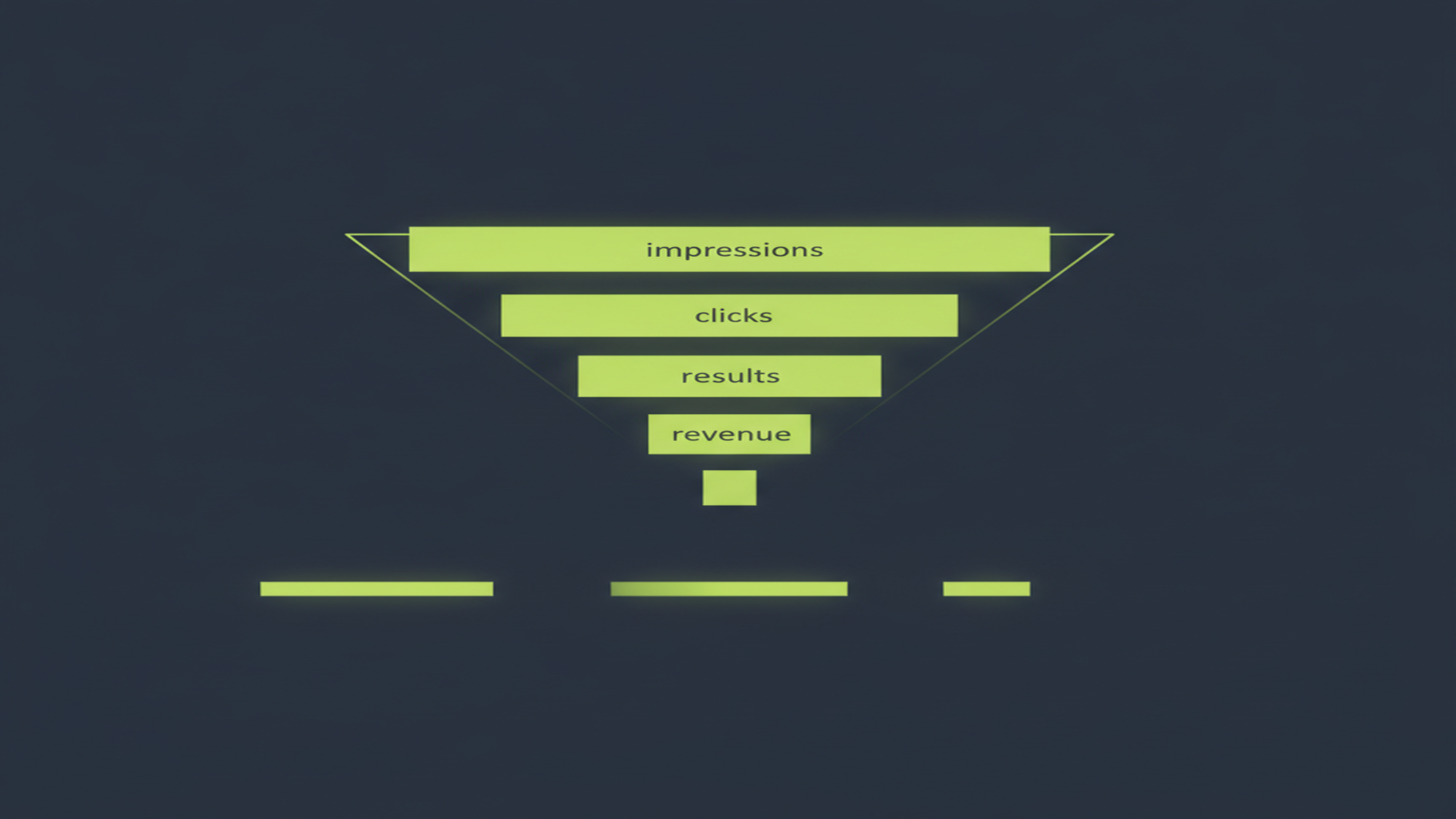
Meta Ads Account Structure 2026: Campaign, Ad Set, Ad

50
Optimization events per ad set per week required to exit Meta's learning phase. Below this threshold an ad set enters “learning limited” status — delivery is unstable and splitting budget across more ad sets makes it worse, not better.
Source: Meta Business Help Center; Pigeon Digital 2026; Modern Marketing Institute 2026
Meta Ads Account Structure: Campaigns, Ad Sets & Ads
A Meta Ads account is built on three nested levels — a meta ad structure that determines who sees your ads, what they cost, and how much control you keep. The Campaign sets the objective — the single most consequential decision in the account, and the only one locked permanently on launch. The Ad Set controls who sees the ad (audience), where (placements), when (schedule), and how much is spent (budget). The Ad holds only the creative: image or video, primary text, headline, call-to-action, and destination URL. Each level hands the delivery algorithm a distinct input; misconfiguring the top level cascades through everything below it.
This structure is a control tree, not a folder system. Meta's delivery engine reads the campaign objective to determine which machine learning model to deploy, reads the ad set to define the audience pool and optimization event, then uses the ad's creative to predict which users within that pool are most likely to engage. A campaign set to “Traffic” when the business goal is purchases trains the system to maximize cheap link clicks, not sales. The fix requires rebuilding the campaign under the Sales objective — editing an existing campaign's objective is not possible after launch.
Before structuring an account, understand what the platform is — see what Meta Ads are and how the auction works. For a breakdown of the six objectives available at the campaign level, see Meta Ads campaign objectives.
Getting Started with Meta Ads Manager
Meta Ads Manager is the dedicated campaign-building interface where campaigns, ad sets, and ads are created, edited, and reported on. It is separate from Meta Business Suite (the day-to-day dashboard for posts and messages) and from the Business Portfolio (the admin layer for ownership and permissions). Ads Manager is accessed at facebook.com/adsmanager or through the Business Portfolio's left-hand navigation.
The “Boost Post” button on a Facebook Page is not an entry point to Ads Manager — it is a different, structurally shallower product. Boosting creates an ad without the campaign-objective menu, granular audience controls, placement selection, or optimization event choices that Ads Manager exposes. An advertiser who has only boosted posts has never made an objective decision, never chosen placements, and never set an optimization event. Switching from boosting to structured campaigns in Ads Manager is not a settings change; it is a rebuild from scratch. For DTC and e-commerce advertisers making this transition, see Fashion PPC services and Supplements & Nutrition PPC services.
Key Takeaways
- Three levels, three decisions. Campaign = objective (locked on launch). Ad Set = audience, placements, schedule, budget, optimization event. Ad = creative only. Each level feeds the algorithm a distinct input.
- The objective cannot be changed after launch. Choosing “Traffic” instead of “Sales” trains the system to maximize link clicks. The only fix is a new campaign under the correct objective.
- Budget sits at two possible levels. Advantage campaign budget (CBO) pools spend at the campaign level; Meta distributes it in real time. Ad-set budgets (ABO) pin spend per audience. Meta defaults to CBO for new campaigns since 2024.
- 50 optimization events per week is the learning-phase threshold. Each ad set needs 50 events weekly to exit the learning phase. Splitting budget across too many ad sets divides event volume and keeps each one in “learning limited” status.
- Meta recommends 1–3 ad sets per campaign. The 2026 structural direction is consolidation: fewer, larger ad sets with more creative diversity per ad set — not granular interest-based segmentation.
- “Business Manager” is now “Business Portfolio.” Meta rebranded the admin ownership layer in 2024. The structural role — owning ad accounts, Pages, pixels, billing — is unchanged. Meta Business Suite remains the day-to-day working dashboard.
- Account limits are not the real constraint. Standard accounts allow 5,000 campaigns, 5,000 ad sets, and 5,000 active ads. The binding limit for most SMBs is the active-ad ceiling tied to monthly spend: under €100K/month, only 250 active ads are permitted.
50
Optimization events/week per ad set to exit the learning phase
6
ODAX objectives in Meta Ads (consolidated from 11 in 2023)
11.7%
Average CPA improvement with Advantage+ placements vs. manual selection (Meta, 2026)
1–3
Ad sets per campaign recommended by Meta in 2026 for most account types
The Three-Level Meta Ads Hierarchy: What Is Configured at Each Level
The Campaign, Ad Set, and Ad levels are not organizational containers — each controls a distinct category of decisions and hands the delivery algorithm a different input. The campaign level is the root: its objective is the only setting in the entire account that cannot be changed after launch.
| Level | Controls | Key settings at this level | Locked after launch? |
|---|---|---|---|
| Campaign | The outcome Meta optimizes toward | Objective (one of six ODAX); Advantage campaign budget on/off; special ad category; buying type (Auction or Reach & Frequency) | Objective: yes — cannot be changed after launch |
| Ad Set | Who, where, when, how much | Audience (demographics, interests, custom, lookalike, Advantage+); placements; schedule; budget (when campaign-level Advantage campaign budget is off); optimization event; bid strategy | No |
| Ad | The creative message | Format (image, video, carousel, collection, Instant Experience); primary text; headline; description; CTA button; destination URL; UTM parameters | No |
The ad level has no audience, no budget, and no objective — all three decisions are locked at the levels above it. Creative testing at the ad level improves the message delivered to a given audience; it cannot override a wrong objective at the campaign level or a mis-targeted audience at the ad set level. The campaign objective is the most consequential and least reversible structural decision in the account.
Service businesses running lead-generation campaigns should confirm the objective is set to Leads or Sales before launching — not Traffic, which trains the system toward link clicks rather than form fills. For legal and professional-services advertisers, see Legal PPC services; for dental practices, see Dental PPC services; for financial advisors, see Financial Services PPC.
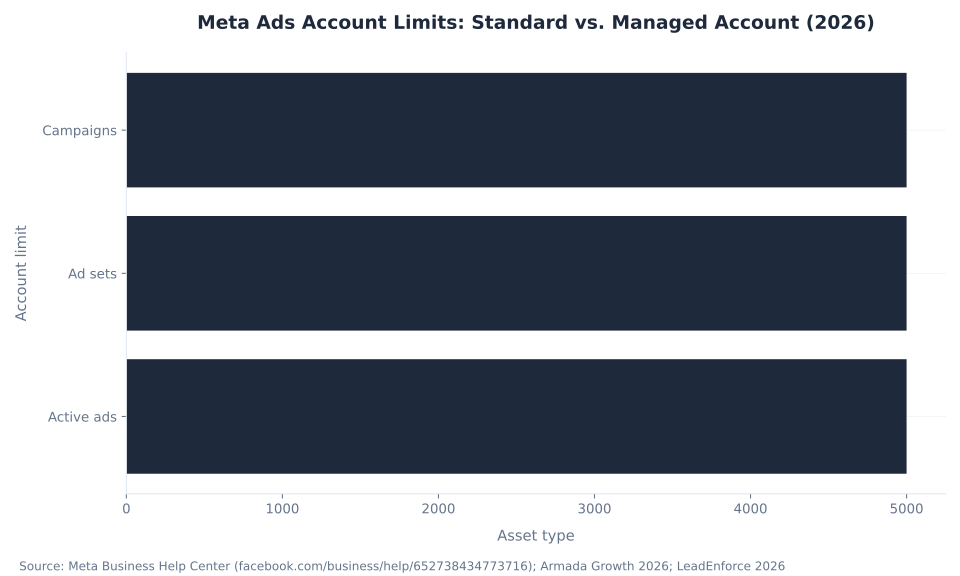
Meta Ads Account Limits: Standard vs. Managed Account (2026)
A standard Meta ad account holds up to 5,000 campaigns, 5,000 ad sets, and 5,000 active ads. A managed account — assigned a dedicated Meta account manager — expands to 10,000 campaigns, 10,000 ad sets, and 50,000 active ads. Meta counts both active and inactive assets toward these ceilings: paused campaigns and archived ads consume quota.
| Asset | Standard account | Managed account |
|---|---|---|
| Campaigns | 5,000 | 10,000 |
| Ad sets | 5,000 | 10,000 |
| Active ads | 5,000 | 50,000 |
| Ad sets per campaign | ≤50 recommended | ≤50 recommended |
| Ads per ad set | 50 | 50 |
| Custom audiences | 500 | 500 |
| Lookalike audiences | 500 | 500 |
| Dynamic creative ads | 1,000 | 1,000 |
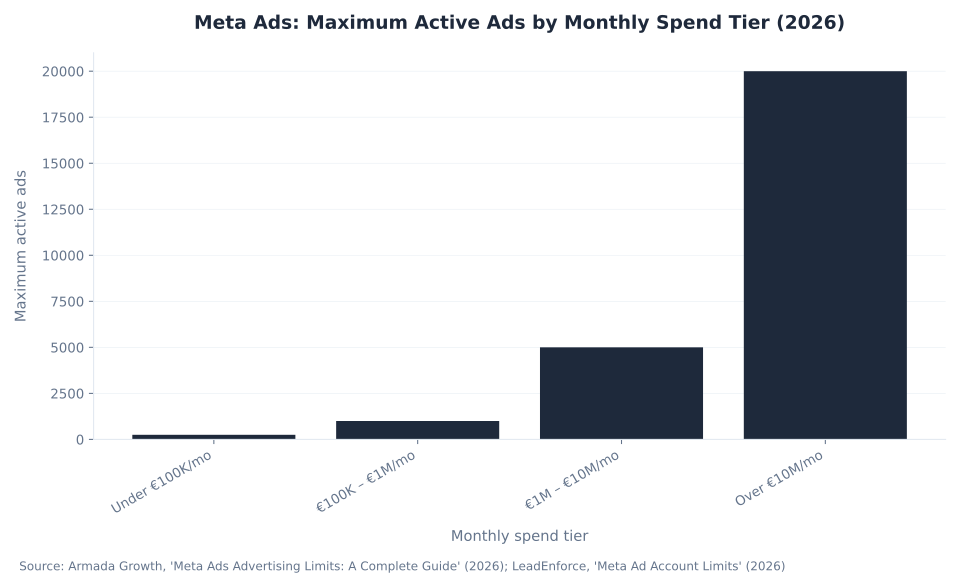
A more binding ceiling for most SMB accounts is the active-ad cap tied to monthly spend. This applies to all account types regardless of structural limits. Most SMBs operate under the under-€100K/month tier and face a hard cap of 250 active ads — well below the 5,000 structural ceiling but easily exhausted by accounts running untrimmed legacy campaigns.
| Monthly ad spend | Maximum active ads |
|---|---|
| Under €100,000/month | 250 |
| €100,000 – €1,000,000/month | 1,000 |
| €1,000,000 – €10,000,000/month | 5,000 |
| Over €10,000,000/month | 20,000 |
MB Adv Agency has found that accounts reach structural chaos — duplicate audiences, overlapping ad sets bidding against each other, untracked legacy campaigns — long before approaching any numeric platform limit. The discipline failure arrives at 50 active ads, not 5,000. Structural hygiene (naming conventions, archived legacy campaigns, consolidated ad sets) matters more than the headroom the platform provides. For local service businesses managing Meta accounts across multiple service areas, see PPC management in Austin and PPC management in Chicago.
Business Portfolio vs. Meta Business Suite: The Surrounding Structure
The Campaign → Ad Set → Ad hierarchy runs inside an ad account, which sits inside a Business Portfolio (formerly Business Manager). Meta Business Suite is a separate day-to-day working dashboard layered on top. These are four distinct layers — and conflating them is the most common onboarding confusion for first-time Meta advertisers.
| Layer | Function | What lives here | Legacy name |
|---|---|---|---|
| Business Portfolio | Ownership & access | People & permissions; partners; ad accounts; Pages; pixels/datasets; catalogs; payment methods; billing | Business Manager (pre-2024) |
| Ad Account | Runs ads, carries spend | Campaigns → ad sets → ads; payment method assignment; account-level audiences; Meta Pixel | Ad account |
| Meta Business Suite | Day-to-day operations | Posts, messages, scheduling, notifications, light analytics across Facebook and Instagram | Business Suite |
| Ads Manager | Campaign building & management | Campaign/ad set/ad creation; reporting; audience management; A/B tests; Automated Rules | Ads Manager |
Meta officially announced the Business Manager → Business Portfolio rename in 2024. The structural job — owning ad accounts, Pages, pixels, and managing partner access — is unchanged; only the label shifted. A new Business Portfolio starts with a limit of 2 ad accounts, increasing as spending history and account trust accumulate. Meta caps individuals at 2 Business Portfolio accounts per person.
The practical distinction readers consistently conflate: the Portfolio handles ownership and access (the keys); the Suite handles day-to-day operations (the driving). Ads Manager is a third layer entirely — it lives inside the ad account and is where campaigns are actually built and managed. A business owner uses Business Suite for organic content without ever opening Ads Manager; an advertiser uses Ads Manager constantly and the Suite rarely.
For HVAC and home-services businesses setting up structured Meta accounts for local lead generation, see HVAC PPC services, Plumbing PPC services, and Roofing PPC services. For city-level HVAC campaign setup, see HVAC PPC in Flagstaff.
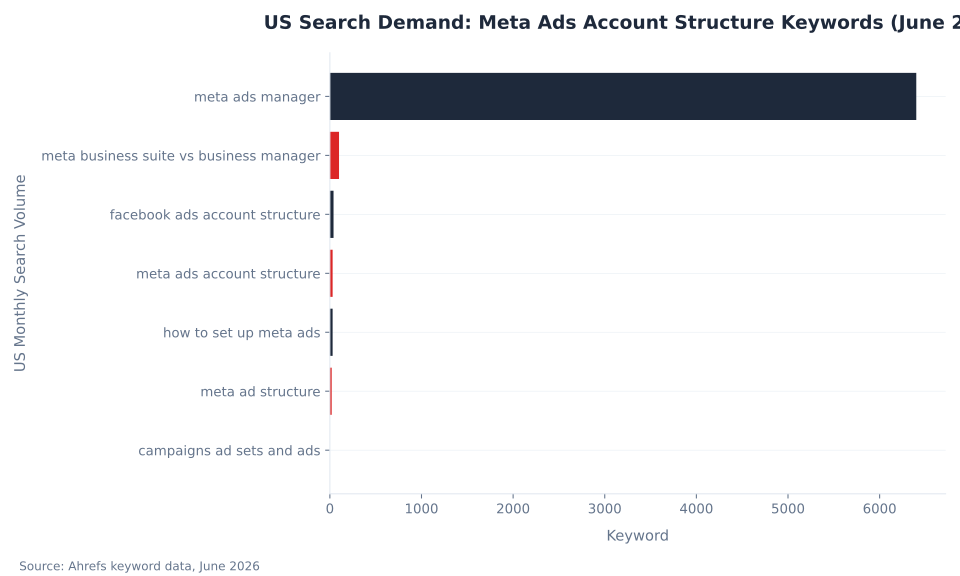
US Search Demand: Meta Ads Account Structure Keywords (June 2026)
The Six Meta Ads Campaign Objectives (ODAX, 2026)
Meta consolidated 11 legacy objectives into 6 under the “Outcome-Driven Ad Experiences” (ODAX) framework in 2023; the 6-objective interface is fully rolled out as of 2026. Each objective tells Meta’s algorithm which machine learning model to deploy. The choice is locked on launch — choosing the wrong one trains the system toward the wrong outcome from day one.
| Objective | What Meta optimizes toward | Legacy objectives absorbed |
|---|---|---|
| Awareness | Reach, brand recall, video views | Brand Awareness, Reach, Video Views |
| Traffic | Link clicks, landing page views | Traffic |
| Engagement | Post interactions, Page likes, event responses, messages | Engagement, Messages |
| Leads | Form fills, Messenger/WhatsApp leads, calls | Lead Generation |
| App Promotion | App installs, in-app events | App Installs |
| Sales | Conversions, catalog sales, store traffic | Conversions, Catalog Sales, Store Traffic |
Any content referencing “Brand Awareness,” “Reach,” “Video Views,” or “Catalog Sales” as top-level selectable objectives is stale — those are sub-options or optimization events within the six ODAX objectives, not standalone campaign types. The objective chosen at campaign creation cannot be changed after launch. To switch objectives, duplicate the campaign under the new objective and archive the original.
For service businesses where the primary goal is lead generation, Leads is the correct objective — not Traffic, which trains the system to maximize link clicks. For e-commerce advertisers with a functioning pixel and conversion history, Sales is the correct objective. See Meta Ads campaign objectives for a full breakdown of which of the six to use by business type, and Meta Ads audience targeting for how the ad set level refines who sees each campaign.
Meta Ads Account Limits: Standard vs. Managed Account (2026)
Ad Set Settings: Audience, Placements, Budget & Optimization
The ad set is where the bulk of campaign configuration happens. Six setting categories are controlled here: audience, placements, schedule, budget, optimization event, and bid strategy. Each ad set runs independently within its parent campaign and — when using ad-set budgets — has its own dedicated spend allocation.
| Setting category | What it covers |
|---|---|
| Audience | Demographics (age, gender, location); detailed targeting (interests, behaviors); custom audiences; lookalike audiences; Advantage+ audience (AI-driven — recommended for most objectives in 2026) |
| Placements | Advantage+ placements (automated selection across the full Meta ecosystem — default and recommended) or manual selection across Facebook, Instagram, Messenger, Audience Network, WhatsApp, Threads |
| Schedule | Start date/time; optional end date; dayparting (hour-of-day delivery restrictions — available with lifetime budgets only) |
| Budget & spend | Daily or lifetime budget per ad set — only relevant when Advantage campaign budget is turned OFF at the campaign level |
| Optimization event | The specific action Meta bids toward within the campaign objective (e.g., Purchase, Lead, Landing Page View, ThruPlay) |
| Bid strategy | Lowest cost (default); cost cap (target CPA); bid cap (manual ceiling per action); ROAS goal (Sales objective) |
Audiences are configured at the ad set level but created and stored at the account level in the Audiences section of Ads Manager. A standard account holds up to 500 custom audiences and 500 lookalike audiences — a ceiling that constrains accounts running high-volume retargeting programs, not typical SMBs. See Meta Ads audience targeting for custom audience creation, match-rate considerations, and the 500-audience cap.
Meta Ads: Maximum Active Ads by Monthly Spend Tier (2026)
Meta Ads Placements: Where Ads Appear (2026)
Placements are configured at the ad set level and control which surfaces across the Meta ecosystem the ad appears on. Meta’s Advantage+ Placements product page reports an average CPA improvement of 11.7% compared to manual placement selection. Manual selection remains available for advertisers with surface-specific restrictions.
| Surface | Available placements |
|---|---|
| Feed, Stories, Reels, Marketplace, Search results, In-stream video, Video feeds, Right column | |
| Feed, Stories, Reels, Explore, Explore Home, Search | |
| Messenger | Inbox, Stories |
| Audience Network | Native, banner, interstitial, rewarded video |
| Business Inbox (selected objectives only) | |
| Threads | Feed (selected objectives, limited rollout as of 2026) |
The 11.7% CPA improvement figure is self-reported Meta data from their own product page, not a third-party study. The directional conclusion — automated placement outperforms manual for most objectives — is corroborated by practitioner evidence: restricting placements narrows the delivery pool and limits the algorithm’s ability to find the lowest-cost impression. Advantage+ placements is the correct default; manual selection is justified only when a specific surface consistently produces poor results for a given creative format.
For real estate and financial-services advertisers subject to special ad category restrictions — which limit certain audience targeting and placement options — see Real Estate PPC services and Financial Services PPC services. For legal advertisers navigating similar restrictions, see Legal PPC in Missoula.
Advantage Campaign Budget (CBO) vs. Ad-Set Budget (ABO): When to Use Each
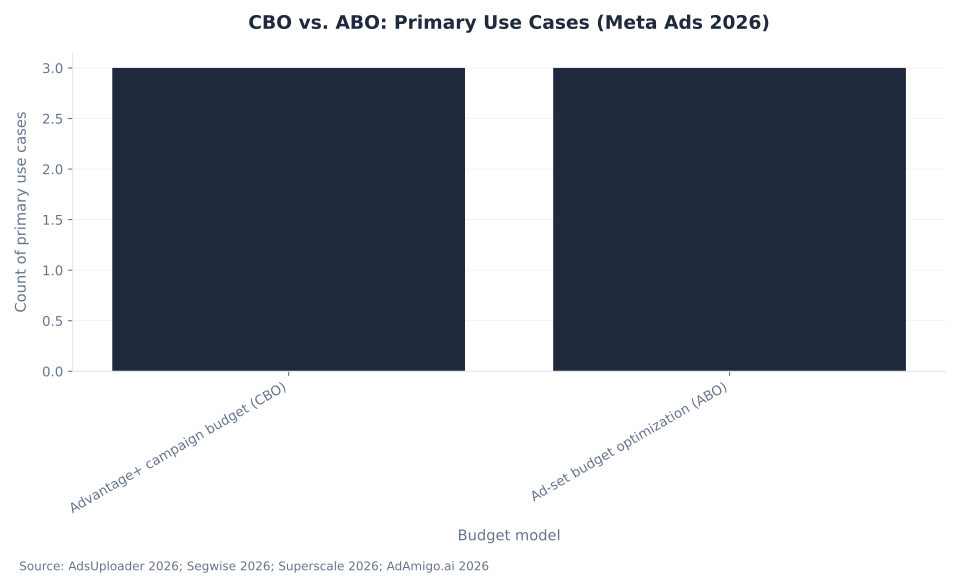
Meta offers two budget models. Advantage campaign budget (CBO) pools one budget at the campaign level and distributes spend across ad sets in real time based on performance. Ad-set budget optimization (ABO) pins a fixed budget per ad set, giving the advertiser direct spend control per audience. Meta defaults to CBO for all new campaigns since 2024; ABO requires a manual override at campaign creation.
| Feature | Advantage campaign budget (CBO) | Ad-set budget optimization (ABO) |
|---|---|---|
| Budget location | Campaign level — one pooled budget | Ad set level — fixed budget per ad set |
| Spend allocation | Meta distributes in real time toward best-performing ad sets | Advertiser controls — each ad set gets its fixed allocation |
| Learning phase impact | Budget concentrates on top performers — easier to reach 50 events/week per ad set | Fixed small budgets risk “learning limited” on underfunded ad sets |
| Meta default (2024+)? | Yes | No — manual override required |
| Best use case | Broad prospecting; scaling proven concepts across similar ad sets; accounts with sufficient conversion volume for the algorithm to read signal | Testing distinct audiences or concepts independently; protecting guaranteed spend on a high-value retargeting list; mandatory spend allocation to a specific geo |
The most common CBO mistake is expecting equitable spend distribution. Meta’s algorithm directs budget toward whichever ad set is performing — a retargeting list with strong historical CVR absorbs most of the budget, starving a cold prospecting ad set that needs time to build signal. The fix is campaign separation, not model switching: give retargeting and prospecting their own campaigns, each with CBO applied to the ad sets within that campaign type.
MB Adv Agency structures Meta campaigns by goal type — prospecting campaigns on CBO with broad audiences, retargeting campaigns on ABO with spend floors per ad set — rather than mixing both types in a single campaign. This separation keeps learning-phase signal clean per objective and prevents the algorithm from cannibalizing retargeting spend to chase prospecting volume. See Meta Ads cost, budgeting, and bidding for bid strategy and ROAS goal details.
How to Set Up Meta Ads: Campaign → Ad Set → Ad
Setting up a Meta Ads campaign follows the same three-level sequence every time: Business Portfolio first, then ad account, then the Campaign → Ad Set → Ad build. Ad accounts created outside a Business Portfolio cannot be transferred to one later — this is the structural error that forces account rebuilds.
- Create a Business Portfolio. Go to business.facebook.com and create a Business Portfolio (formerly Business Manager). Connect your Facebook Page. A new Portfolio starts with a limit of 2 ad accounts; this grows with spending history.
- Set up the ad account. Inside the Portfolio, create an ad account, assign a payment method, and set the account time zone and currency. These settings cannot be changed after creation.
- Install the Meta Pixel / Conversions API. The pixel must record conversion events before launching any Sales or Leads objective campaign. Install the pixel on your website, verify events fire in Events Manager, and confirm at least one optimization event (Purchase, Lead) is recording before creating the campaign.
- Choose a campaign objective. In Ads Manager, click Create → Campaign. Select one of the six ODAX objectives. This decision is locked on launch — confirm the business goal before proceeding. For most SMBs: Leads for lead generation, Sales for e-commerce.
- Configure the ad set. Set audience (Advantage+ audience or custom), placements (Advantage+ recommended), schedule, optimization event, and budget (or enable Advantage campaign budget at the campaign level in step 4).
- Create the ad. Upload creative (image or video), write primary text and headline, select the CTA button, and enter the destination URL with UTM parameters. Add UTM tags here — editing them later resets the ad’s social proof (likes, comments, shares).
- Monitor the learning phase. After launch, track optimization events per ad set per week. Each ad set needs 50 events/week to exit the learning phase. If an ad set enters “learning limited” status, consolidate — increase budget or merge it with another ad set — rather than creating additional ad sets to compensate.
Pixel installation is the prerequisite for conversion campaigns. Running a Sales-objective campaign without the Meta Pixel or Conversions API installed gives the algorithm no signal to optimize toward. It delivers impressions but cannot learn which users convert. Verify purchase or lead events fire correctly in Events Manager before campaign launch.
For pixel installation and conversion event setup, see Meta Pixel and conversion tracking. For roofing and home-services advertisers setting up local lead-gen campaigns from scratch, see Roofing PPC in Flagstaff and Plumbing PPC in Missoula.
CBO vs. ABO: Primary Use Cases (Meta Ads 2026)
Meta Ads structure is the foundation. Getting it wrong costs every campaign that follows.
MB Adv Agency builds and restructures Meta Ads accounts for DTC brands and local service businesses — from Business Portfolio setup to campaign consolidation and learning-phase optimization.
Fashion & DTC PPC management →Andromeda and the 2026 Shift to Structural Consolidation
Meta’s “Andromeda” ad retrieval engine rolled out across most objectives and placements by October 2025 and became the system default by Q1 2026. Meta Engineering reports that Andromeda achieved a +6% recall improvement to the retrieval system and a +8% ads quality improvement on selected segments. These are aggregate system-level figures — per-account variation is wide — but the structural implication for campaign architecture is concrete and consistent across practitioner reporting.
What Andromeda changed for account structure: The engine now evaluates creative first — using format, hook, tone, and subject matter to predict which users are most likely to engage — rather than relying primarily on advertiser-defined audience segments. Interest-based ad set segmentation carries less performance weight than it did in 2022–2023. The signal that used to live in the audience definition now lives in the creative itself.
This shift has a direct structural consequence. The 2021 playbook was: one concept per ad set, each targeting a different interest cluster, CBO optimizing across them. The 2026 playbook is: fewer ad sets with broader audiences, more creative diversity per ad set, and Advantage+ audience or broad targeting as the default. The algorithm finds the audience from the creative; the advertiser’s job is to give it enough creative variation to work with.
Flighted’s 2026 Meta account structure guide states Meta’s own guidance has converged on 1–3 ad sets per campaign for most account types. Accounts with more than 5 active ad sets per campaign in 2026 are building against the algorithm’s current architecture.
The learning phase threshold reinforces the math. An account spending $500/day at a $20 CPA generates 25 conversions/day — 175/week. That is sufficient signal for one ad set to exit the learning phase comfortably, or three ad sets at 58 events/week each. Split across eight ad sets, each receives 22 events/week; each stays in “learning limited” status indefinitely. Pigeon Digital’s 2026 analysis of the learning phase confirms this arithmetic and cites Meta’s Help Center as the source for the 50-event threshold.
MB Adv Agency’s experience restructuring Meta accounts across DTC and lead-gen verticals aligns with this direction: accounts rebuilt from 8–12 ad sets per campaign down to 2–3 consistently produce faster learning phase exits and more predictable delivery curves. The creative library — not audience segmentation — is where meaningful differentiation now lives. For e-commerce advertisers building catalog-driven campaigns, see Furniture PPC services and Beauty Products PPC services.
Three Structural Misconceptions That Cost Meta Advertisers Money
The three most expensive structural mistakes in Meta Ads are rooted in false beliefs about how the account hierarchy works. Each is refutable against Meta’s documented platform behavior.
“More ad sets means more control”
This is false. More ad sets fragment the learning phase. Each ad set needs 50 optimization events per week to exit learning and deliver stable results. An account running 10 ad sets at $100/day total spend with a $20 CPA generates 5 events/day — 35/week — spread across 10 ad sets: 3.5 events per ad set per week. Every ad set stays in “learning limited” indefinitely. The correct structural response is consolidation: 2–3 ad sets that each receive enough budget to generate signal. Creative granularity belongs at the ad level, not the ad set level.
“The budget is set at the campaign level”
This is a half-truth. Budget sits at the campaign level only when Advantage campaign budget (CBO) is enabled. When CBO is off — available via manual override — budget is set per ad set. These two models produce different spend distributions and are not equivalent. An advertiser who switches from ABO to CBO without understanding the difference finds their retargeting ad set starved as the algorithm routes budget toward the higher-volume prospecting ad set. Treating them as the same setting is how accounts either overspend on cold audiences or underspend on retargeting lists with proven CVR.
“Boosting a post is the same as running a Meta Ads campaign”
It is not. The Boost Post button creates an ad without the campaign-objective menu, granular audience controls (no custom audiences or lookalikes via the Boost flow), placement selection, or optimization event choices that Ads Manager exposes. An advertiser who has only boosted posts has never made an objective decision. The structural decisions that determine whether spend produces outcomes — which machine learning model to deploy, which audience pool to draw from, which event to optimize toward — are entirely absent from the Boost flow. MB Adv Agency treats “I’ve boosted posts before” as a starting point for education, not evidence of prior campaign experience. For how properly structured campaigns differ from boosted posts in measurable outcomes, see Dental PPC services and Supplements & Nutrition PPC services.
Frequently Asked Questions: Meta Ads Account Structure
Ready to rebuild your Meta Ads account structure?
MB Adv Agency audits Meta Ads account structure, consolidates fragmented campaigns, and builds the learning-phase environment that moves ad sets from “learning limited” to stable delivery.
Get a Meta Ads structure audit →Methodology
This pillar draws from Meta’s Business Help Center (campaign/ad set/ad limits, objective documentation, Advantage+ placements, ODAX transition), corroborated across Armada Growth (2026), LeadEnforce (2026), AdStellar (2026), Adnabu (2026), Get Ryze (2026), Flighted (2026), AdsUploader (2026), Segwise (2026), Superscale (2026), Pigeon Digital (2026), Modern Marketing Institute (2026), Leadsie (2026), Latitude Social (2026), AgencyAccess (2026), and Meta Engineering’s official Andromeda blog post (December 2024). Meta’s Help Center blocks automated fetch requests; all Meta-sourced figures were corroborated across two or more independent 2026 practitioner sources. Active-ad spend tiers are denominated in euros per Meta’s published source. The Advantage+ placements 11.7% CPA improvement is self-reported Meta data. The Andromeda +6% recall and +8% quality figures are aggregate system-level metrics from Meta Engineering. Keyword search volume from Ahrefs, June 2026. Reviewed by MB Adv Agency, June 2026.

As a Google Ads expert, I bring proven expertise in optimizing advertising campaigns to maximize ROI.
I specialize in sharing advanced strategies and targeted tips to refine Google Ads campaign management.
Committed to staying ahead of the latest trends and algorithms, I ensure that my clients receive cutting-edge solutions.
My passion for digital marketing and my ability to interpret data for strategic insights enable me to offer high-level consulting that aims to exceed expectations.
Google Partner Agency
We're a certified Google Partner Agency, which means we don’t guess — we optimize withGoogle’s full toolkit and insider support.
Your campaigns get pro-level execution, backed by real expertise (not theory).

4.9 out of 5 from 670+ reviews on Fiverr.
That’s not luck, that’s performance.
Highly recommend Matteo to set up your server side tracking. He has a deep understanding of e-commerce tracking and will go above and beyond to make sure everything is set up correctly and working 100%. If you are scaling your store this set up is non-negotiable in my opinion and there isn't many people who have this much knowledge or put the effort in to get it right. Thanks again!
avorodesign.com
I can only recommend Matteo! He was very patient, professional and very knowledgeable about GA4, Consent Mode v2, and GDPR compliance. Communication was clear, and the setup was done professionally and efficiently. Highly recommend him for anyone needing reliable tracking implementation.

www.natureiki.life
Matteo shines in the realm of online professionals. His work is not only deep in data but also complemented by his proactive communication and cooperation, setting a new standard for freelancers. If you want someone who truly exceeds expectations, look no further. Highly recommended!

www.omanbeverlysmyth.com
Exceptional Service Beyond Expectations - Outstanding Service Impeccable depth, flawless delivery, and exceptional language fluency—this service exceeded all expectations. Highly recommended. Matteo truly ROCKS!!!

ium-paris.com
Top-notch, always highly value working with Matteo. An absolute Google Ads Genius. This is approximately the 8th time I have hired him and he's helped us get 6-7 ROAS. We are excited in continuing to improve our lead flow. Hire this guy if you need Google Ads help. Thanks Matteo!

www.dleeventgroup.com
I finally found the guy who can setup server side tracking and all the ecosystem properly. I definitely recommend Matteo. He is very responsive, kind and wants to dig into things. He configured GA4, Meta, Google Ads, Outbrain and google consent v2 with Cookiebot. Thanks Matteo.

inomega.fr
MB Adv delivered exceptional work with outstanding professionalism and lots of patience, taking time to see effects of changes made and not just do the work and submit it. The proactive communication and video summaries of the work completed made working with Matteo a pleasure, as he consistently went above and beyond. Highly recommended for web analytics projects! We are already working on another project.

www.withnellsensors.co.uk
Working with Matteo on my Google Ads was a game-changer. He's not just a strategist, he's a true partner. He understood my goals and tailored a campaign that perfectly reached my target audience. I'm grateful for his expertise and dedication.

dccargo.com
Click-driven mind
with plastic-brick obsession.
We build Google Ads campaigns with the same mindset we use to build tiny brick worlds: strategy, patience, and zero tolerance for wasted pieces.
Data is our blueprint. Growth is the only acceptable outcome.