
Microsoft Ads vs Google Ads: CPC, Reach & Features (2026)

Microsoft Advertising vs Google Ads — 2026 Benchmarks
~33%
lower average CPC on Microsoft Advertising vs Google Ads
NaMedia Experts / Searchlab, Q1 2026 vendor estimates — not mbadv client data
724M
monthly searchers on Microsoft Search Network
~38%
of Microsoft Search Network users never use Google
~6%
of paid-search budgets go to Microsoft — rest to Google
Microsoft Advertising vs Google Ads: What This Comparison Actually Answers
The honest answer to “Microsoft Ads vs Google Ads” is almost never “pick one.” Microsoft Advertising (formerly Bing Ads, rebranded April 2019) reaches ~724M unique monthly searchers on the Microsoft Search Network — Bing, Yahoo, AOL, DuckDuckGo, and Ecosia. About 38% of those searchers (~275M) never use Google at all (Searchlab 2026). That is incremental volume, not a discounted copy of your Google campaigns.
Google dominates global search at roughly 90% market share. That dominance concentrates bidding competition, which raises CPCs. Microsoft Advertising's ~5% global share means thinner auction pressure and a structurally lower clearing price — blended average ~$1.54 per click vs Google's ~$2.96, a delta of ~33–40% on comparable queries (NaMedia Experts / Searchlab, Q1 2026 vendor estimates). The catch: volume is real but not equivalent. A campaign that has maxed out Google impression share does not have a cheaper Microsoft twin — it has a second, smaller, demographically distinct audience to add.
Two specific edges make Microsoft worth running alongside Google for most B2B and lead-gen advertisers. First: structurally lower CPC from thinner competition, most pronounced in B2B SaaS and legal verticals. Second: LinkedIn-profile targeting — the ability to layer by company, industry, job function, and (added June 16, 2026) job seniority. No other search platform offers this. A 45-year-old VP at a mid-market software firm is reachable on Microsoft search by job title at a fraction of what LinkedIn's own native inventory charges per click.
This pillar covers the cost comparison with per-vertical CPC data, reach and audience demographics, the Microsoft-exclusive LinkedIn targeting capability, feature parity in 2026, a decision framework for when to prioritize each platform, budget allocation, and the mechanics of importing a Google Ads account into Microsoft Advertising. New to Microsoft Advertising? Start with what Microsoft Advertising is before comparing platforms. For campaign formats, see Microsoft Ads campaign types.
Key Takeaways
Five facts that change how you allocate paid-search budget between Google and Microsoft.
- Microsoft Advertising averages ~$1.54 blended CPC vs Google's ~$2.96 — a ~33–40% lower rate per click (NaMedia Experts / Searchlab 2026 vendor estimates).
- About 38% of Microsoft Search Network users (~275M globally) do not use Google — Microsoft buys additional reach, not a discounted copy of existing Google campaigns.
- Microsoft is the only search-and-native platform with LinkedIn-profile targeting: company, industry, job function, and job seniority (added June 16, 2026). Google has no equivalent.
- Feature parity between the platforms is closer than older comparisons suggest — Microsoft has Performance Max with new-customer-acquisition goals (generally available early 2026), data-driven attribution, portfolio bidding, and Copilot.
- Importing from Google Ads takes minutes via the Import Center (May 2026), but conversion tracking (UET) does not transfer — it requires a separate tag install and goal rebuild.
~$1.54
Blended avg CPC — Microsoft Advertising
vs ~$2.96 on Google Ads (NaMedia Experts / Searchlab 2026)
~41%
Bing users with HHI ≥$100K
vs broader income spread on Google (Searchlab / Embryo 2026)
~31%
Lower avg cost per conversion vs Google
Blended across industries (NaMedia Experts 2026 vendor avg)
45 yrs
Median Bing user age vs 38 on Google
71% of Bing users are aged 35–65 (Searchlab 2026)
Microsoft Advertising vs Google Ads: Platform Overview
Microsoft Advertising and Google Ads share the same structural DNA — search, shopping, display/native, and Performance Max — but diverge significantly on reach, audience demographics, CPC, and one unique targeting capability. The table below maps the key dimensions; the sections that follow cover each in depth.
| Dimension | Microsoft Advertising (formerly Bing Ads) | Google Ads |
|---|---|---|
| Avg blended search CPC | ~$1.54 — ~33–40% lower (vendor est.) | ~$2.96 (vendor est.) |
| Search network | Microsoft Search Network: Bing, Yahoo, AOL, DuckDuckGo, Ecosia + syndication partners | Google Search + Search partners |
| Native / display | Microsoft Audience Network (MSAN) — ~296M unique monthly users | Google Display Network |
| Monthly reach | ~724M unique monthly searchers; ~38% (~275M) search only on Bing | Dominant global reach |
| Search market share | ~5% global / ~14–17% US desktop | ~90% global |
| Audience skew | Median age 45; 71%+ aged 35–65; 41% HHI ≥$100K; 32% management-level+ | Median age 38; broad / mainstream demographic |
| LinkedIn-profile targeting | Yes — company, industry, job function, job seniority (Microsoft-only) | Not available |
| Performance Max | Yes — incl. new-customer-acquisition goals (GA early 2026) | Yes |
| Share of paid-search budgets | ~6% industry average (NaMedia Experts 2026) | ~94% (majority of spend) |
Naming note: Microsoft Advertising is the current brand name (rebranded from Bing Ads in April 2019). The legacy “Bing Ads” label persists in industry searches and competitor comparisons — this pillar uses it where needed for search-term coverage. Keep the Microsoft Search Network (search inventory: Bing, Yahoo, AOL, DuckDuckGo, Ecosia) distinct from the Microsoft Audience Network / MSAN (native-display inventory) — they are separate surfaces that serve different campaign types.
For account and campaign structure on Microsoft, see Microsoft Ads account structure. For bidding strategy, see Microsoft Ads bidding and budget.
Microsoft Ads Cost vs Google Ads: CPC by Vertical
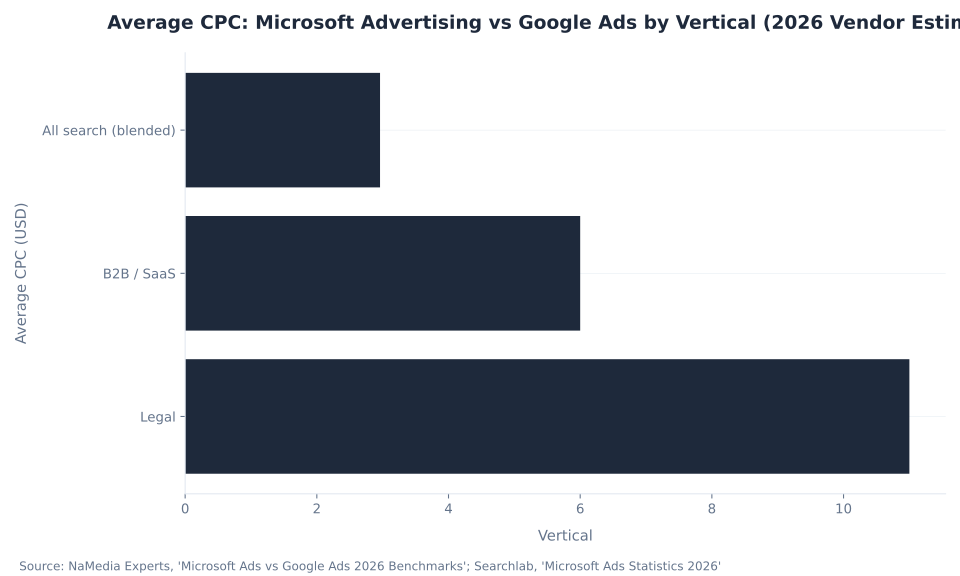
Microsoft Advertising's blended average CPC runs ~$1.54 vs Google's ~$2.96 — a ~33–40% lower rate per click on comparable search queries (NaMedia Experts / Searchlab, Q1 2026 vendor estimates — not mbadv data). The delta holds across most verticals but narrows in highly competitive categories and widens in B2B and legal, where Google's auction is densest.
| Vertical | Google Ads CPC (est.) | Microsoft Advertising CPC (est.) | Approx. delta |
|---|---|---|---|
| All search (blended avg) | ~$2.96 | ~$1.54 | ~33–40% lower |
| Legal | ~$8–14 (personal injury pushes past $20) | ~$5–9 | ~30–40% lower |
| B2B / SaaS | ~$4–8 | ~$2.50–5 | ~30–40% lower |
| Finance & insurance | — | — | ~30–40% lower (vendor characterization; no sourced per-platform absolute figures available) |
Cost per conversion follows a similar pattern. According to NaMedia Experts 2026, average cost per conversion on Microsoft Advertising runs ~31% lower than the equivalent industry on Google Ads — ranging from ~$15 in hospitality to ~$73 in legal. These are vendor-aggregated averages, not a guarantee for any one account.
Misconception: "Microsoft Ads is always about a third cheaper than Google." The ~33% figure is a blended vendor average (and Microsoft's own marketing line), not a fixed discount. The actual delta for any account runs from ~20% to 60%+ depending on the keyword and vertical — in some competitive categories the gap narrows toward parity. A lower CPC is also not automatically a lower cost per acquisition: if search volume on Microsoft is thin for your specific queries, lower CPC and lower conversion volume can produce an equivalent or higher CPL. The correct claim is directional, not precise: Microsoft is typically cheaper per click, by an amount only your own account data confirms. All figures above are third-party vendor estimates — never mbadv client data.
Microsoft Advertising Reach and Search Market Share
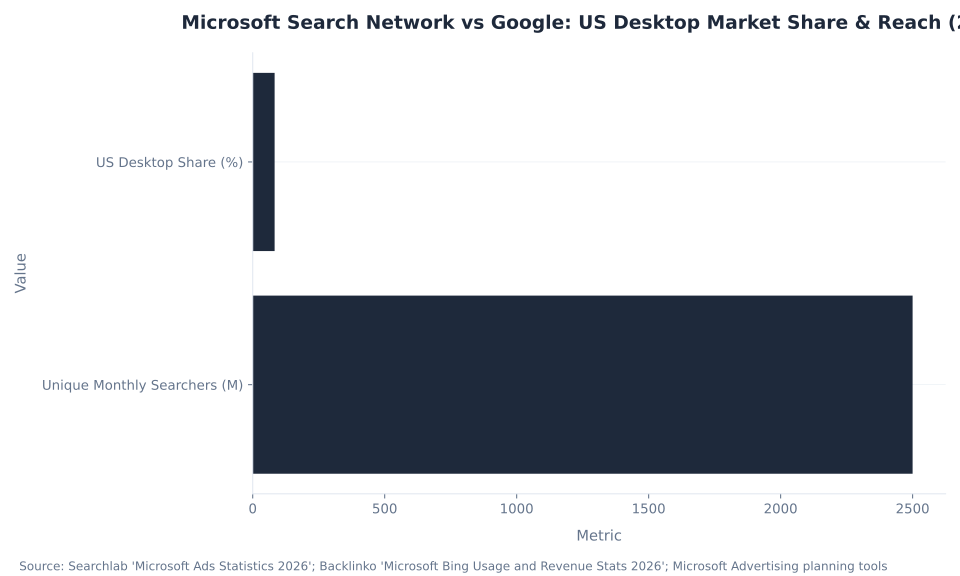
The Microsoft Search Network reaches ~724M unique monthly searchers worldwide across Bing, Yahoo, AOL, DuckDuckGo, and Ecosia (Microsoft Advertising planning data / Searchlab 2026). About 38% of those users (~275M) never use Google — a pool of search demand that Google campaigns cannot access at any price. For advertisers already maxing out Google impression share, that is incremental volume with no Google-side alternative.
| Metric | Microsoft / Bing | |
|---|---|---|
| Unique monthly searchers | ~724M (Microsoft Search Network) | ~2,500M (approx. global est.) |
| Bing-exclusive searchers (don't use Google) | ~38% of MSN users / ~275M globally; ~60M US-only | — |
| Global search market share | ~4–5% | ~90%+ |
| US desktop search share | ~14–17% (Statcounter-sourced range; 14.2% March 2026 / up to 17.58% mid-2026) | ~80%+ |
| Combined Bing + Yahoo US desktop | ~18.7% (Yahoo runs on Bing results) | — |
| Native display reach (MSAN) | ~296M unique monthly users | — |
The "38% Bing-exclusive" figure and the "60M US-only" figure measure different populations — global percentage vs US absolute count. Do not mix them in the same sentence. Backlinko's 2026 Microsoft Bing statistics and Affinco's 2026 Bing statistics are the primary sources for market-share ranges; Microsoft Advertising's own planning tool is the canonical source for the 724M network figure.
The Microsoft Audience Network (MSAN) — the native-display surface — is a separate inventory from search. MSAN reaches ~296M unique monthly users via MSN, Outlook, Microsoft Edge, and partner sites. It runs on image, native, and responsive ad formats and is not included in the 724M search-network count.
Average CPC: Microsoft Advertising vs Google Ads by Vertical (2026 Vendor Estimates)
The Microsoft Advertising Audience: Demographics and Buyer Profile
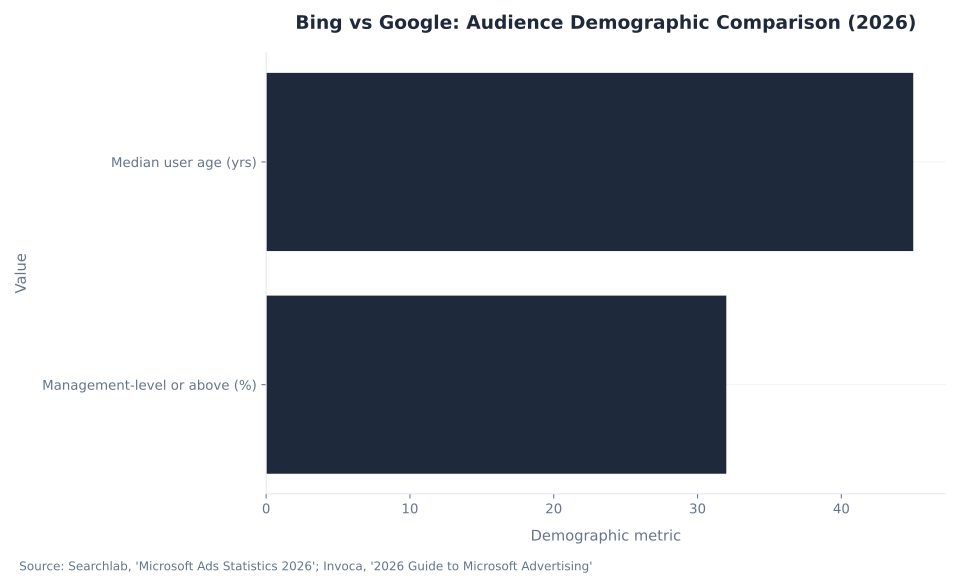
Bing's user base skews older, wealthier, and more senior than Google's mainstream audience. The median Bing user is 45 years old vs 38 on Google; 41% have household income ≥$100K; 32% hold a management-level position or above vs 24% on Google (Searchlab / Invoca 2026). For B2B, financial services, legal, and considered consumer purchases, this is the primary case for Microsoft — not lower CPC.
| Demographic metric | Bing / Microsoft | |
|---|---|---|
| Median user age | 45 years | 38 years |
| Share aged 35–65 | ~71% | Mainstream age spread |
| HHI ≥ $100K | ~41% | Broader income spread |
| Upper socioeconomic bracket | ~58% | — |
| Bachelor's degree or higher | ~59% | — |
| Management-level or above | ~32% | ~24% |
| Time on commercial pages | 35% more than avg search audience | — |
These are platform-level characterizations aggregated by Searchlab 2026 and Embryo from Microsoft Advertising's own audience data. They describe the Bing user base as a whole — any individual campaign's audience depends on keyword intent and targeting settings.
MB Adv Agency has found that B2B advertisers in legal, financial services, and SaaS and software consistently see stronger lead quality from Microsoft Advertising campaigns compared to equivalent Google spend at the same CPL. The age and seniority skew of the Bing audience maps directly onto the buyer profile in these verticals — a B2B campaign targeting directors and VPs reaches a proportionally larger share of its target on Bing than on Google at equivalent CPL thresholds.
For real estate and insurance advertisers, the higher-income skew is the operative factor — buyers researching premium property or high-value policies tend to overindex on Bing's 41% HHI ≥$100K user base.
Microsoft Search Network vs Google: US Desktop Market Share & Reach (2026)
LinkedIn Profile Targeting: The Microsoft-Exclusive Competitive Edge
Because Microsoft owns LinkedIn, Microsoft Advertising is the only search-and-native ad platform that targets by LinkedIn company, industry, job function, and (added June 16, 2026) job seniority. This capability is available in both Search and Audience campaigns, at campaign and ad-group level. Microsoft Advertising Help documents the full targeting interface. Google Ads has no equivalent.
| Targeting dimension | Options | Notes |
|---|---|---|
| Company | Millions of LinkedIn company profiles | Target by employer; enterprise-ABM use case |
| Industry | 150+ LinkedIn industries | Engineering, Finance, IT, Legal, Marketing, Operations, etc. |
| Job Function | Multi-select function list | Cross-filters with Industry |
| Job Seniority | 10 levels (added June 16, 2026) | CXO, VP, Director, Manager, Senior, Entry, Owner, Partner, Training, Volunteer |
| Channel | Approx. B2B CPC (vendor est.) |
|---|---|
| Microsoft Advertising — LinkedIn-profile targeted Search | ~$2–6 per click |
| LinkedIn native ads (Sponsored Content, Message Ads) | ~$8–15+ per click |
The cost gap is the load-bearing B2B argument for Microsoft. An advertiser paying $10–12 per click on LinkedIn's own native inventory to reach IT directors reaches the same job-title segment on Microsoft search — with keyword-level targeting added — at ~$3–5 per click (DigitalApplied vendor estimates). That is not a platform quality judgment; it is an auction-competition differential. LinkedIn native has a minimum CPM floor that search does not.
MB Adv Agency applies LinkedIn profile targeting as a standard layer on every B2B Microsoft Advertising launch — job function plus industry filters typically narrow the served audience by 30–60% while improving lead quality to a degree that offsets the slightly higher CPCs that tighter targeting produces. The net effect on CPL depends on how cleanly the keyword set matches the job-function filter; for IT and managed IT services and SaaS advertisers, the combination consistently outperforms Google-equivalent campaigns on lead quality scores.
Geographic availability (June 2026): Job seniority targeting is live in the US and selected APAC, Americas, and EMEA markets (PPC.land, June 16, 2026). It is not yet available in UK, Germany, France, or the Netherlands as of this writing. Company, industry, and job-function targeting are available in all markets where Microsoft Advertising operates.
Bing vs Google: Audience Demographic Comparison (2026)
Feature Comparison: Microsoft Advertising vs Google Ads in 2026
The “Microsoft is years behind Google on features” narrative is outdated as of 2026. Performance Max with new-customer-acquisition goals is generally available globally (ALM Corp 2026). Data-driven attribution rolled out to all Microsoft Advertising accounts. The capability gap between the platforms is now narrow. The remaining difference is mostly scale of automation and inventory, not missing capabilities.
| Feature | Microsoft Advertising | Google Ads |
|---|---|---|
| Performance Max | Yes — incl. new-customer-acquisition goals (GA early 2026) | Yes |
| Data-driven attribution | Yes — all advertisers (2026) | Yes |
| Smart / automated bidding | Yes — Target CPA, Target ROAS, Max Conversions | Yes |
| Portfolio / cross-account bidding | Yes | Yes |
| LinkedIn-profile targeting | Yes — exclusive to Microsoft | Not available |
| Shopping / feed-based ads | Yes — Microsoft Shopping Campaigns | Yes — Google Shopping |
| Seasonality adjustments | Yes | Yes |
| In-platform AI assistant | Copilot (Microsoft) | Gemini-powered recommendations |
The question is no longer “what can't Microsoft do” — it's “is your buyer searching there, and does the lower clearing price justify the management overhead of a second platform.” On the first question, 724M monthly searchers and a distinct older/higher-income/more-B2B audience say yes for most B2B and lead-gen accounts. On the second, the Search Engine Land 2026 analysis of how Performance Max approaches differ between the platforms notes that Microsoft's auction system works well for advertisers who import Google campaigns and layer in LinkedIn targeting — the import removes most of the setup overhead.
The one capability running in the opposite direction — Microsoft has it and Google does not — is LinkedIn-profile targeting. Framing Microsoft as a feature laggard misreads the 2026 platform state. See Microsoft Ads campaign types for the full rundown of available campaign formats.
Should You Use Microsoft Ads, Google Ads, or Both?
The answer is almost always "both" — but the case for expanding into Microsoft Advertising is strongest under three conditions: (1) your Google Search impression share has plateaued above 70%, (2) your buyer profile skews 35+, management-level, or B2B, or (3) your Google CPCs in legal, B2B SaaS, or financial services have crossed $6 per click and you need a lower-cost incremental source of conversions.
| Scenario | Recommended approach | Why |
|---|---|---|
| New account, under $2,000/month budget | Google first | Higher volume = faster learning; Microsoft adds complexity before you have a baseline |
| Google impression share > 70%, CPCs rising | Add Microsoft | Google volume is near-maxed; Microsoft is incremental reach at a lower clearing price |
| B2B / lead-gen, buyer profile 35+, management-level | Run both from the start | Bing audience skew matches buyer profile; LinkedIn targeting closes the precision gap |
| Legal, financial services, B2B SaaS (Google CPCs > $6) | Run both; test Microsoft at 15–20% of total budget | CPC delta is widest here; audience skew aligns; LinkedIn targeting adds precision |
| DTC / e-commerce, broad consumer, low-AOV product | Google primary; test Microsoft Shopping if budget allows | Volume advantage matters more; demographic skew adds less value for broad consumer |
MB Adv Agency recommends a Google-first start for most new accounts, then layering Microsoft Advertising once Google campaigns achieve 65%+ impression share or $5,000+/month in spend. At that threshold, the incremental cost of managing a second platform is offset by the lower clearing price and the reach of the ~275M Bing-exclusive searchers that Google campaigns cannot touch. For B2B accounts where the buyer is a director or VP — IT and managed IT, financial services, SaaS and software, legal — the budget-expansion case for Microsoft is strong from day one, not a post-saturation add-on.
For local-services advertisers, the decision is more budget-dependent. HVAC advertisers in smaller markets and legal advertisers in smaller metros sometimes find Microsoft's lower competition particularly useful in markets where Google CPCs are already high relative to local search volume. PPC management in Austin and PPC management in Chicago — both high-CPC, high-competition markets — are candidates where the Microsoft arbitrage matters most.
For DTC advertisers in fashion and furniture, and for dental practices: the Bing demographic skew (older, higher-income) is a mild positive for high-AOV or premium-positioned products, but volume constraints make Google the necessary primary. Microsoft Shopping is worth testing alongside Google Shopping once Google campaigns are optimized — the CTR differential on Shopping can be significant.
Budget Allocation: How to Split Spend Between Google and Microsoft Ads
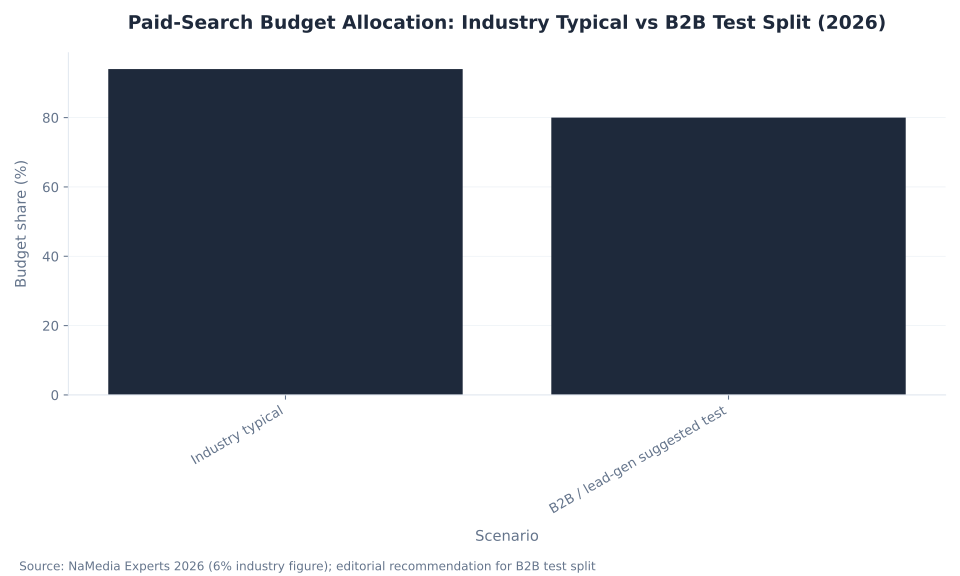
Industry data from NaMedia Experts 2026 shows the average paid-search budget allocates ~6% to Microsoft Advertising and ~94% to Google. That 6% figure reflects the broader market, not an optimal allocation for any specific account type. B2B and lead-gen advertisers who run Microsoft campaigns actively tend to test at a higher share — a 15–20% starting allocation is a reasonable first test for accounts where the audience and CPC case is strong.
| Scenario | Google Ads share | Microsoft Advertising share |
|---|---|---|
| Industry average (all advertisers) | ~94% | ~6% |
| B2B / lead-gen suggested starting test | ~80% | ~20% |
The 80/20 starting allocation is editorial guidance — the right split depends on category-level search volume on Microsoft for your specific keywords, which varies significantly. Plumbing advertisers in smaller markets see different Microsoft volume than enterprise SaaS companies targeting the same keywords. Run a 30-day test at 15–20% of your total search budget on Microsoft, import your top Google campaigns, and compare CPL before committing to a permanent split. For bidding strategy on the Microsoft side, see Microsoft Ads bidding and budget.
Paid-Search Budget Allocation: Industry Typical vs B2B Test Split (2026)
Running Google Ads? The Microsoft arbitrage is likely available to you now.
MB Adv Agency sets up and manages cross-platform paid-search programs for B2B and lead-gen advertisers — including the Google→Microsoft import, UET implementation, and LinkedIn-profile targeting setup.
Financial services PPC →How to Import Google Ads Campaigns into Microsoft Advertising
Microsoft Advertising imports your Google campaigns, ad groups, keywords, ads, and most extensions in a single job. The process takes minutes, not hours, and the new Import Center (launched May 19, 2026, at Microsoft Advertising Activate 2026) centralizes imports from Google Ads and Meta Ads, adds post-import optimization tips, and provides clearer error resolution and status controls (Microsoft Advertising blog, May 2026). Import is a head start — not a finished campaign. The sections below cover what transfers, what doesn't, and what to review afterward.
| Element | Transfers via import? | Action needed |
|---|---|---|
| Campaigns, ad groups, keywords | Yes — default import behavior | Review campaign settings; enable/pause as needed |
| Ads and most ad extensions | Yes — most formats | Some extensions need review |
| Budget and bid adjustments | Optional — import allows budget adjustment (e.g. +25%) during the job | Confirm budgets match intent |
| Conversion tracking | NO — Microsoft uses UET (Universal Event Tracking) | Install UET tag; rebuild conversion goals |
| Performance Max campaigns | Partial — import supported but "does not guarantee full parity" | Review goals, assets, audience signals after import |
| Audience associations | Partial — needs review | Rebuild or remap audiences |
| Negative-keyword lists | Partial — needs review | Verify list application to correct campaigns |
Import step-by-step (via Import Center, 2026): Sign in to Microsoft Advertising, open the Import Center (under Tools → Import Center), select “Import from Google Ads,” authorize with the Google account that has access to your Google Ads account, choose the specific account and campaigns to import, set your import options (budget adjustment, entity exclusions), pick a schedule — Now, Once, Daily, Weekly, Monthly, or Auto (Microsoft optimizes timing for recurring syncs) — and confirm. Microsoft Learn's Google Ads Import guide documents the full option set and notes explicitly that “not all information will be imported.” Recurring schedule (Daily or Auto) is useful for keeping keyword and bid changes in sync, but run the first import as “Now” and verify the output before enabling a recurring sync.
For Performance Max imports: Google PMax campaigns including new-customer-acquisition goals now import into Microsoft PMax. However, ALM Corp 2026 explicitly notes this “does not guarantee full parity” — asset groups, audience signals, and store-specific goals need manual review post-import. Treat a PMax import as a faster starting point, not a clone. For Microsoft Ads account structure on PMax and search campaigns, see Microsoft Ads account structure.
Post-Import Checklist: What to Review After the Google → Microsoft Import
Misconception: “Once you import from Google, you're done.” Microsoft's own documentation states explicitly that “not all information will be imported.” Treating import as set-and-forget is how advertisers run blind, untracked spend on Microsoft for weeks. Four items require immediate action after every import.
Priority 1: Install UET and rebuild conversion goals
Microsoft Advertising uses Universal Event Tracking (UET) — a separate JavaScript tag from Google's gtag or GA4. It does NOT transfer via import. Install the UET tag on all pages, create conversion goals in Microsoft Advertising's Conversion Tracking interface, and confirm goal fires before enabling automated bidding. Campaigns running without UET have no signal for Target CPA or Target ROAS strategies.
Priority 2: Review Performance Max campaigns. If your Google account runs PMax, the imported Microsoft PMax campaigns need manual review of asset groups, audience signals, and new-customer-acquisition goal configurations. Asset types that transferred with format issues render in fallback modes — check the asset group status indicators in-platform before enabling.
Priority 3: Verify negative-keyword list assignments. Negative-keyword lists often import but lose their campaign-level associations during the job. Check that each imported list is correctly linked to the campaigns it was protecting in Google — an unassigned negative list means traffic you excluded in Google is now reaching your Microsoft campaigns.
Priority 4: Check bid strategies. Some Google bid strategies do not map cleanly to Microsoft equivalents. Campaigns that imported with an unsupported strategy default to Manual CPC. Review every campaign's bidding status before enabling; switch to the Microsoft equivalent (Target CPA, Target ROAS, Enhanced CPC) once UET is confirmed firing. For a full breakdown of Microsoft's bidding options, see Microsoft Ads bidding and budget.
Frequently Asked Questions: Microsoft Advertising vs Google Ads
Is Microsoft Advertising cheaper than Google Ads?
Yes — on average, and with important qualifiers. Microsoft Advertising's blended average CPC runs ~$1.54 vs Google's ~$2.96, a ~33–40% lower rate per click on comparable queries (NaMedia Experts / Searchlab, Q1 2026 vendor estimates). Microsoft's own marketing cites “on average 33% lower CPC,” consistent with independent benchmarks.
The spread across verticals runs from ~20% cheaper to 60%+ depending on keyword competitiveness. In legal and B2B SaaS — where Google's auction is densest — the delta is widest. In some consumer categories with high Microsoft advertiser concentration, the gap narrows toward parity. A lower CPC does not automatically produce a lower cost per acquisition: lower competition on Microsoft also means lower search volume on many queries, so conversion volume is thinner. Per NaMedia Experts 2026, average cost per conversion runs ~31% lower than Google across industries — but the correct framing is directional. Only your own account data confirms the actual CPL delta for your specific keyword set. All cost figures cited here are third-party vendor estimates — not mbadv client data.
Does Microsoft Advertising have enough search volume to matter?
Yes — the scale argument against Microsoft Advertising is outdated. The Microsoft Search Network reaches ~724M unique monthly searchers worldwide across Bing, Yahoo, AOL, DuckDuckGo, and Ecosia (Microsoft Advertising planning data / Searchlab 2026). More importantly, ~38% of those searchers (~275M globally) never use Google. That is incremental demand — not a discounted copy of your Google campaigns — that sits outside Google's auction entirely.
Volume is lower than Google's on most queries, which means Microsoft campaigns typically generate fewer clicks and conversions per month at equivalent budgets. For a brand new account allocating $500/month to search, that volume constraint matters: Google's signal accumulates faster. But for a B2B advertiser already running $5,000+/month on Google with impression share above 65%, Microsoft's additional reach is the only incremental search volume available at any price. In high-competition markets like Chicago and Austin, Microsoft's lower auction density is an active advantage for lead-gen advertisers willing to manage two platforms.
What makes the Microsoft Advertising audience different from Google's?
Bing's user base skews meaningfully older, wealthier, and more senior than Google's mainstream audience. The median Bing user is 45 years old vs 38 on Google; ~71% of Bing users are aged 35–65; ~41% have household income ≥$100K; ~32% hold a management-level or above position vs ~24% on Google (Searchlab / Invoca 2026 — platform-level vendor characterizations, not census data).
For most B2B, financial services, legal, and high-ticket consumer categories, this demographic skew is the primary argument for Microsoft — not lower CPC. A 45-year-old director searching for enterprise software, a wealth-management firm, or a personal-injury attorney skews overrepresented in Bing's user base. The practical implication: if your buyer is a decision-maker with income above the median, an equivalent CPL on Microsoft produces higher-quality leads than on Google for many B2B advertisers. The audience skew does not benefit all advertisers equally. Broad consumer products with mainstream age and income targets see less advantage — the demographic “edge” is most pronounced for legal, financial services, and B2B SaaS.
Can I use LinkedIn targeting on Microsoft Advertising search campaigns?
Yes. Because Microsoft owns LinkedIn, Microsoft Advertising is the only search platform that targets by LinkedIn company, industry, job function, and (added June 16, 2026) job seniority. The targeting is available in both Search and Audience campaigns, at campaign and ad-group level. Job seniority covers 10 levels — CXO, VP, Director, Manager, Senior, Entry, Owner, Partner, Training, and Volunteer — enabling a B2B advertiser to serve search ads only to directors and above within a specific industry.
The cost differential vs LinkedIn's own native inventory is the operative advantage. On Microsoft search with LinkedIn profile targeting applied, B2B advertisers pay ~$2–6 per click for the same job-title segment they'd reach at ~$8–15+ per click on LinkedIn native ads (DigitalApplied 2026 vendor estimates). Targeting constraints narrow reach volume, which is expected — but for IT and managed IT and SaaS advertisers, the lead quality improvement typically offsets the lower click volume. Geographic availability note: job seniority targeting is live in the US and selected markets as of June 2026 — not yet in UK, Germany, France, or the Netherlands.
How do I import my Google Ads campaigns into Microsoft Advertising?
The import takes five steps: (1) Open the Import Center in Microsoft Advertising (Tools → Import Center). (2) Select “Import from Google Ads” and authorize with the Google account that has access to your Google Ads account. (3) Choose the specific Google Ads account and, optionally, individual campaigns to import. (4) Set import options — you adjust budgets during the import job (e.g. reduce by 20% to start conservatively) and exclude entity types you prefer to build manually. (5) Choose a schedule: Now, Once, Daily, Weekly, Monthly, or Auto (Microsoft optimizes recurring sync timing).
The new Import Center (launched May 2026) also supports Meta Ads imports and surfaces optimization tips immediately after the job completes. Microsoft's own Google Ads Import documentation notes that “not all information will be imported” — conversion tracking (UET), Performance Max audience signals, and some bid strategies need manual attention after import. Run the first import as “Now,” verify what landed, and review the post-import checklist above before scheduling recurring syncs. Campaigns, ad groups, keywords, ads, and most extensions transfer in the default import. Conversion goals do not — install UET before enabling automated bidding on imported campaigns.
Do I need a different tracking tag for Microsoft Advertising?
Yes. Microsoft Advertising uses Universal Event Tracking (UET) — a separate JavaScript tag from Google's gtag, GA4, or Google Tag Manager's Google Ads conversion tag. UET does not transfer via the Google Ads import. Without it, Microsoft campaigns have no conversion data, and automated bidding strategies (Target CPA, Target ROAS, Max Conversions) run blind.
To set up UET: In Microsoft Advertising, go to Tools → Conversion Tracking → UET Tags, create a tag, copy the JavaScript snippet, and install it on every page of your website — ideally via Google Tag Manager or your site's tag management system. Then create conversion goals in Microsoft Advertising that correspond to your Google conversion actions. Most Google conversion goal types have direct Microsoft equivalents (URL destination, event, phone call, app install). The UET tag fires independently of Google's tags; both run on the same page without conflict. Calculation check: if your site gets 1,000 visits/month from Microsoft and your Google-measured CVR on equivalent traffic is 3%, you'd expect ~30 conversions/month — but you won't see them in Microsoft Advertising until UET is live. Budget for 2–4 weeks of UET data accumulation before switching to Target CPA bidding on Microsoft campaigns.
Ready to add Microsoft Advertising to your paid-search mix?
MB Adv Agency handles cross-platform setup, UET implementation, LinkedIn-profile targeting, and ongoing optimization — so you get the CPC arbitrage without the management overhead of running two platforms solo.
Talk to a PPC consultant →Methodology
CPC and cost-per-conversion benchmarks: NaMedia Experts, Microsoft Ads vs Google Ads 2026 Benchmarks. Reach, market share, and audience demographics: Searchlab, Microsoft Ads Statistics 2026; Backlinko, Microsoft Bing Usage and Revenue Stats 2026; Affinco, Bing Statistics 2026; Invoca, 2026 Guide to Microsoft Advertising; Embryo, Top Facts and Figures About Microsoft Advertising; Microsoft Advertising planning tool (canonical reach figure). LinkedIn targeting: Microsoft Advertising Help; PPC.land (June 16, 2026); DigitalApplied 2026. Import mechanics: Microsoft Learn, Google Ads Import; Microsoft Advertising blog, New Import Center and Other Product News for May 2026; ALM Corp 2026. Ahrefs keyword data: pulled June 2026 for the microsoft-ads cluster (US, 12-month rolling). No mbadv client data used anywhere in this pillar. Last updated: June 2026. Reviewed by MB Adv Agency, June 2026.

As a Google Ads expert, I bring proven expertise in optimizing advertising campaigns to maximize ROI.
I specialize in sharing advanced strategies and targeted tips to refine Google Ads campaign management.
Committed to staying ahead of the latest trends and algorithms, I ensure that my clients receive cutting-edge solutions.
My passion for digital marketing and my ability to interpret data for strategic insights enable me to offer high-level consulting that aims to exceed expectations.
Google Partner Agency
We're a certified Google Partner Agency, which means we don’t guess — we optimize withGoogle’s full toolkit and insider support.
Your campaigns get pro-level execution, backed by real expertise (not theory).
4.9 out of 5 from 670+ reviews on Fiverr.
That’s not luck, that’s performance.
Highly recommend Matteo to set up your server side tracking. He has a deep understanding of e-commerce tracking and will go above and beyond to make sure everything is set up correctly and working 100%. If you are scaling your store this set up is non-negotiable in my opinion and there isn't many people who have this much knowledge or put the effort in to get it right. Thanks again!
avorodesign.com
I can only recommend Matteo! He was very patient, professional and very knowledgeable about GA4, Consent Mode v2, and GDPR compliance. Communication was clear, and the setup was done professionally and efficiently. Highly recommend him for anyone needing reliable tracking implementation.

www.natureiki.life
Matteo shines in the realm of online professionals. His work is not only deep in data but also complemented by his proactive communication and cooperation, setting a new standard for freelancers. If you want someone who truly exceeds expectations, look no further. Highly recommended!

www.omanbeverlysmyth.com
Exceptional Service Beyond Expectations - Outstanding Service Impeccable depth, flawless delivery, and exceptional language fluency—this service exceeded all expectations. Highly recommended. Matteo truly ROCKS!!!

ium-paris.com
Top-notch, always highly value working with Matteo. An absolute Google Ads Genius. This is approximately the 8th time I have hired him and he's helped us get 6-7 ROAS. We are excited in continuing to improve our lead flow. Hire this guy if you need Google Ads help. Thanks Matteo!

www.dleeventgroup.com
I finally found the guy who can setup server side tracking and all the ecosystem properly. I definitely recommend Matteo. He is very responsive, kind and wants to dig into things. He configured GA4, Meta, Google Ads, Outbrain and google consent v2 with Cookiebot. Thanks Matteo.

inomega.fr
MB Adv delivered exceptional work with outstanding professionalism and lots of patience, taking time to see effects of changes made and not just do the work and submit it. The proactive communication and video summaries of the work completed made working with Matteo a pleasure, as he consistently went above and beyond. Highly recommended for web analytics projects! We are already working on another project.

www.withnellsensors.co.uk
Working with Matteo on my Google Ads was a game-changer. He's not just a strategist, he's a true partner. He understood my goals and tailored a campaign that perfectly reached my target audience. I'm grateful for his expertise and dedication.

dccargo.com
Click-driven mind
with plastic-brick obsession.
We build Google Ads campaigns with the same mindset we use to build tiny brick worlds: strategy, patience, and zero tolerance for wasted pieces.
Data is our blueprint. Growth is the only acceptable outcome.