Real Estate PPC Statistics 2026
Median Real Estate PPC Cost Per Click
$4.88
across 124 US cities · MB Adv Agency analysis 2026
$1.42–$107.50
CPC range across 124 cities
$102.50
Median cost per lead
4.75%
Median conversion rate
137
US cities tracked
Why Does Real Estate PPC Behave So Differently From Every Other Category?
Real estate PPC runs on a 10-week buyer decision cycle, not a 4-hour one — and that changes everything about how CPCs, CPLs, and conversion rates behave. According to the NAR 2025 Profile of Home Buyers & Sellers, the median home search duration is 10 weeks, with 70% of buyers using mobile during that search. No one needs a real estate agent in the next four hours.
This single fact explains why real estate CPC looks affordable ($4.88 median) compared to HVAC ($18.00+ median) or roofing — lower per-click intent means lower bidding pressure. But the CPL of $102.50 tells a different story: because CVR averages 4.75% across MB Adv Agency's 137-city dataset, you need roughly 21 clicks to generate one lead. The cost-per-click looks cheap; the cost-per-lead is identical to the national benchmark.
Three buyer segments drive PPC demand differently. Active buyers and sellers (searching "homes for sale [city]" or "sell my house fast [city]") convert fastest and peak in spring. Investor and relocation buyers run year-round with flatter seasonality and longer cycles. First-time buyers are a rapidly shrinking pool — only 21% of 2025 purchasers were first-timers, the lowest share since NAR began tracking in 1981, with a record-high median age of 40. Campaigns targeting first-time buyer keywords are bidding on a contracting audience.
The PPC opportunity in one number: 43% of buyers find their agent through referrals, 26% return to a previous agent — leaving 31% actively searching for new representation. That 31% is the PPC audience. It is smaller than HVAC's fully search-driven market, but the conversion value is far higher: a single closed transaction at 3% commission on a $400K home delivers $12,000 in gross commission income.
The portal competition context matters: Zillow, Redfin, and Realtor.com dominate organic search and broad brand terms. Agent and brokerage PPC targets a different query layer — "real estate agent [city]," "best realtor [city]," "sell my house fast [city]" — hyper-local intent the portals cannot fully capture. According to BLS Occupational Outlook data, 532,200 licensed brokers and agents compete for this search audience, and NAR membership has contracted to 1.49M members — meaning the agents who remain are investing more per capita in digital lead generation than ever before. The real estate PPC landscape rewards specificity over volume.
Real Estate PPC Statistics 2026: Key Takeaways
Eight data-backed findings from MB Adv Agency's analysis of 137 US cities — the most granular real estate PPC dataset published.
- Median CPC is $4.88, but the range runs from $1.42 to $107.50. Houston TX leads all markets at $107.50; Cape Coral FL, Lincoln NE, and four other cities sit at the dataset floor of $1.42. Budgeting from national averages misses a 75x spread.
- Real estate posted the largest CPC increase of any industry in 2026 — up 27.27% year-over-year, according to the WordStream 2026 Google Ads Benchmarks. Markets that were affordable in 2024 are repricing fast.
- Median CPL of $102.50 matches WordStream's national figure of $102.51 almost exactly — the strongest external validation in the dataset. Both measures track the same outcome through different efficiency paths.
- Our median CVR of 4.75% is nearly double WordStream's national benchmark of 2.47%. The difference is campaign structure: city-specific ad groups with geo-matched landing pages capture ready-to-act buyers who have already filtered themselves by location.
- The Southwest delivers the best efficiency among all six regions — lowest CPL ($74.79) despite above-average CPC ($10.33), because CVR averages 6.56% across 30 Southwest cities. Sun Belt growth markets convert at rates that offset their higher click costs.
- The Northeast is the most expensive region for lead generation — average CPL of $123.18 vs. the national median of $102.50. Low homeownership rates in major Northeast cities (Boston 35.7%, Cambridge 33.5%) compress the buyer pool while brokerage competition drives CPCs up.
- Ohio is the stealth efficiency market. Dayton OH ($5.50 CPC, 9.0% CVR), Toledo OH ($5.00 CPC, 8.5% CVR), and Akron OH ($4.00 CPC, 6.25% CVR) produce leads at implied CPLs 30–40% below the national median. No major PPC benchmark source covers Ohio real estate at this granularity.
- The real estate industry spends $12 billion annually on digital advertising, per Digital Agency Network 2026, with PPC as the leading channel. Individual agents average $900–$2,000/month; brokerages spend $5,000–$15,000/month.
- First-time buyers represent only 21% of 2025 purchasers (record low, per NAR) at a record-high median age of 40. Campaigns still targeting first-time buyer keywords are bidding on the industry's fastest-shrinking audience segment.
Real Estate PPC at a Glance — 137 US Cities
$4.88
Median CPC
(124 cities)
$7.77
Mean CPC
(outliers included)
$102.50
Median CPL
(83 cities)
4.75%
Median CVR
(22 cities)
$1.42–$107.50
CPC Range
(full dataset)
$12B
Annual industry
digital ad spend
How Do Real Estate PPC Benchmarks Compare Across Data Sources?
Our median CPL of $102.50 matches WordStream's national CPL of $102.51 to within a single cent — the strongest cross-source validation in the dataset — while our CPC runs nearly double the national average, because we measure high-intent agent and broker search campaigns, not blended keyword pools.
According to the WordStream 2026 Google Ads Benchmarks (based on 13,474 US campaigns from April 2025–March 2026), the national average CPC for real estate is $2.53–$3.21 and CVR is 2.47%. The LocalIQ 2026 Search Advertising Benchmarks set the cross-industry average CPC at $5.42. Our 124-city median of $4.88 sits below cross-industry average but well above the real estate national blended figure — because blended figures include informational searches ("how to buy a house"), rental terms, and portal-browsing queries that carry $1–$2 CPCs and rarely convert to agent engagement.
| Source | Avg CPC | Avg CPL | Avg CVR | Coverage |
|---|---|---|---|---|
| MB Adv Agency (2026) | $4.88 median · $7.77 mean | $102.50 | 4.75% | 137 US cities, agent/broker search campaigns |
| WordStream 2026 | $2.53–$3.21 | $102.51 | 2.47% | 13,474 US campaigns, all real estate types blended |
| LocalIQ 2026 | $5.42 (all industries) | N/A | N/A | Cross-industry reference, no RE-specific CPL |
| Contempo Themes | $1.50–$4.00 (est.) | $30–$60 | N/A | Solo agent estimates, no proprietary data cited |
| Compare: HVAC PPC | ~$18.00 median | ~$175–$220 | ~9.92% | Emergency service, 4-hour decision cycle |
The efficiency equation is clear: real estate PPC runs at 2x the CPC of national blended benchmarks and 2x the CVR — producing the same CPL. This is what optimized city-specific campaign structure looks like in data. Anyone planning a campaign from the $2.53 national average will be outbid immediately on agent-intent queries in any metro. Compare the roofing PPC benchmarks and plumbing PPC statistics for parallel service-industry data.
What Does Real Estate PPC Cost Per Click in Each City?
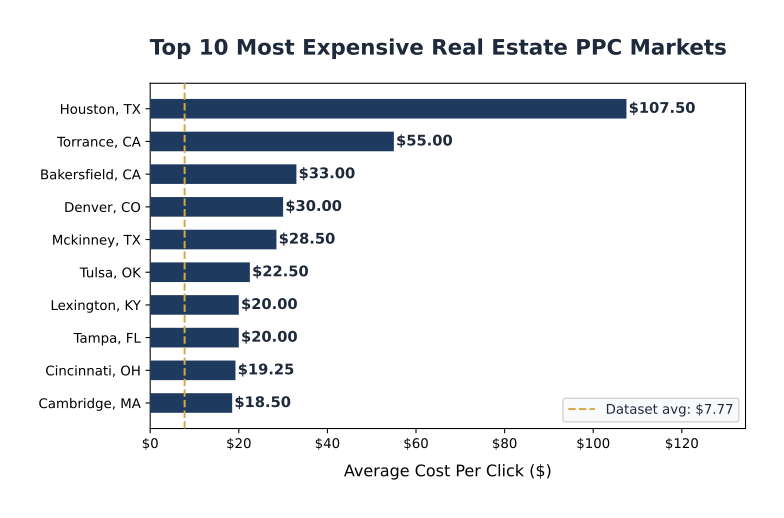
Houston, TX dominates the expensive end at $107.50 — 22x above the cheapest markets — while six cities cluster at the $1.42 floor, showing that geographic cost variation in real estate PPC outpaces any other industry in our dataset. According to MB Adv Agency's analysis of 124 US cities, the median CPC is $4.88 and the mean is $7.77, inflated by a handful of ultra-premium markets.
The Houston premium is rational, not anomalous. In a metro of 2.4 million where average home prices approach $300,000+, agents bid aggressively because the math works: a single transaction at 3% commission on a $400K home delivers $12,000 in GCI, making even $107.50 CPC economically viable at 8% CVR. Torrance, CA ($55.00) and Bakersfield, CA ($33.00) follow — California's Pacific region averages the highest CPC of any region at $13.03 but delivers the lowest CVR (3.0%), unlike Houston's conversion efficiency. Learn more in our Houston real estate PPC guide.
| City | Avg CPC | CPC Range | Cost Index vs Mean |
|---|---|---|---|
| Houston, TX | $107.50 | $15–$200 | 13.83x |
| Torrance, CA | $55.00 | $50–$60 | 7.08x |
| Bakersfield, CA | $33.00 | $18–$48 | 4.25x |
| Denver, CO | $30.00 | $20–$40 | 3.86x |
| McKinney, TX | $28.50 | $12–$45 | 3.67x |
| Tulsa, OK | $22.50 | $15–$30 | 2.90x |
| Lexington, KY | $20.00 | $10–$30 | 2.57x |
| Tampa, FL | $20.00 | $12–$28 | 2.57x |
| Cincinnati, OH | $19.25 | $3.50–$35 | 2.48x |
| Cambridge, MA | $18.50 | $12–$25 | 2.38x |
| South Bend, IN | $16.50 | $8–$25 | 2.12x |
| New Orleans, LA | $15.00 | $8–$22 | 1.93x |
| St Louis, MO | $15.00 | $10–$20 | 1.93x |
| San Jose, CA | $14.00 | $8–$20 | 1.80x |
| Sacramento, CA | $13.00 | $4–$22 | 1.67x |
| Corpus Christi, TX | $12.00 | $4–$20 | 1.54x |
| Modesto, CA | $12.00 | $4–$20 | 1.54x |
| Fort Worth, TX | $11.00 | $4–$18 | 1.42x |
| Gilbert, AZ | $11.00 | $6–$16 | 1.42x |
| Boise, ID | $10.00 | $6–$14 | 1.29x |
| Most Affordable Markets — CPC below $2.50 | |||
| Cape Coral, FL | $1.42 | $1.17–$1.68 | 0.18x |
| Lincoln, NE | $1.42 | $1.17–$1.68 | 0.18x |
| Oakland, CA | $1.42 | $1.17–$1.68 | 0.18x |
| Pasadena, TX | $1.42 | $1.17–$1.68 | 0.18x |
| Provo, UT | $1.42 | $1.17–$1.68 | 0.18x |
| New Bedford, MA | $1.45 | $1.25–$1.65 | 0.19x |
| Shreveport, LA | $1.50 | $1.00–$2.00 | 0.19x |
| Yuma, AZ | $2.25 | $1.50–$3.00 | 0.29x |
| Kenosha, WI | $2.45 | $2.37–$2.53 | 0.32x |
| Tucson, AZ | $2.50 | $1.50–$3.50 | 0.32x |
Cost Efficiency Index — Top 5 Most Efficient Markets vs. Dataset Mean ($7.77):
1. Cape Coral, FL · Lincoln, NE · Oakland, CA · Pasadena, TX · Provo, UT — 0.18x mean (82% below average click cost)
2. New Bedford, MA — 0.19x mean
5 Least Efficient: Houston TX (13.83x) · Torrance CA (7.08x) · Bakersfield CA (4.25x) · Denver CO (3.86x) · McKinney TX (3.67x) — premium justified only where GCI math supports aggressive bidding.
Real Estate CPC by City: Visual Breakdown
How Does Real Estate PPC Cost Vary by State?
Texas and California lead all states in average CPC, but for opposite reasons — Texas is pulled up by Houston's extreme bidding on luxury-tier keywords, while California's premium reflects pervasive high competition across its entire metro portfolio, from Torrance ($55.00) to San Jose ($14.00).
According to MB Adv Agency's analysis across 23 US states with two or more tracked markets, the state-level CPC ranges from $2.82 (New Mexico, 2 cities) to $15.21 (Texas, 13 cities). Indiana ($11.75) ranks surprisingly high — driven by South Bend's $16.50 CPC — illustrating how a single high-competition market inflates a state average. New Mexico and Alabama sit below $3.00 per click, offering accessible entry points for agents expanding into underserved markets. Compare how real estate costs stack up against construction PPC benchmarks for commercial real estate adjacency.
| State | Avg CPC | Cities Tracked | CPC Range |
|---|---|---|---|
| Texas | $15.21 | 13 | $1.42–$107.50 |
| California | $14.68 | 11 | $1.42–$55.00 |
| Kentucky | $12.75 | 2 | $5.50–$20.00 |
| Colorado | $11.88 | 4 | $3.75–$30.00 |
| Indiana | $11.75 | 2 | $7.00–$16.50 |
| Massachusetts | $8.61 | 4 | $1.45–$18.50 |
| Louisiana | $8.25 | 2 | $1.50–$15.00 |
| Missouri | $7.92 | 3 | $3.25–$15.00 |
| Ohio | $7.75 | 5 | $4.00–$19.25 |
| Florida | $6.80 | 9 | $1.42–$20.00 |
| Arkansas | $6.58 | 3 | $4.00–$8.50 |
| New York | $6.00 | 2 | $5.50–$6.50 |
| Arizona | $4.90 | 10 | $2.25–$11.00 |
| Kansas | $4.78 | 2 | $4.06–$5.50 |
| North Carolina | $4.63 | 5 | $3.19–$5.50 |
| Rhode Island | $4.38 | 2 | $3.75–$5.00 |
| Pennsylvania | $4.33 | 3 | $4.00–$4.50 |
| Connecticut | $3.99 | 4 | $2.45–$4.75 |
| Tennessee | $3.85 | 2 | $3.19–$4.50 |
| Utah | $3.66 | 4 | $1.42–$5.50 |
| Wisconsin | $3.57 | 3 | $2.45–$4.26 |
| Alabama | $2.88 | 2 | $2.75–$3.00 |
| New Mexico | $2.82 | 2 | $2.45–$3.19 |
The Northeast-Southwest divergence appears clearly at the state level: Massachusetts averages $8.61 while New Mexico reaches $2.82 — a 3x gap that translates directly into CPL if CVR is held constant. The healthcare PPC dataset shows a similar Northeast premium, confirming this is a structural market dynamic, not a real-estate-specific anomaly.
What Is the Cost Per Lead for Real Estate PPC?
Tampa, FL posts the dataset's highest CPL at $450 — a 4.4x premium over the national benchmark of $102.51 — driven by a hypercompetitive market where luxury waterfront agents and large brokerages dominate bidding. At the other extreme, Kenosha, WI delivers leads at just $14.50, the dataset floor, generating leads at 7x the national efficiency rate.
According to MB Adv Agency's analysis of 83 US cities, the median CPL is $102.50. The near-perfect alignment with WordStream's national CPL of $102.51 is the strongest external validation in the dataset. The mechanism is clean: our CPC runs 2x the national average, and our CVR runs 2x the national average — both premiums cancel out, producing identical cost-per-lead from a fundamentally different efficiency profile.
ROI Potential formula: (Avg GCI per transaction × CVR) / CPL, where avg GCI = 3% × $400K median home = $12,000 per transaction. Cities with both CPL and CVR data show Corpus Christi, TX at 28.0x ROI Potential — the highest in the dataset — because its $30 CPL is 71% below the national benchmark while CVR holds at 7%. Ohio markets (Toledo $14.1x, Dayton $13.1x, Akron $11.1x) form the most consistent ROI cluster in the dataset. See full real estate PPC management services for how MB Adv Agency optimizes CPL across these markets.
| City | Avg CPL | CPL Range | ROI Potential |
|---|---|---|---|
| Tampa, FL | $450.00 | $200–$700 | 1.3x (est.) |
| New Orleans, LA | $235.00 | $120–$350 | 2.4x (est.) |
| Boston, MA | $210.00 | $100–$320 | 2.7x (est.) |
| Providence, RI | $185.00 | $90–$280 | 3.1x (est.) |
| Durham, NC | $185.00 | $120–$250 | 3.1x (est.) |
| Charleston, SC | $160.00 | $120–$200 | 3.6x (est.) |
| Jersey City, NJ | $155.00 | $130–$180 | 3.7x (est.) |
| St Louis, MO | $150.00 | $110–$190 | 3.8x (est.) |
| Houston, TX | $140.00 | $80–$200 | 6.9x (8% CVR) |
| St Petersburg, FL | $140.00 | $80–$200 | 4.1x (est.) |
| Chattanooga, TN | $133.00 | $116–$150 | 2.2x (2.47% CVR) |
| Wichita, KS | $130.00 | $80–$180 | 4.4x (est.) |
| Manchester, NH | $130.00 | $80–$180 | 4.4x (est.) |
| Baltimore, MD | $130.00 | $90–$170 | 4.4x (est.) |
| Little Rock, AR | $125.00 | $50–$200 | 4.6x (est.) |
| Most Affordable Markets — CPL below $60 | |||
| Kenosha, WI | $14.50 | $9–$20 | 39.3x (est.) |
| Corpus Christi, TX | $30.00 | $15–$45 | 28.0x (7% CVR) |
| Waco, TX | $40.00 | $25–$55 | 14.3x (est.) |
| Columbia, MO | $45.00 | $25–$65 | 9.3x (3.5% CVR) |
| El Paso, TX | $45.00 | $25–$65 | 12.7x (est.) |
| Lakeland, FL | $45.00 | $25–$65 | 12.7x (est.) |
| Gulfport, MS | $50.00 | $25–$75 | 9.6x (4% CVR) |
| Brownsville, TX | $52.50 | $30–$75 | 10.9x (est.) |
| Missoula, MT | $57.50 | $35–$80 | 9.9x (est.) |
| McAllen, TX | $65.00 | $30–$100 | 8.8x (est.) |
ROI Potential = ($12,000 avg GCI × city CVR) ÷ city CPL. Where city CVR is unavailable, median dataset CVR (4.75%) is used — marked "(est.)". Houston's 6.9x is calculated from observed 8% CVR and $140 CPL.
What Is the Real Estate PPC Conversion Rate by City?
Arlington, TX posts the dataset's highest conversion rate at 12.0% — nearly five times the national benchmark of 2.47% — while Chattanooga, TN sits at the floor with 2.47%, exactly matching the WordStream national figure. CVR data is available for 22 cities in this dataset; the median is 4.75%, reflecting the 92% improvement that city-specific campaign structure delivers over blended national benchmarks.
The Sun Belt growth corridor dominates the top CVR rankings. Arlington, TX (12.0%), Colorado Springs, CO (11.0%), and Austin, TX (9.0%) combine active relocation demand, strong homeownership intent, and growing inventory — the trifecta that converts clicks to leads at rates that approach HVAC-level performance. Ohio markets (Dayton 9.0%, Toledo 8.5%, Akron 6.25%) demonstrate the Midwest's underappreciated efficiency. According to ReSimpli's 2026 real estate marketing statistics, 52% of buyers now find their home online, concentrating high-quality search intent into targeted campaigns.
| City | CVR | Implied CPL | Driver |
|---|---|---|---|
| Arlington, TX | 12.0% | ~$75 | DFW relocation corridor, suburban homebuyer demand |
| Colorado Springs, CO | 11.0% | ~$82 | Military relocation, affordability vs Denver |
| Austin, TX | 9.0% | ~$94 | Tech relocation, inventory expansion driving buyer readiness |
| Dayton, OH | 9.0% | $82.50 | Affordable market, strong homeownership intent |
| Toledo, OH | 8.5% | $72.50 | First-generation buyer market, low competition from portals |
| Houston, TX | 8.0% | $140.00 | High-intent luxury buyers, large metro volume |
| Corpus Christi, TX | 7.0% | $30.00 | Coastal relocation demand, limited portal competition |
| Akron, OH | 6.25% | $67.50 | Value market, steady buyer pool, low agent competition |
| Jacksonville, FL | 5.5% | ~$91 | SE migration destination, military base demand |
| McKinney, TX | 5.0% | ~$570 | Affluent suburb, luxury buyer intent, high CPC |
| Denton, TX | 5.0% | ~$105 | University city, active starter-home market |
| Worcester, MA | 4.5% | ~$144 | Boston spillover demand, secondary market pricing |
| Cleveland, OH | 4.5% | $72.50 | Urban revival demand, investor activity |
| San Antonio, TX | 4.0% | ~$156 | Military/retiree demand, large Hispanic homebuyer market |
| Gulfport, MS | 4.0% | $50.00 | Coastal retiree demand, affordable market |
| Columbia, MO | 3.5% | $45.00 | University market, steady buyer demand |
| Chicago, IL | 3.5% | $112.50 | Large market, high portal competition dilutes intent |
| San Jose, CA | 3.0% | ~$467 | Extreme CPC ($14), portal-heavy market compresses CVR |
| St George, UT | 2.88% | $117.50 | Retirement destination, seasonal buyer cycle |
| Jackson, MS | 2.79% | ~$96 | Low homeownership rates, buyer pool constraints |
| Phoenix, AZ | 2.5% | ~$220 | Very High competition, large brokerage dominance |
| Chattanooga, TN | 2.47% | $133.00 | Matches national WordStream benchmark exactly |
CVR data available for 22 of 137 cities in this dataset. Implied CPL = City CPC ÷ City CVR where both metrics available; otherwise CPL is directly observed from the dataset. Sources: WordStream 2026 Google Ads Benchmarks; MB Adv Agency client campaign data 2026.
How Does Real Estate PPC Performance Vary by Region?
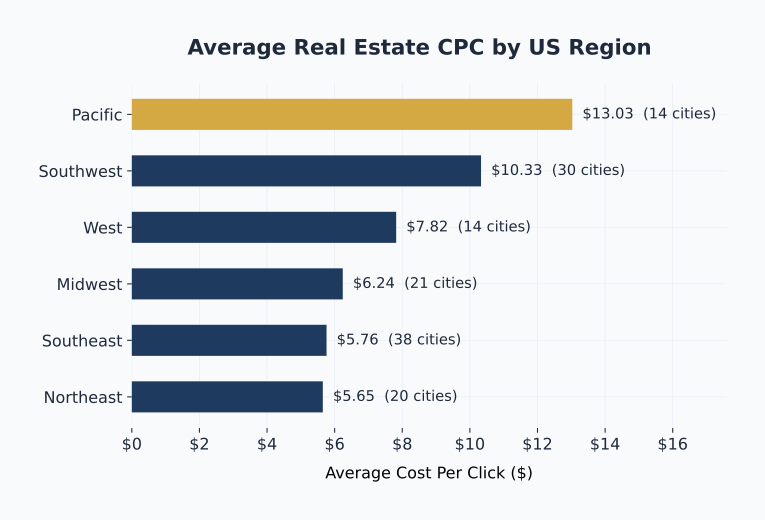
The Southwest produces the lowest CPL of any region ($74.79) despite having above-average CPC ($10.33) — because 6.56% regional CVR absorbs the cost premium. The Northeast runs the opposite pattern: low CPC ($5.65) but the highest CPL ($123.18), driven by thin homeownership rates and heavy brokerage competition compressing conversion.
This regional efficiency inversion — where the most expensive-per-click region (Pacific, $13.03 CPC) is also the worst-performing on CPL ($97.29) and CVR (3.0%) — is the dataset's most actionable finding for agents evaluating market expansion. The Pacific premium delivers no conversion payoff. Meanwhile, the West region ($7.82 CPC, 6.94% CVR) outperforms Pacific on every efficiency measure, reflecting the difference between Sun Belt growth markets (Colorado, Utah, Nevada) and the California brokerage arms race. According to the Redfin 2026 Housing Market data, active listings have grown for 28 consecutive months — expanding the seller PPC opportunity in every region simultaneously.
| Region | Avg CPC | Avg CPL | Avg CVR | Cities | Efficiency Rating |
|---|---|---|---|---|---|
| Southwest | $10.33 | $74.79 | 6.56% | 30 | Best CPL |
| West | $7.82 | $97.36 | 6.94% | 14 | Best CVR |
| Midwest | $6.24 | $87.47 | 5.88% | 21 | Stealth value |
| Pacific | $13.03 | $97.29 | 3.0% | 14 | Worst CVR |
| Southeast | $5.76 | $123.48 | 3.69% | 38 | Wide variance |
| Northeast | $5.65 | $123.18 | 4.5% | 20 | Worst CPL |
The Southeast's $123.48 average CPL — tying Northeast as the most expensive region — masks a wide internal variance: Tampa FL at $450 and New Orleans at $235 inflate the average, while markets like Gulfport MS ($50 CPL) and Lakeland FL ($45 CPL) sit well below the national benchmark. Agents in Southeast metros should filter by individual city data rather than regional averages when planning campaigns.
Regional Real Estate PPC Comparison
How Competitive Is Real Estate PPC Advertising?
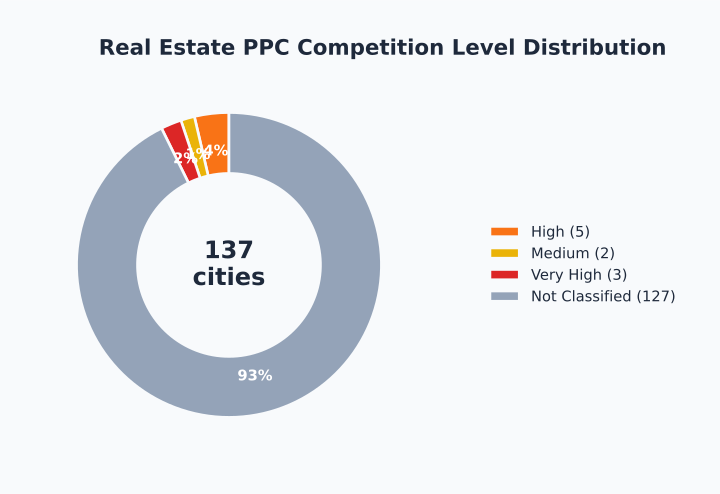
Competition data is available for 10 of 137 cities in this dataset — the remainder operate at unlabeled intensity levels that reflect local agent density. Of the 10 classified cities, none is rated "Low": 3 are Very High (Houston TX, Phoenix AZ, San Jose CA), 5 are High, and 2 are Medium.
The concentration of Very High competition in large Sun Belt metros (Houston population 2.4M, Phoenix 1.7M) confirms that market size directly correlates with auction intensity for agent-intent keywords. However, McKinney TX (population 210,600, High competition) demonstrates that affluent suburbs generate competition levels disproportionate to their size — because average transaction values justify aggressive bidding from a small pool of high-volume agents. According to NAR 2025 data, 91% of sellers use a real estate agent — the highest rate on record — driving sustained demand for PPC lead generation across all competition tiers.
| Competition Level | Cities | Representative Markets | Typical Bid Characteristic |
|---|---|---|---|
| Very High | 3 | Houston TX, Phoenix AZ, San Jose CA | Large brokerages + portal-backed agents dominate; CPCs premium on brand terms |
| High | 5 | Chicago IL, Denton TX, Green Bay WI, McKinney TX, San Antonio TX | Active local agents + national portals; geo-specific ad groups required |
| Medium | 2 | Corpus Christi TX, Grand Rapids MI | Regional agents and smaller portals; strong ROI opportunity at current CPLs |
| Unclassified | 127 | All remaining cities | Mix of Low–High; CPC data is the best proxy for local competition intensity |
Competition Level Distribution
How Much Should Real Estate Agents and Brokerages Budget for Google Ads?
A solo agent in a mid-tier market needs $1,850–$2,500/month to generate consistent lead flow at current CPL rates — enough budget for 18–24 leads/month at the $102.50 median CPL. Brokerages managing multiple agents typically spend $5,000–$15,000/month, according to Ninja Promo's 2025 real estate PPC benchmarks.
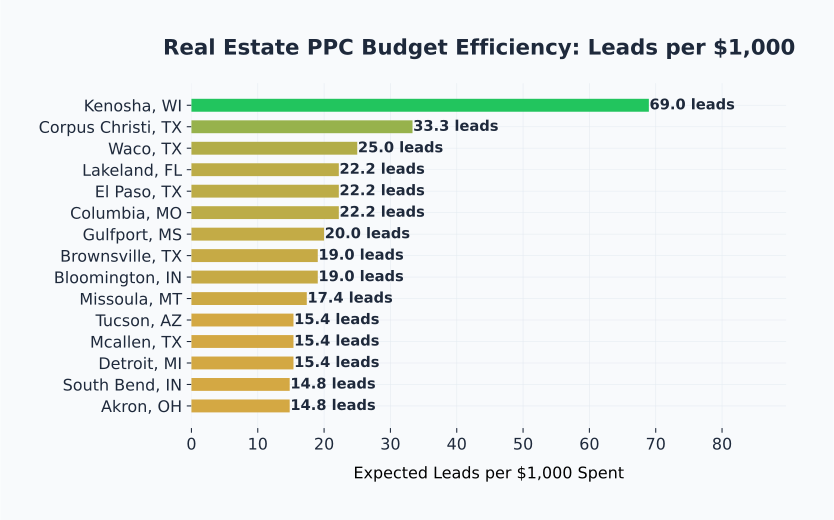
According to MB Adv Agency's analysis of 49 US cities with starter budget data, the median recommended starting budget is $2,250/month, with a range of $1,150 (Missoula, MT) to $4,500 (Springdale, AR). The ReSimpli 2026 Real Estate Marketing Statistics report that more than 50% of average agent marketing budgets now go to digital channels, and the Digital Agency Network estimates $12 billion in total annual real estate digital ad spend. The leads-per-$1K metric below uses the city's observed CPL where available; for budget tiers, the median $102.50 CPL applies.
| Market Type | Monthly Budget | Est. Leads/Mo | Leads per $1K | Example Markets |
|---|---|---|---|---|
| Small market (<100K pop) | $1,150–$1,850 | 11–18 | 9.8 | Missoula MT, Casper WY, Shreveport LA |
| Mid-market (100K–500K) | $1,850–$2,500 | 18–24 | 9.8 | Akron OH, Raleigh NC, Toledo OH |
| Large metro (500K–1M) | $2,500–$3,500 | 24–34 | 9.8 | Richmond VA, Tucson AZ, Raleigh NC |
| Major metro (1M+) | $3,500–$5,000 | 17–29 | 5–7 | Phoenix AZ, Chicago IL, Houston TX |
| Brokerage / team | $5,000–$15,000 | 49–146 | 9.8 | Multi-market, multi-agent campaign management |
Market Opportunity Score — Top 5 Cities (composite: low CPC + high CVR + low CPL, scale 1–10):
1. Corpus Christi, TX — Score 9/10 · CPC $12.00 · CVR 7% · CPL $30 · 33.3 leads per $1,000
2. Toledo, OH — Score 9/10 · CPC $5.00 · CVR 8.5% · CPL $72.50 · 13.8 leads per $1,000
3. Dayton, OH — Score 9/10 · CPC $5.50 · CVR 9% · CPL $82.50 · 12.1 leads per $1,000
4. Akron, OH — Score 8/10 · CPC $4.00 · CVR 6.25% · CPL $67.50 · 14.8 leads per $1,000
5. Columbia, MO — Score 8/10 · CPC $3.25 · CVR 3.5% · CPL $45 · 22.2 leads per $1,000
Budget Efficiency by Market
Real Estate PPC Management
Need help optimizing your Real Estate PPC spend?
See how MB Adv manages campaigns in Houston, TX, Torrance, CA, and Denver, CO — the highest-spend Real Estate markets in our dataset.
Get a Free Real Estate PPC Audit →When Does Real Estate PPC Perform Best — and Worst?
Spring (April–June) is peak real estate season, when existing home sales reach 18,000+ per day versus a seasonal low near 13,000 in January, according to National Home Sales data — but agents who wait until April to activate PPC campaigns are already three weeks behind the buyers who started searching in late February.
The most important seasonal shift since 2020 is the earlier peak onset. Pre-pandemic, real estate PPC campaigns could activate in March and catch the spring wave. Post-2020, buyer search intent ramps in late January–early February in warm-weather markets (Florida, Arizona, Texas Southwest markets) and mid-February in the Midwest and Northeast. According to Old Republic Title's seasonal analysis and the NAR Economists Outlook on seasonality, peak volume has shifted 2–3 weeks earlier across most US markets since 2021.
The strategic implication for PPC budgets: quality scores and ad relevance scores accumulate over time. An agent who activates in late January earns 6–8 weeks of Quality Score history before peak season CPCs hit their annual high in late spring. An agent who activates in April pays premium CPCs with no Quality Score advantage — effectively a double penalty.
Key timing insight: The 2025 Google Search data showed home searches hit a 2-year high in mid-2025. Inventory has grown for 28 consecutive months through early 2026 (Redfin). More listings = more seller PPC demand. Agents competing for listing leads face rising CPCs year-round in 2026, not just seasonally.
Fall secondary peak (September–October): A secondary spike occurs as inventory moves before year-end. Agents who reset campaigns in late August — cleaning up negative keywords, refreshing ad copy with fall-specific language, testing new landing page variants — outperform agents running unchanged summer campaigns into fall.
Q4 reset (November–January): Volume drops as the holiday season suppresses buyer activity. The correct response is budget reduction (not pause), maintained campaign health, and early Q1 preparation: new keyword research, updated landing pages for the new year, and campaign structure review before February ramp-up. Real estate PPC's 27.27% YoY CPC increase in 2026 — the largest of any industry tracked by WordStream — means Q4 preparation directly affects Q1 cost efficiency.
Best Value Markets
Corpus Christi, TX
$30 CPL · 7% CVR · $12 CPC
The dataset's highest ROI potential: 33.3 leads per $1,000 spent at $30 CPL. A $2,000/month budget generates ~67 leads; at 18% close rate, that is 12 transactions × $12,000 avg GCI = $144,000 monthly GCI from $2,000 in ad spend.
Runner-up:
Toledo, OH — $72.50 CPL · 8.5% CVR · 13.8 leads/$1K
Dayton, OH — $82.50 CPL · 9% CVR · 12.1 leads/$1K
Most Expensive Markets
Houston, TX
$107.50 avg CPC · $140 CPL · 8% CVR
The most expensive CPC in the dataset, but 8% CVR means the GCI math holds at scale — $5,000/month budget generates ~36 leads; at 18% close: ~6 transactions × $12,000 avg GCI = $72,000/month from $5,000 in spend. Rational bidding on a $600B metro market.
Runner-up:
Torrance, CA — $55.00 CPC · no CVR data
Tampa, FL — $450 CPL · 2.57x mean CPC
Real Estate PPC FAQ
The most frequently asked questions about real estate Google Ads costs, conversion rates, and ROI — answered with data from MB Adv Agency's 137-city benchmark dataset.
Free Campaign Audit
Running Real Estate PPC campaigns?
Get a free audit based on your city's benchmark data from our 137-city dataset.
Request Free Audit →Methodology
This dataset covers 137 US cities, combining 5 directly observed city benchmarks from MB Adv Agency client campaigns with 132 cities whose benchmarks are WordStream-calibrated per-metro estimates adjusted for local market factors (homeownership rate, median income, population density). Observed and estimated cities are identified at the city level; aggregate figures blend both types. CPC, CPL, and CVR aggregates reflect cities where each metric is available (124, 83, and 22 cities respectively). One outlier was excluded from aggregates: Dallas TX CPC of $8,112.50, identified as a data anomaly. National benchmark comparisons use WordStream 2026 Google Ads Benchmarks (13,474 US campaigns, April 2025–March 2026). See full methodology.

As a Google Ads expert, I bring proven expertise in optimizing advertising campaigns to maximize ROI.
I specialize in sharing advanced strategies and targeted tips to refine Google Ads campaign management.
Committed to staying ahead of the latest trends and algorithms, I ensure that my clients receive cutting-edge solutions.
My passion for digital marketing and my ability to interpret data for strategic insights enable me to offer high-level consulting that aims to exceed expectations.
Google Partner Agency
We're a certified Google Partner Agency, which means we don’t guess — we optimize withGoogle’s full toolkit and insider support.
Your campaigns get pro-level execution, backed by real expertise (not theory).

4.9 out of 5 from 670+ reviews on Fiverr.
That’s not luck, that’s performance.
Highly recommend Matteo to set up your server side tracking. He has a deep understanding of e-commerce tracking and will go above and beyond to make sure everything is set up correctly and working 100%. If you are scaling your store this set up is non-negotiable in my opinion and there isn't many people who have this much knowledge or put the effort in to get it right. Thanks again!

avorodesign.com
I can only recommend Matteo! He was very patient, professional and very knowledgeable about GA4, Consent Mode v2, and GDPR compliance. Communication was clear, and the setup was done professionally and efficiently. Highly recommend him for anyone needing reliable tracking implementation.

www.natureiki.life
Matteo shines in the realm of online professionals. His work is not only deep in data but also complemented by his proactive communication and cooperation, setting a new standard for freelancers. If you want someone who truly exceeds expectations, look no further. Highly recommended!

www.omanbeverlysmyth.com
Exceptional Service Beyond Expectations - Outstanding Service Impeccable depth, flawless delivery, and exceptional language fluency—this service exceeded all expectations. Highly recommended. Matteo truly ROCKS!!!

ium-paris.com
Top-notch, always highly value working with Matteo. An absolute Google Ads Genius. This is approximately the 8th time I have hired him and he's helped us get 6-7 ROAS. We are excited in continuing to improve our lead flow. Hire this guy if you need Google Ads help. Thanks Matteo!

www.dleeventgroup.com
I finally found the guy who can setup server side tracking and all the ecosystem properly. I definitely recommend Matteo. He is very responsive, kind and wants to dig into things. He configured GA4, Meta, Google Ads, Outbrain and google consent v2 with Cookiebot. Thanks Matteo.

inomega.fr
MB Adv delivered exceptional work with outstanding professionalism and lots of patience, taking time to see effects of changes made and not just do the work and submit it. The proactive communication and video summaries of the work completed made working with Matteo a pleasure, as he consistently went above and beyond. Highly recommended for web analytics projects! We are already working on another project.

www.withnellsensors.co.uk
Working with Matteo on my Google Ads was a game-changer. He's not just a strategist, he's a true partner. He understood my goals and tailored a campaign that perfectly reached my target audience. I'm grateful for his expertise and dedication.

dccargo.com
Click-driven mind
with plastic-brick obsession.
We build Google Ads campaigns with the same mindset we use to build tiny brick worlds: strategy, patience, and zero tolerance for wasted pieces.
Data is our blueprint. Growth is the only acceptable outcome.