Google Ads Bidding Strategies: 2026 Decision Guide

86%
of Google Ads campaigns run automated bidding — yet most Smart Bidding failures trace to a single root cause: adding a conversion target before the data floor was met.
Source: Marketing LTB, Google Ads Statistics 2026 · SEO Design Chicago 2026
What Are Google Ads Bidding Strategies?
A Google Ads bidding strategy is the rule the platform uses to set bids at auction time. The decision about which strategy to use is not a feature preference — it is a conversion-data-readiness decision. Accounts that reach 30+ conversions per month with accurate tracking data operate under fundamentally different constraints than accounts with fewer.
Google Ads offers two broad categories of bidding in 2026: manual strategies, where the account manager sets bids directly, and automated strategies, where Google's auction-time machine learning sets each bid based on the predicted likelihood of a conversion. Within automated bidding, Smart Bidding strategies — Maximize Conversions, Maximize Conversion Value, and Target Impression Share — use conversion signals in real time. Campaign type constrains strategy choice: Performance Max enforces automated bidding; Search and Shopping campaigns support the full range from Manual CPC through Maximize Conversion Value with a Target ROAS target.
Two interface changes redefined the strategy menu. In April 2021, Google allowed Maximize Conversions to accept an optional Target CPA, giving it identical bidding behavior to the old standalone Target CPA strategy. In July 2022, existing standalone "Target CPA" and "Target ROAS" campaign labels were renamed in the UI to "Maximize conversions" and "Maximize conversion value" respectively. New campaigns created in 2026 do not see a standalone tCPA or tROAS option — only the Maximize variants with an optional target field. The bidding algorithm behind both old and new labels is the same. (Sources: Google Ads Help, 2021; Search Engine Roundtable, 2022.)
The strategy menu also shrank from the Manual side. Enhanced CPC, which applied a machine-learning multiplier to manual bids, was retired from Search and Display campaigns on March 31, 2025, following its earlier removal from Shopping in October 2023. Affected campaigns were auto-migrated to Manual CPC. (Sources: Search Engine Land, 2024; Digital Ads, 2025.) Before selecting any Smart Bidding strategy, confirm that conversion tracking is implemented correctly — the algorithm optimizes toward whatever conversion actions are active, and a misconfigured tracking setup produces a confidently wrong bid.
Key Takeaways
- 86% of Google Ads campaigns run automated bidding in 2026 — yet the majority of Smart Bidding failures share one cause: launching a constrained target before conversion data is ready. (Source: Marketing LTB 2026.)
- Standalone "Target CPA" and "Target ROAS" strategy labels no longer appear when creating new campaigns; they merged into Maximize Conversions and Maximize Conversion Value with optional targets (April 2021 behavioral merge; July 2022 UI rename).
- Enhanced CPC is retired: removed from Shopping in October 2023, from Search and Display on March 31, 2025. Campaigns previously using eCPC were auto-migrated to Manual CPC.
- Accelerated delivery was removed from Search, Shopping, and shared budgets on October 7, 2019. Standard delivery is the only option for those campaign types in 2026.
- Smart Bidding is not a black box: conversion action weighting, value rules, seasonality adjustments (1–7 days), data exclusions, and budget constraints all give account managers direct influence over the algorithm's behavior.
- Google's recommended data floor before adding a Target CPA is 30 conversions per 30 days; the practitioner threshold before adding a Target ROAS is 50+ conversions per month with value data attached — this figure reflects practitioner consensus, not a Google-published number.
- Device, location, audience, and ad-schedule bid adjustments are ignored under any Smart Bidding strategy. The only adjustments with real effect are -100% device exclusions, seasonality adjustments, and data exclusions.
86%
of Google Ads campaigns use automated bidding
Source: Marketing LTB 2026
30/mo
Google's recommended minimum conversions before adding a Target CPA
Source: Google Ads Help
50+/mo
with value data: practitioner threshold before adding a Target ROAS (practitioner consensus)
Source: Practitioner consensus — not a Google-published figure
Oct 7
2019
Date accelerated delivery was removed from Search, Shopping, and shared budgets
Source: Google Ads announcement, 2019
The 2026 Smart Bidding Strategy Menu
Five bid strategies are active in 2026 — down from seven after eCPC's retirement in March 2025 and the consolidation of standalone tCPA and tROAS into the Maximize variants.
The five active strategies divide across three categories. Smart Bidding strategies — Maximize Conversions, Maximize Conversion Value, and Target Impression Share — use Google's auction-time machine learning and conversion signals to set bids. Maximize Clicks is an automated strategy that does not use conversion data; it sets bids to generate the highest click volume within a daily budget. Manual CPC is the baseline option: the account manager sets a maximum bid per keyword or ad group, and Google does not adjust it at auction time.
Enhanced CPC (eCPC) occupied a middle position — it applied a machine-learning multiplier to manual bids but did not require conversion data. That category no longer exists. Google retired eCPC from Shopping campaigns in October 2023, then removed it from Search and Display on March 31, 2025. Campaigns on eCPC were auto-migrated to Manual CPC with no bidding-behavior replacement. (Sources: Search Engine Land, eCPC deprecation announcement; Digital Ads, transition guide 2025.)
Within Smart Bidding, the UI changed in two stages. In April 2021, Maximize Conversions gained an optional Target CPA field with identical algorithmic behavior to the old standalone Target CPA strategy. In July 2022, existing standalone "Target CPA" and "Target ROAS" campaign labels were renamed in the UI. A new campaign created in 2026 shows only Maximize Conversions (with an optional CPA target) and Maximize Conversion Value (with an optional ROAS target) — the standalone names are gone. Confirm that conversion tracking is accurate before enabling any Smart Bidding strategy; the algorithm optimizes toward whatever signals it receives. For retailers managing product catalogs — including fashion and apparel advertisers with strong SKU-level revenue data — Maximize Conversion Value with a tROAS target is the strategy that unlocks value-based bidding at scale.
| Strategy | Category | What It Optimizes | Conversion Data Required |
|---|---|---|---|
| Manual CPC | Manual | Direct bid control | No |
| Maximize Clicks | Automated (non-Smart) | Click volume | No |
| Target Impression Share | Automated (non-Smart) | Ad visibility % | No |
| Maximize Conversions | Smart Bidding | Conversion volume | No* |
| Maximize Conversions + Target CPA | Smart Bidding | Conversion volume at target CPA | Yes |
| Maximize Conversion Value | Smart Bidding | Total conversion value | Yes |
| Maximize Conversion Value + Target ROAS | Smart Bidding | Value at target ROAS | Yes |
| * No technical minimum to start; performs substantially better with 30+ conversions per 30 days. Source: Google Ads Help, Maximize Conversions. | |||
Google Ads Bid Strategy Selection Matrix (2026)
The strategy selection decision reduces to three questions: What is the campaign goal? Does the account have conversion data? What is the minimum conversion volume needed to run a constrained target without triggering learning-phase churn?
The matrix below maps every active strategy against those three inputs. For accounts with no conversion history, the two viable starting points are Manual CPC — full bid control, no algorithmic risk — and Maximize Clicks, which prioritizes traffic volume. Neither requires conversion data and neither enters a learning phase tied to conversion signal quality.
Maximize Conversions without a target is the recommended progression once conversion tracking is confirmed working via conversion tracking and attribution setup. It will spend the budget to acquire as many conversions as possible, without a cost guardrail. The algorithm learns fastest when unconstrained in its early weeks. Setting a target too early forces the system to reject auctions it would otherwise win, starving the learning phase of the volume it needs.
KEY INSIGHT: Legacy names tCPA and tROAS no longer appear in the new-campaign UI. Since July 2022, these strategies are labeled Maximize Conversions (optional CPA target) and Maximize Conversion Value (optional ROAS target). The bidding algorithm is unchanged — only the label shifted. (Sources: Search Engine Roundtable, 2022; Jumpfly, 2022; Groas 2026 guide.)
For lead-generation accounts — including legal firms and dental practices running high-intent Search campaigns — Maximize Conversions with a Target CPA becomes the correct strategy once the account clears 30 conversions per 30 days. Setting a CPA target below what the account has historically achieved produces underspend; the algorithm cannot find enough qualifying auctions within the cost constraint. Before setting any CPA or ROAS target, establish a CPA and ROAS baseline from at least 30 days of unconstrained data.
| Strategy | Primary Goal | Requires Conv. Data | Min. Conv. Volume | Budget Behavior | Best Starting Point |
|---|---|---|---|---|---|
| Manual CPC | Full bid control | No | None | Spends to daily budget at manager-set bids | New accounts, brand campaigns, low-volume niche |
| Maximize Clicks | Traffic volume | No | None | Spends full budget; can set max CPC cap | Awareness phase, seeding conversion data |
| Target Impression Share | Ad visibility % | No | None | Adjusts bids to hit impression share target | Brand defense, competitor conquest |
| Maximize Conversions | Conversion volume | No (learns faster with data) | 0 technical min; 30/mo recommended | Spends full budget for max conversions | First Smart Bidding step; unconstrained learning |
| Maximize Conversions + Target CPA (formerly standalone tCPA) | Conversion volume at CPA target | Yes | 15/30d selectable; 30/30d Google-recommended; 30–50/mo practitioner | Restricts spend to auctions within CPA guardrail; underspend if target too low | Lead-gen at scale (legal, dental, financial) |
| Maximize Conversion Value | Total conversion value | Yes — requires value data | 30+/mo with value attached | Spends full budget; bids up on higher-value conversions | E-commerce with revenue values, unconstrained phase |
| Maximize Conversion Value + Target ROAS (formerly standalone tROAS) | Value at ROAS target | Yes — requires value data | 30+ Google-recommended; 50+/mo practitioner consensus | Restricts spend to auctions within ROAS guardrail; underspend if target too high | E-commerce with established ROAS baseline |
| Portfolio Strategy (any of above) | Shared goal across campaigns | Depends on underlying strategy | 30+/mo pooled across campaigns | Pools signal from all included campaigns | Multi-campaign accounts with related goals; not available for Performance Max |
Conversion Volume Thresholds Before Adding a Bid Target
The tCPA and tROAS targets inside Maximize Conversions and Maximize Conversion Value require conversion data to function — adding a target too early extends the learning phase and causes underspend. The threshold that matters is not what makes the field selectable, but what gives the algorithm enough signal to hit the target without churn.
Three tiers define the data floor for each strategy. The technical minimum is the volume at which Google's interface allows a target to be entered at all. The Google-recommended threshold is the volume Google states in its own Help documentation as the level at which the strategy performs reliably. The practitioner consensus threshold is the level at which experienced account managers typically add a target — drawn from agency and tool-provider data rather than Google documentation. These tiers are not interchangeable.
For Maximize Conversions with a Target CPA, the 15-conversion technical minimum is the unlocking threshold — not an operating recommendation. The gap between 15 and 30 is the range where the strategy is theoretically active but practically unstable: the learning phase restarts on each significant target change, and with only 15 conversions per month, even one week of variance causes a recalibration. (Source: Store Growers, Target CPA guide.)
KEY INSIGHT: The 15-conversion figure is the technical minimum for tCPA to be selectable — not the operating recommendation. Running tCPA at 15 conversions/month produces unstable targets and learning-phase churn. (Source: Google Ads Help.)
For Maximize Conversion Value with a Target ROAS, volume requirements are higher because the algorithm must predict not just whether a conversion will occur, but what value it will carry. Confirm that conversion tracking passes revenue values to Google Ads before enabling this strategy; a missing value field causes the algorithm to treat all conversions as equal and the ROAS target becomes meaningless. E-commerce verticals where revenue data is consistently available — including supplements and nutrition advertisers and pet supplies retailers — are the primary use case for value-based bidding with a ROAS target. (Source: Optmyzr, impact of PPC bidding strategies.)
| Strategy | Technical Minimum | Google Recommended | Practitioner Consensus | Source |
|---|---|---|---|---|
| Maximize Conversions (no target) | 0 — no minimum | 30/mo before expecting stable performance | 30/mo | Google Ads Help |
| Maximize Conversions + Target CPA (formerly standalone tCPA) | 15 conv/30d (selectable threshold) | 30 conv/30d | 30–50/mo | Google Ads Help; Store Growers |
| Maximize Conversion Value (no target) | 0 — requires value data in tracking | 30+/mo with value data | 30+/mo with value data | Google Ads Help |
| Maximize Conversion Value + Target ROAS (formerly standalone tROAS) | No hard minimum; unlocks with value data present | 30+/mo with value data attached | 50+/mo with value data (practitioner consensus — not a Google-published figure) | Google Ads Help; Optmyzr |
| Maximize Clicks | None | None — no conversion data required | None | Google Ads Help |
| Target Impression Share | None | None — no conversion data required | None | Google Ads Help |
| Portfolio Strategy (pooled) | Varies by underlying strategy | 30+/mo pooled across all campaigns in portfolio | 30+/mo pooled | Triple Dart, portfolio strategies guide |
Monthly US Search Volume by Google Ads Bidding Strategy Term (Ahrefs, May 2026)

Maximize Conversions and Maximize Conversion Value: Mechanics and Targets
These are the two core Smart Bidding strategies. Adding a Target CPA or Target ROAS transforms them from volume-maximizers into efficiency-constrained optimizers — and that constraint causes underspend when set before the data floor is met.
Maximize Conversions spends the full daily budget to generate the highest number of conversions within that budget. There is no per-conversion cost floor: the algorithm bids as high as necessary to win auctions it predicts will convert. Without a Target CPA attached, the strategy functions as a pure volume tool — appropriate for accounts in the data-collection phase or for campaigns where conversion volume is the primary metric. Google's Help documentation sets 30 conversions per 30 days as the threshold before expecting stable performance, though the strategy runs at zero conversions technically. The learning phase — the window during which the algorithm calibrates bids against actual auction outcomes — runs 2 to 4 weeks by editorial consensus among practitioners; Google does not publish a fixed duration. (Source: Google Ads Help, Maximize Conversions.)
Maximize Conversion Value requires that conversion tracking pass a revenue value to Google Ads with each conversion event. Without value data, the strategy has no signal to differentiate a $20 conversion from a $2,000 conversion — and the algorithm treats all conversions identically, making the strategy equivalent to Maximize Conversions. The value requirement makes this strategy the standard choice for furniture and home goods advertisers and pet supplies retailers with SKU-level revenue data in their tracking setup, where bid optimization toward higher-order values produces a direct revenue lift over volume-only bidding. The conversion tracking and attribution setup must confirm that revenue values are passing before this strategy is enabled.
KEY INSIGHT: A common misconception is that "Target CPA" and "Target ROAS" are standalone strategies in the 2026 Google Ads interface. They are not. Since July 2022, these are optional target fields within Maximize Conversions and Maximize Conversion Value — not separate strategy selections. The bidding algorithm did not change; only the UI label did. New campaigns created today show only the Maximize variants with an optional target field. (Sources: Search Engine Roundtable, July 2022; Jumpfly, 2022.)
The tCPA/tROAS merge happened in two stages. In April 2021, Google updated Maximize Conversions to accept an optional Target CPA field, giving it identical algorithmic behavior to the old standalone Target CPA strategy. In July 2022, existing "Target CPA" and "Target ROAS" campaign labels were renamed in the UI to "Maximize conversions" and "Maximize conversion value" respectively — with the target value carried over unchanged. No campaign settings changed; the rename was cosmetic. (Sources: Google Ads Help, April 2021 update; Search Engine Roundtable, 2022.) In 2026, the standalone tCPA and tROAS selections are not available when creating a new campaign. (Sources: Groas 2026 guide; Shopstory, tCPA/tROAS discontinuation.)
When to add a target — and at what level — is a more consequential decision than which strategy to select. The correct sequence is: run Maximize Conversions without a target until the account reaches a stable conversion volume, then add a Target CPA set at the historical average CPA from that unconstrained period, not at an aspirational lower figure. The same logic applies to Target ROAS: the initial target should match what the account achieved uncontrolled. Tightening the target is a 30-day interval process, not a launch setting. (Sources: Groas AI, tCPA vs tROAS vs Max Conversions; Jumpfly, 2022.)
MB Adv Agency has found that accounts adding a Target CPA below their historical average CPA — often in an attempt to improve efficiency immediately — extend the learning phase by 2–4 additional weeks and consistently underspend available budget. Starting the target at the current average CPA and tightening over 30-day intervals is the approach that exits learning without sacrificing volume.
| Dimension | Maximize Conversions | Maximize Conversion Value |
|---|---|---|
| Goal | Volume — maximize number of conversions | Revenue — maximize total conversion value |
| Value tracking required | No | Yes — revenue values must pass via tracking |
| Target option | Target CPA (optional) | Target ROAS (optional) |
| Best for | Lead gen, app installs, service inquiries | E-commerce with product-level value data |
| Underspend risk | When Target CPA is set too tight relative to historical average | When Target ROAS is set too tight relative to historical average |
Recommended Conversion Volume Before Adding a Bid Target (Google Ads, 2026)

Manual CPC, Maximize Clicks, and Target Impression Share: When They Apply
Three strategies optimize for objectives other than conversion efficiency: Manual CPC preserves full bid control, Maximize Clicks maximizes traffic volume, and Target Impression Share targets ad visibility percentage.
Manual CPC is active in 2026. The account manager sets a maximum cost-per-click bid at the keyword or ad group level; Google does not adjust it at auction time. This makes Manual CPC appropriate for new campaigns with no conversion history — Smart Bidding has no signal to work with, and running Maximize Conversions with zero data produces erratic bids. Manual CPC is also the correct choice for brand campaigns and test campaigns where controlling the bid ceiling is more important than algorithmic optimization, and for accounts with very small daily budgets where the Smart Bidding learning-phase cost outweighs any efficiency benefit. Verticals that regularly launch new local service campaigns — including roofing contractors and HVAC companies — often start new market campaigns on Manual CPC until sufficient conversion data accumulates for Smart Bidding. (Source: Jyll, Manual CPC vs Maximize Conversions.)
Maximize Clicks is an automated strategy with a single objective: generate the highest click volume within the daily budget. It does not use conversion data and does not optimize toward any conversion goal. A maximum CPC cap can be applied to prevent the strategy from bidding above a specified amount, but the optimization target remains click volume — not cost per conversion, not conversion rate. Maximize Clicks is appropriate for awareness-phase campaigns, list-building campaigns where click volume seeds a remarketing audience, or early-stage accounts collecting traffic data before conversion tracking is fully operational. It is not appropriate for lead-generation or sales campaigns where conversion efficiency is the KPI; using Maximize Clicks in that context drives volume at the expense of auction relevance signals.
KEY INSIGHT: Target Impression Share bids toward a visibility percentage — not a conversion goal. CPC under this strategy can spike well above what conversion-based strategies would pay for the same auction, because the algorithm bids to hit the impression share target regardless of conversion probability. (Source: Google Ads Help, Target Impression Share.)
Target Impression Share sets bids to achieve a target percentage of auctions in a chosen position tier. Three position options are available: Absolute Top of Page (above all organic results), Top of Page (above organic results, any position in the ad block), and Anywhere on Page. The strategy drives two primary use cases: brand defense — owning the top impression share on branded terms so competitors cannot displace the brand in its own name auctions — and competitor conquesting, where an advertiser targets a competitor's brand terms at high impression share. Local accounts managing brand presence in competitive markets use Target Impression Share for exactly this purpose; PPC management in Austin, TX and Chicago, IL regularly deploys this strategy for brand defense campaigns where visibility rather than CPA efficiency is the stated goal. (Sources: Google Ads Help, Target Impression Share; Search Engine Land, Target Impression Share explained.)
| Position Option | Ad Placement | Typical Use Case |
|---|---|---|
| Absolute Top of Page | Position 1 above all organic results | Brand defense on own branded terms; high-stakes competitive conquesting |
| Top of Page | Any ad position above the organic results block | Branded campaigns where any top-of-page position suffices; competitor terms |
| Anywhere on Page | Any ad position on the search results page | Maximum impression share at lower CPC; awareness campaigns with broad visibility goals |
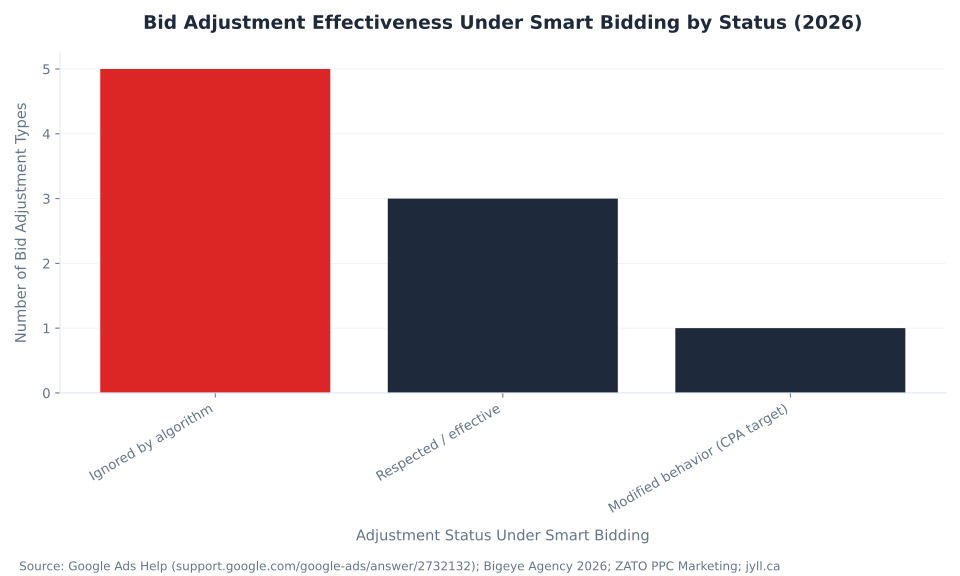
Bid Adjustment Effectiveness Under Smart Bidding by Status (2026)
Standard vs. Accelerated Delivery: What Google Ads Offers in 2026
Accelerated delivery no longer exists for Search campaigns, Shopping campaigns, or shared budgets — it was removed on October 7, 2019. Standard delivery is the only available option. Any content comparing the two options for a 2026 Search or Shopping campaign is working from outdated information.
Accelerated delivery front-loaded impressions at the start of the day, spending budget as fast as possible until depleted. Google removed it from Search, Shopping, and shared budgets on October 7, 2019. The stated reason: accelerated delivery did not improve budget utilization. Standard delivery's pacing algorithm — which distributes impressions throughout the day based on predicted auction performance and budget remaining — outperformed the intraday front-loading that accelerated delivery applied. (Sources: eBoost Consulting, accelerated delivery removal; Digital Thrive AI, removal announcement; Media Vision, Google eliminates accelerated delivery.)
Standard delivery is not a pacing compromise. Google's algorithm considers remaining daily budget, historical performance by time of day, and auction competition when deciding which impressions to enter — producing a spending pattern that prioritizes higher-converting windows within the day's budget envelope. There is no configuration UI for delivery pacing under standard delivery; the algorithm manages it automatically. (Source: Collective Measures, standard delivery mechanics.)
MB Adv Agency continues to receive client questions about accelerated delivery years after its removal — the volume of outdated content still ranking for these queries is significant. Standard delivery is not a limitation; Google's pacing algorithm outperforms the manual intraday front-loading that accelerated delivery attempted.
| Campaign Type | Accelerated Delivery | Standard Delivery | Notes |
|---|---|---|---|
| Search | Removed Oct 7, 2019 | Only option | No delivery pacing configuration available in 2026 UI |
| Shopping | Removed Oct 7, 2019 | Only option | No delivery pacing configuration available in 2026 UI |
| Shared Budgets | Removed Oct 7, 2019 | Only option | Removal applied to shared budgets in same October 2019 update |
| Display | Not confirmed for 2026 | Available | Demand Gen transition beginning June 2026 makes Display campaign type largely moot for new campaign builds |
| Video | Status unverified for 2026 | Available | Do not publish a definitive statement about accelerated delivery status for Video campaigns in 2026 |
| Performance Max | Not available | Standard only | Performance Max enforces automated budget pacing; no manual delivery setting |
Bid Adjustments Under Smart Bidding: What Works, What Doesn't
Smart Bidding processes device, location, audience, and ad schedule signals internally at auction time. Static bid adjustments for these dimensions are silently ignored — the algorithm already accounts for them with more granularity than any manual modifier provides.
The reason bid adjustments are ignored under Smart Bidding is architectural. At each auction, Google's algorithm evaluates thousands of real-time signals — the specific device, the user's location, the time of day, the audience memberships, the search query, the landing page, the historical conversion rate for that user profile — and computes a predicted conversion probability. A static +20% mobile bid adjustment adds a blunt multiplier on top of a system already computing device conversion probability at the individual-user level. The adjustment cannot make the system more precise; it introduces a fixed modifier the algorithm was not designed to honor. Google's own documentation confirms that device, location, audience, and ad schedule adjustments are ignored under all Smart Bidding strategies. (Sources: Google Ads Help, bid adjustments with Smart Bidding; Big Eye Agency, bid adjustments in 2026.)
This affects account managers who migrate campaigns from Manual CPC to Smart Bidding without auditing their bid adjustment settings. The adjustments remain visible in the UI after migration — they do not disappear or warn of inactivity — and managers who do not know the behavior continues applying effort to modifiers that produce no effect on auction bids. Understanding this distinction is foundational to operating Smart Bidding correctly, alongside the auction mechanics that determine how Google weights signals in real time.
KEY INSIGHT: The correct Smart Bidding control surface is data quality — accurate conversion tracking, correct conversion values, and data exclusions when tracking breaks — not bid modifier inputs. Bid adjustments that Smart Bidding ignores consume manager time that would produce measurable results if redirected toward conversion tracking audits, value rule setup, and seasonality adjustment scheduling.
| Bid Adjustment Type | Manual CPC | Max Conversions | Max Conv + tCPA | Max Conv Value + tROAS |
|---|---|---|---|---|
| Device +/- (standard multiplier) | Applied to bid | Ignored | Ignored | Ignored |
| Device -100% exclusion | Applied | Applied (hard exclude) | Applied (hard exclude) | Applied (hard exclude) |
| Device modifier with tCPA target | N/A | N/A | Modifies CPA target, not bid | Ignored |
| Location +/- | Applied to bid | Ignored | Ignored | Ignored |
| Audience +/- | Applied to bid | Ignored | Ignored | Ignored |
| Ad schedule +/- | Applied to bid | Ignored | Ignored | Ignored |
| Seasonality adjustment (1–7 days) | N/A | Applied | Applied | Applied |
| Data exclusion (tracking outage) | N/A | Applied | Applied | Applied |
| Sources: Google Ads Help, bid adjustments and Smart Bidding; Google Ads Help, seasonality adjustments; Savvy Revenue, data exclusions guide. | ||||
Three controls do work under Smart Bidding — and they work for reasons that are structurally different from standard bid adjustments.
A -100% device exclusion is not a bid signal. It is a hard exclude that prevents ads from showing on that device entirely. The algorithm does not receive the auction and cannot bid on it. This is categorically different from a -50% device modifier, which Smart Bidding ignores. If serving on mobile is counterproductive for a specific campaign — a desktop-only tool, a conversion flow that fails on mobile — the -100% exclusion is the correct lever. (Source: Google Ads Help, bid adjustments.)
Seasonality adjustments notify the algorithm of a known, short-duration CVR change — a promotional sale, a product launch, a seasonal event where conversion rates will deviate from the historical baseline. Access: Tools > Shared Library > Bid Strategies > Advanced Controls. The critical constraint is duration: Google recommends seasonality adjustments of 1 to 7 days. Adjustments set for 14 or more days negatively affect performance because the algorithm begins treating the adjusted state as the new normal, undermining its own calibration. This tool is appropriate for pre-planned events; it is not a persistent optimization mechanism. (Source: Google Ads Help, seasonality adjustments.) High-CPA verticals such as insurance advertisers and financial services accounts benefit from seasonality adjustments during open enrollment periods and rate-change windows where conversion rates shift predictably and temporarily.
Data exclusions address a different problem: tracking outages. When the conversion tracking implementation breaks — a tag fires incorrectly, a CRM integration stops passing data, a site migration drops the tag — the algorithm records a period of zero or distorted conversions and learns against that phantom signal. A data exclusion marks the outage window so the algorithm excludes it from its learning history. Without data exclusions, a 48-hour tracking gap teaches Smart Bidding that those days produce no conversions, skewing its bid calibration for weeks afterward. (Source: Savvy Revenue, data exclusion guide.)
MB Adv Agency has found that account managers who spend time managing device and location bid adjustments on Smart Bidding campaigns are doing work the algorithm renders meaningless. Redirecting that effort toward conversion tracking audits, value rule setup, and seasonality adjustment scheduling produces measurable results; adjusting bids the algorithm ignores does not.
Portfolio Bid Strategies: When to Pool Campaigns
A portfolio bid strategy pools conversion data across multiple campaigns under one shared optimization target. This shortens the learning phase when individual campaigns lack sufficient volume — but only when the campaigns share a genuine performance goal.
Portfolio bid strategies are created in the Shared Library and applied to multiple campaigns simultaneously. The algorithm treats all pooled campaigns as a single data source, using conversion history from every campaign in the portfolio to calibrate bids. This has a direct consequence on the learning phase: a campaign running Maximize Conversions in isolation at 8 conversions per month sits below Google's 30-conversion threshold and operates in a perpetual semi-learning state. Three campaigns each at 8 conversions per month, pooled in a portfolio, reach 24 conversions — still below threshold. Four such campaigns reach 32, clearing the floor and enabling stable optimization. The portfolio model exists precisely for this scenario. (Source: Triple Dart, portfolio bid strategies guide.)
| Dimension | Standard Bid Strategy | Portfolio Bid Strategy |
|---|---|---|
| Scope | One campaign | Multiple campaigns (pooled) |
| Where it lives | Set directly on campaign | Created in Shared Library; applied to campaigns |
| Data pool | Campaign's own history | Pooled across all campaigns in portfolio |
| Learning phase | Per-campaign | Shorter when pooled volume exceeds per-campaign threshold |
| PMax compatibility | Yes | No — not available for Performance Max |
| Source: Google Ads Help, portfolio bid strategies. | ||
Portfolio strategies are supported for Maximize Conversions (optional Target CPA), Maximize Conversion Value (optional Target ROAS), Target Impression Share, and Maximize Clicks. They are not available for Performance Max campaigns, which manage bidding at the asset group level with Google's own optimization layer. (Source: Google Ads Help, portfolio strategies.) Local service accounts with multiple geo-targeted campaigns — plumbing contractors, HVAC companies, and roofing advertisers running separate city campaigns — represent the most common portfolio strategy use case, where three or four campaigns each see 8–12 conversions per month but collectively clear the 30-conversion floor. Local guides for markets like HVAC advertising in Flagstaff, AZ and plumbing PPC in Missoula, MT show exactly this pattern: low per-campaign volume that becomes manageable when pooled under a shared strategy.
Three conditions favor portfolio strategies: individual campaigns each running 8–10 conversions per month but collectively reaching 30+; campaigns optimizing toward the same conversion action; and accounts where a single CPA or ROAS target applies across all pooled campaigns. The central target management benefit — one target field governs all pooled campaigns — reduces the operational overhead of adjusting targets across a multi-campaign account structure. (Source: PPC Digest, portfolio bid strategies.)
Two conditions introduce risk. The first is mismatched conversion rate campaigns: a branded campaign converting at 15% and a non-branded campaign converting at 2% operate under fundamentally different auction dynamics. Pooling them forces the algorithm to optimize toward an average CVR that does not reflect either campaign's actual behavior — the branded campaign is under-bid, the non-branded over-bid. The second risk is a tracking outage in one campaign contaminating the shared data pool. A single campaign's phantom conversion data corrupts the signal for every campaign in the portfolio. Data exclusions applied per-campaign within a portfolio do not fully insulate the pooled signal from an outage-affected member. (Source: PPC Digest.)
Google Ads Campaign Bidding Approach Adoption Rate (2026)

Need an Expert to Set Up Smart Bidding the Right Way?
MB Adv Agency audits conversion tracking before recommending any Smart Bidding strategy — because the algorithm is only as reliable as the data it receives. Every engagement starts with a tracking audit, then moves to strategy selection and target calibration grounded in the account's actual historical performance.
Get a Free PPC Audit →Smart Bidding Adoption and What the Data Shows
86% of Google Ads campaigns run automated bidding in 2026 — a market shift driven by time savings and Google's progressive reduction of manual control surfaces, including eCPC's retirement in March 2025 and the removal of accelerated delivery in 2019. (Sources: Marketing LTB, Google Ads Statistics 2026; SEO Design Chicago, Google Ads performance guide 2026.)
The adoption figure breaks across two measurements. 86% of campaigns use automated bidding when measured at the campaign level; 80%+ of advertisers use automated strategies when measured at the account level. The difference reflects account structures where some campaigns remain on Manual CPC for specific use cases — brand defense, new launches, niche low-volume keywords — while the majority of campaigns within the same account run Smart Bidding. The primary benefit cited by advertisers who switched to Smart Bidding is time savings: 50%+ of automated bidding users name time efficiency as the leading reason for the adoption. (Sources: Marketing LTB 2026; SEO Design Chicago 2026.)
Manual CPC is now a minority configuration. That does not mean it has no use cases — new accounts, brand campaigns, test campaigns, and very-low-volume verticals each have documented reasons to remain on Manual CPC. The adoption data does establish that Manual CPC is no longer the default starting point for the median Google Ads advertiser; the default assumption is now automated bidding from campaign launch. For accounts managing broad match keyword strategies alongside Smart Bidding — Google's currently recommended combination — this means the account manager's role shifts from bid-setting to data architecture: structuring conversion actions, assigning values, and maintaining tracking integrity.
KEY INSIGHT: 86% automated does not mean 86% optimized. Adoption rate and optimization rate are not the same metric. The difference between an account that runs Smart Bidding and an account that runs Smart Bidding well is conversion data quality and target setting discipline — not the strategy selection itself.
The adoption data also does not capture target-setting correctness. An account running Maximize Conversions with a Target CPA set 40% below its historical average CPA is counted in the 86% automated figure — and is functionally underperforming compared to the same account running unconstrained. The adoption rate measures strategy selection; it says nothing about whether the conversion floor was met before the target was added, whether the target was set at the historical average or at an aspirational figure, or whether conversion tracking is accurate. These are the variables that separate Smart Bidding accounts that perform from those that don't.
High-intent local markets show the same pattern. Advertisers in competitive verticals such as legal advertising in Missoula, MT and automotive PPC in Austin, TX have moved to Smart Bidding at the same rate as national accounts — and the same data quality prerequisites apply regardless of market size. A local campaign with 28 conversions per month adding a Target CPA faces the same learning-phase instability as a national account at the same volume. The threshold does not scale with geography.
Four Bidding Strategy Misconceptions That Cost Budget
Smart Bidding misconceptions are expensive. Treating the algorithm as a black box, stacking bid adjustments it ignores, believing accelerated delivery still exists, or assuming tCPA and tROAS are standalone strategies — each produces a predictable outcome: wasted spend or misconfigured campaigns.
Misconception 1: "Smart Bidding is a black box you cannot influence." This is false. The control surface is different from traditional bid adjustments, but it exists. Account managers directly influence Smart Bidding outcomes through conversion action weighting (assigning different values or priorities to different conversion types), value rules (adjusting conversion values based on audience, location, or device), seasonality adjustments for 1–7 day CVR spikes, data exclusions that protect the algorithm from learning against tracking outage periods, and budget constraints that define the ceiling within which bids operate. The auction-time bid calculation is opaque — the algorithm does not expose which signals weighted most heavily for a given impression. The optimization target, data quality, and ceiling are not opaque. Managing those inputs is the job; auditing bid modifiers the algorithm ignores is not.
Misconception 2: "Accelerated delivery gets you more impressions early in the day." Not applicable. Accelerated delivery was removed from Search campaigns, Shopping campaigns, and shared budgets on October 7, 2019. The option does not exist in the 2026 Google Ads interface for these campaign types. There is no delivery pacing configuration available for Search or Shopping — standard delivery is the only option and is applied automatically. Any guide published before 2020 that frames accelerated vs. standard as a 2026 decision for Search advertisers is describing a feature that was removed six years ago.
KEY INSIGHT: The correct Smart Bidding control surface is conversion data quality, value rules, seasonality adjustments, and data exclusions — not bid modifiers that the algorithm processes internally and ignores when set manually.
Misconception 3: "More bid adjustments mean more control under Smart Bidding." This is false. Device, location, audience, ad schedule, and demographic bid adjustments are silently ignored under any Smart Bidding strategy — Maximize Conversions, Maximize Conversion Value, and Target Impression Share. The adjustments remain visible in the UI after migration from Manual CPC, do not display a warning that they are inactive, and consume manager time without affecting a single bid. Stacking additional adjustments adds maintenance overhead with zero precision gain. The only adjustments that function under Smart Bidding are -100% device exclusions (hard excludes, not signal inputs), seasonality adjustments (1–7 day duration), and data exclusions for tracking outages. (Sources: Google Ads Help, bid adjustments with Smart Bidding; Big Eye Agency, bid adjustments in 2026.)
Misconception 4: "Portfolio bid strategies are only for big accounts." This is false. Portfolio strategies exist specifically to help small and mid-size accounts clear the conversion volume threshold that individual campaigns cannot reach on their own. Three campaigns each generating 8–10 conversions per month are individually below Google's 30-conversion recommended floor for stable Smart Bidding. Pooled into a portfolio, those same campaigns collectively generate 24–30 conversions per month — clearing the threshold and enabling algorithmic optimization that would remain unstable in isolation. Local accounts with multiple geo-targeted campaigns — such as auto repair advertisers running separate campaigns across Dallas-area markets — benefit from portfolio pooling precisely because per-city conversion volumes are modest but aggregate volume is sufficient. The constraint is not account size; it is conversion-goal alignment across the pooled campaigns.
Frequently Asked Questions About Google Ads Bidding Strategies
What's the difference between Target CPA and Maximize Conversions with a Target CPA?
There is no functional difference. In April 2021, Google restructured Smart Bidding so that Maximize Conversions accepts an optional Target CPA parameter. The underlying bidding algorithm is identical to the old standalone Target CPA strategy — both optimize each auction for conversion probability subject to a CPA constraint. In July 2022, Google renamed existing standalone "Target CPA" campaigns to "Maximize conversions" in the UI. New campaigns created from the 2026 Google Ads interface will only see "Maximize conversions" with an optional CPA target field — standalone Target CPA is not selectable for new campaigns. If an account shows a campaign labeled "Target CPA" in reporting, it was created before July 2022 and behaves identically to a current Maximize Conversions campaign with the same target. The practical implication: advertisers should not attempt to access standalone tCPA — it does not exist as a separate strategy in 2026, and no migration is needed for existing campaigns showing legacy labels. (Sources: Google Ads Help, April 2021 update; Search Engine Roundtable, July 2022.)
How many conversions do I need before switching to Smart Bidding?
The threshold depends on which Smart Bidding configuration is chosen. For Maximize Conversions with no target: Google imposes no technical minimum, but 30 conversions per 30 days is the point before which Smart Bidding performs significantly better than Manual CPC on a learning-adjusted basis. For Maximize Conversions with a Target CPA: Google's technical minimum to select the strategy is 15 conversions in the past 30 days; Google's recommended minimum for stable performance is 30 conversions per 30 days; practitioners commonly cite 30–50 for most verticals. For Maximize Conversion Value with a Target ROAS: Google's published guidance is 30+ conversions per 30 days with conversion value data; practitioner consensus cites 50+ conversions per 30 days with value data — this is not a number published in Google's Help documentation, but Store Growers, Optmyzr, and groas.com all cite it based on client experience. Below these thresholds, running Maximize Conversions without a target first is the standard approach for accumulating data. (Sources: Google Ads Help; Store Growers; Optmyzr.)
Do bid adjustments work with Smart Bidding strategies?
Most do not. Under Maximize Conversions, Maximize Conversion Value (with or without targets), and Target Impression Share, the following bid adjustments are processed internally by the algorithm and have no additive effect when set manually: device (+/- %), location, audience, ad schedule, and demographic. Smart Bidding evaluates all of these signals — and thousands more — in real time at every auction. A static +20% mobile modifier tells the algorithm nothing it is not already computing at greater granularity, and Google's documentation confirms these adjustments are disregarded. Three adjustments do work: a -100% device exclusion (treated as a hard exclude — prevents ads from showing on that device entirely), seasonality adjustments for 1–7 day conversion rate spikes (available under Tools > Shared Library > Bid Strategies > Advanced Controls), and data exclusions for periods when conversion tracking was broken. A Target CPA device modifier has modified behavior: it adjusts the CPA target for that device type, not the bid itself. (Sources: Google Ads Help; Zato Marketing.)
What is accelerated delivery in Google Ads, and is it still available?
Accelerated delivery was a budget pacing option that spent the daily budget as fast as possible, concentrating impressions early in the day rather than distributing them throughout it. Google removed accelerated delivery from Search campaigns, Shopping campaigns, and shared budgets on October 7, 2019. The reason Google cited: accelerated delivery did not improve budget utilization or performance outcomes — it caused campaigns to exhaust budgets before the day's peak conversion windows. As of 2026, standard delivery is the only available option for Search and Shopping campaigns. No UI setting for delivery method appears for these campaign types; standard delivery is automatic and non-configurable. Standalone Display campaigns retained accelerated delivery after 2019, but Display is transitioning to Demand Gen starting June 2026, making the question moot for that campaign type. Any article published before 2020 that recommends choosing between standard and accelerated delivery for Search or Shopping campaigns is giving advice about a feature that no longer exists. (Sources: eBoost Consulting; Digital Thrive AI.)
When should I use a portfolio bid strategy instead of a standard bid strategy?
A portfolio bid strategy is the right choice when two or more campaigns share the same conversion action and performance goal, but each generates too few conversions individually to exit Smart Bidding's learning phase. Google's recommended minimum — 30 conversions per 30 days — applies to the pooled portfolio, not each individual campaign. An account running three Search campaigns each generating 8–10 conversions per month cannot run stable tCPA individually on any of them, but a portfolio pooling all three into a single 30-conversion data set can. The constraints: (1) campaigns must share a genuine performance goal — grouping a branded search campaign with a non-branded campaign averages their conversion rates and obscures signal from both; (2) portfolio strategies are not available for Performance Max campaigns; (3) if one campaign has a tracking outage, the contaminated data affects the shared pool. For accounts where campaigns vary materially in conversion rate or audience quality, standard per-campaign bid strategies preserve cleaner signal. (Source: Google Ads Help, portfolio strategies; Triple Dart.)
Is Manual CPC still worth using in 2026?
Manual CPC remains the right choice in four specific circumstances: (1) brand-new campaigns with zero conversion history — Smart Bidding has no data to optimize against, and the learning phase with Manual CPC costs less than the learning phase with an unconstrained Maximize Conversions campaign on a zero-history account; (2) test campaigns where budget control is the priority and conversion data collection is the objective; (3) accounts with very small budgets where the learning-phase spend under Smart Bidding represents a disproportionate share of the monthly budget; (4) accounts with non-standard conversion tracking setups where automated optimization would misread the data. Outside these four cases, the 2026 practitioner consensus is to run Maximize Conversions without a target to build data, then add a Target CPA once the 30-conversion threshold is met. Manual CPC has 86% of the market running against it on Smart Bidding — the competitive disadvantage in auction efficiency grows over time for accounts that stay manual past the point where Smart Bidding is ready. (Source: Marketing LTB 2026; Jyll, Manual CPC vs Maximize Conversions.)
Bidding Strategy Questions? We Answer Them.
MB Adv Agency reviews conversion data volume and tracking accuracy before recommending any strategy change — every consultation starts with the data, not the feature.
Contact MB Adv Agency →Methodology and Data Sources
Mechanical facts about bidding strategy behavior, conversion thresholds, eCPC retirement, and accelerated delivery removal are sourced from Google Ads Help documentation (support.google.com) as primary authority. Keyword search volume and demand data reflect Ahrefs data for the US market, May 2026. Threshold benchmarks and bid adjustment behavior draw on practitioner sources: Store Growers, groas.com, Optmyzr, jyll.ca, ZATO PPC Marketing, Big Eye Agency, and TripleDart. Adoption statistics (86% automated bidding, 50%+ citing time savings) are sourced from Marketing LTB and SEO Design Chicago, 2026. The 2–4 week Smart Bidding learning-phase duration is practitioner consensus, not a published Google statistic and is labeled accordingly throughout. Last updated: May 2026. Reviewed by MB Adv Agency, May 2026.

As a Google Ads expert, I bring proven expertise in optimizing advertising campaigns to maximize ROI.
I specialize in sharing advanced strategies and targeted tips to refine Google Ads campaign management.
Committed to staying ahead of the latest trends and algorithms, I ensure that my clients receive cutting-edge solutions.
My passion for digital marketing and my ability to interpret data for strategic insights enable me to offer high-level consulting that aims to exceed expectations.
Google Partner Agency
We're a certified Google Partner Agency, which means we don’t guess — we optimize withGoogle’s full toolkit and insider support.
Your campaigns get pro-level execution, backed by real expertise (not theory).

4.9 out of 5 from 670+ reviews on Fiverr.
That’s not luck, that’s performance.
Highly recommend Matteo to set up your server side tracking. He has a deep understanding of e-commerce tracking and will go above and beyond to make sure everything is set up correctly and working 100%. If you are scaling your store this set up is non-negotiable in my opinion and there isn't many people who have this much knowledge or put the effort in to get it right. Thanks again!

avorodesign.com
I can only recommend Matteo! He was very patient, professional and very knowledgeable about GA4, Consent Mode v2, and GDPR compliance. Communication was clear, and the setup was done professionally and efficiently. Highly recommend him for anyone needing reliable tracking implementation.

www.natureiki.life
Matteo shines in the realm of online professionals. His work is not only deep in data but also complemented by his proactive communication and cooperation, setting a new standard for freelancers. If you want someone who truly exceeds expectations, look no further. Highly recommended!

www.omanbeverlysmyth.com
Exceptional Service Beyond Expectations - Outstanding Service Impeccable depth, flawless delivery, and exceptional language fluency—this service exceeded all expectations. Highly recommended. Matteo truly ROCKS!!!

ium-paris.com
Top-notch, always highly value working with Matteo. An absolute Google Ads Genius. This is approximately the 8th time I have hired him and he's helped us get 6-7 ROAS. We are excited in continuing to improve our lead flow. Hire this guy if you need Google Ads help. Thanks Matteo!

www.dleeventgroup.com
I finally found the guy who can setup server side tracking and all the ecosystem properly. I definitely recommend Matteo. He is very responsive, kind and wants to dig into things. He configured GA4, Meta, Google Ads, Outbrain and google consent v2 with Cookiebot. Thanks Matteo.

inomega.fr
MB Adv delivered exceptional work with outstanding professionalism and lots of patience, taking time to see effects of changes made and not just do the work and submit it. The proactive communication and video summaries of the work completed made working with Matteo a pleasure, as he consistently went above and beyond. Highly recommended for web analytics projects! We are already working on another project.

www.withnellsensors.co.uk
Working with Matteo on my Google Ads was a game-changer. He's not just a strategist, he's a true partner. He understood my goals and tailored a campaign that perfectly reached my target audience. I'm grateful for his expertise and dedication.

dccargo.com
Click-driven mind
with plastic-brick obsession.
We build Google Ads campaigns with the same mindset we use to build tiny brick worlds: strategy, patience, and zero tolerance for wasted pieces.
Data is our blueprint. Growth is the only acceptable outcome.